A refrigerator can draw modest power once running but demand a much larger surge when its compressor starts. Choosing the right inverter therefore requires more than comparing headline wattage.
This roundup compares 10 power inverters for refrigerators, focusing on sine-wave quality, startup capacity, battery compatibility, outlets, and practical use in vehicles, RVs, and home backup systems.
Best 10 Power Inverters for Refrigerators Picks for 2026
Best High-Capacity Pick
Ampeak 2000W Pure Sine Wave Inverter

- 2000W continuous and 6000W surge output
- Pure sine wave power with voltage regulation
- Three AC outlets, LCD, remote, and USB ports
Best For: Refrigerators and demanding appliances in RVs, trucks, and backup systems
Maximum Output Option
TOPBULL 4000W Vehicle Power Inverter

- 4000W continuous and 8000W peak output
- Four 20A AC sockets plus USB and Type-C ports
- Color display, 200-foot remote, and dual-fan cooling
Best For: Large 12V systems powering a refrigerator and multiple appliances
Pure Sine Value Pick
BELTTT 3000W Pure Sine Wave Inverter

- 3000W continuous and 6000W peak output
- Pure sine wave power for inductive and sensitive loads
- LCD monitoring, 20A outlet, and 23-foot remote
Best For: Refrigerator backup in RV, truck, and off-grid installations
Compact Electronics Pick

- 1000W continuous and 2000W peak output
- Two AC outlets plus USB-C and USB charging
- Modified sine wave; not recommended for refrigerators
Best For: Small electronics in cars, trucks, and camping setups
Best for Easy Setup
3000W Pure Sine Wave RV Inverter

- 3000W continuous and 6000W peak output
- Pure sine wave power for refrigerators and electronics
- Remote, hardwired terminal, USB, and safety protections
Best For: RV, solar, and emergency backup setups with multiple appliances
Best Display-Focused Option

- 3000W continuous and 6000W surge output
- LCD tracks voltage, battery, load, and fault codes
- Four AC outlets, four USB ports, and remote control
Best For: High-capacity backup with detailed monitoring and many outlets
Best Compact Pure Sine Pick

- 1000W continuous and 2000W peak output
- Pure sine wave power for inductive loads
- LCD monitoring with cables, fuses, and installation tools
Best For: Compact refrigerator backup in RV, truck, or off-grid setups
Heavy-Duty Choice

- 3,000W continuous, 6,000W peak output
- Ten listed safety protections
- Wireless remote and color LED display
Best For: High-capacity refrigerator backup and broader 12V emergency-power systems
Clean-Power Pick

- Pure sine wave output with 3%–4% THD
- 3,000W continuous, 6,000W surge capacity
- LCD remote and multiple AC/USB outlets
Best For: Stable refrigerator power plus sensitive electronics and additional appliances
Certified Value
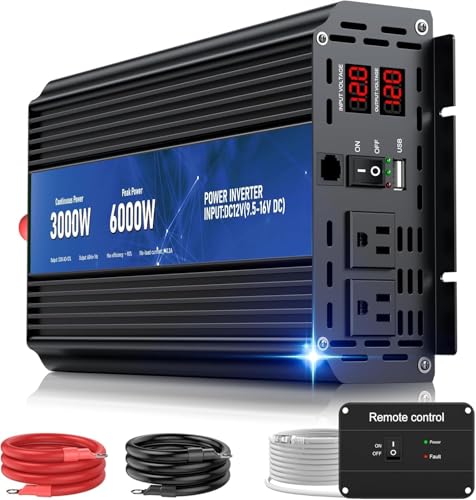
- 3,000W continuous, 6,000W peak output
- UL/CSA certification claims and LCD monitoring
- Includes 5AWG cables and 14.8-foot remote
Best For: RV or emergency use when certification, monitoring, and included accessories are priorities
Best High-Capacity Pick – Ampeak 2000W Pure Sine Wave Inverter
For shoppers comparing power inverters for refrigerators, the Ampeak 2000W model stands out with pure sine wave output and a 6000W surge rating. Its high startup capacity, stable voltage regulation, and multiple outlets make it a practical option for refrigerators and other demanding loads in an RV, truck, off-grid setup, or emergency backup system.
Best For: Refrigerators and other high-startup appliances that need clean, stable 120V AC power.
Pros:
- 2000W continuous output with 6000W surge capacity for demanding startups.
- Pure sine wave output with stated 3%–4% THD for sensitive electronics.
- Includes three AC outlets, a 20A outlet, USB ports, LCD display, remote control, and heavy-duty cables.
- Provides protection against overload, overheating, voltage issues, and short circuits.
Cons:
- A 12V battery system and suitable wiring are required; higher loads can draw substantial battery power.
- Its larger 2000W capacity may be more than needed for small electronics.
With refrigerator-friendly pure sine output, substantial surge headroom, and useful monitoring features, this is a well-rounded choice for backup and mobile power. The 18-month limited warranty and technical support add reassurance for extended use.
Maximum Output Option – TOPBULL 4000W Vehicle Power Inverter
The TOPBULL 4000W is one of the highest-output options among these power inverters for refrigerators. It delivers 4000W continuously and up to 8000W at peak, providing considerable capacity for refrigerator startups and additional appliances when connected to a compatible 12V or 12.8V battery system.
Best For: Users who need very high output and multiple AC connections for vehicle, off-grid, or emergency applications.
Pros:
- 4000W continuous power and 8000W peak output provide substantial startup headroom.
- Four 20A AC sockets, USB ports, Type-C charging, and three AC terminal blocks offer flexible connections.
- Color display shows voltage, power, and operating status, while the remote supports operation from up to 200 feet.
- Includes extensive protection features and temperature-controlled dual-fan cooling.
Cons:
- The very high output requires careful battery, cabling, and installation planning.
- Its modified sine wave output may be less suitable than pure sine wave power for some sensitive equipment.
This model offers exceptional capacity and connectivity for a large 12V installation. It is especially compelling when a refrigerator will run alongside several other appliances, provided the battery bank and installation can support its demands.
Pure Sine Value Pick – BELTTT 3000W Pure Sine Wave Inverter
The BELTTT 3000W combines pure sine wave output with a 6000W peak rating, making it a strong candidate for shoppers seeking power inverters for refrigerators. It supports 110V/120V AC loads, reports battery and load status on an LCD, and includes safety protections for off-grid, RV, truck, and outdoor use.
Best For: Refrigerator backup where clean power, high surge capacity, and real-time monitoring are priorities.
Pros:
- 3000W continuous output and 6000W peak capacity support refrigerator startup loads.
- Pure sine wave output is designed for inductive, capacitive, and sensitive loads.
- LCD displays input and output voltage, battery status, load status, and operating conditions.
- Includes dual AC sockets, a 20A outlet, USB port, hardwire connection, and a 23-foot wired remote.
Cons:
- Only a one-year warranty is specified.
- Its 3000W capacity may require a substantial 12V battery and appropriately sized cables.
For refrigerator use, the combination of pure sine power and generous peak output is the main attraction. The display and long wired remote also make it easier to monitor and control the inverter when it is installed in an RV, truck, or off-grid system.
Compact Electronics Pick – OLTEANP 1000W Car Inverter
The OLTEANP 1000W is a compact vehicle inverter for lighter-duty power needs, but it is not a suitable choice for refrigerators according to its supplied guidance. Although it provides 1000W continuously and 2000W peak, its modified sine wave output is specifically not recommended for refrigerators, microwaves, air conditioners, or sensitive medical devices.
Best For: Laptops, TVs, routers, game consoles, and other smaller electronics in cars, trucks, or camping setups.
Pros:
- 1000W continuous and 2000W peak output for smaller devices.
- Compact design with two AC outlets, 36W USB-C, and 5V/3A USB charging.
- LCD shows input voltage, output voltage, battery status, and protection codes.
- Includes both battery clips and a cigarette-lighter adapter for flexible connection options.
Cons:
- Modified sine wave output is not recommended for refrigerators.
- The cigarette-lighter connection supports up to 150W; higher loads require direct battery connection.
- Its 1000W rating is intended for smaller electronics rather than high-startup appliances.
This is a useful compact inverter for everyday electronics, but refrigerator shoppers should choose a pure sine wave model instead. The manufacturer’s own usage guidance excludes refrigerators, making this better suited as a secondary vehicle-power option.
Best for Easy Setup – 3000W Pure Sine Wave RV Inverter
For shoppers comparing power inverters for refrigerators, this 3000W pure sine wave model stands out when startup demand and clean power matter. Its 6000W peak rating is designed to handle demanding loads, while the pure sine wave output suits refrigerators and other sensitive electronics.
Best For: RVs, home backup, solar setups, and users who need to run a refrigerator alongside other high-demand appliances.
Pros:
- 3000W continuous output with 6000W surge capacity for heavy startups.
- Pure sine wave power is suitable for refrigerators and sensitive electronics.
- Includes three AC outlets, a hardwired terminal, USB ports, 30W PD, and a 15-foot wired remote.
- Multiple protections and thick 1 AWG copper battery cables support safer operation.
Cons:
- Its high output capacity requires substantial battery power and appropriate wiring.
- A 12V battery system is required.
- The larger feature set may be more than needed for refrigerator-only use.
This is the most capable option in the group for a refrigerator with demanding startup characteristics or for powering several appliances at once. The pure sine wave output, remote monitoring, and broad protection package make it a strong choice for extended RV or emergency use.
Best Display-Focused Option – Cantonape 3000W LCD Inverter
This Cantonape model offers the high output often considered when choosing power inverters for refrigerators, with 3000W continuous power and a 6000W surge rating. Its LCD provides real-time information about input and output voltage, battery capacity, load, frequency, and fault codes.
Best For: Users who want a high-capacity refrigerator backup inverter with clear status monitoring and multiple charging outlets.
Pros:
- 3000W continuous output and 6000W surge capacity.
- LCD displays operating information and protection fault codes.
- Four AC outlets and four USB ports provide flexible charging.
- Includes remote control and six listed protection functions.
Cons:
- Uses a modified sine wave output rather than pure sine wave power.
- The remote requires a 12V 23A battery, which is not included.
- Its warranty is 12 months.
The Cantonape is appealing if you prioritize outlet count, readable diagnostics, and substantial surge capacity. However, because it uses modified sine wave output, buyers should verify that their refrigerator and other connected equipment are compatible before choosing it.
Best Compact Pure Sine Pick – BELTTT 1000W Inverter
When comparing power inverters for refrigerators, the BELTTT 1000W model is a more compact choice for lower-demand setups. It delivers pure sine wave output, up to 2000W of startup surge, and an LCD that shows voltage, battery, and load information.
Best For: Smaller refrigerator backup setups, RVs, trucks, and off-grid users who need clean 12V-to-120V power without a 3000W-capacity inverter.
Pros:
- Pure sine wave output is suitable for inductive and sensitive loads.
- 1000W continuous output with 2000W peak surge capacity.
- LCD provides real-time input, output, battery, and load status.
- Includes dual AC outlets, USB charging, cables, fuses, and installation tools.
Cons:
- Lower capacity than the 3000W models for multiple or high-demand appliances.
- Only two AC outlets are provided.
- It is designed for a 12V battery system.
This model makes sense when clean power and compact capacity are more important than running many appliances simultaneously. Its 2000W surge rating may support refrigerator startup, but buyers should compare it with the appliance’s documented starting requirements.
Heavy-Duty Choice – TOPBULL 3000W Inverter
For shoppers comparing power inverters for refrigerators, the TOPBULL 3000W model offers substantial capacity for compressor startup and extended operation. It converts 12V DC to 110/120V AC, provides 3,000W continuous output and up to 6,000W peak power, and is designed for RVs, home backup, and off-grid use.
Best For: Running a refrigerator alongside other household appliances from a 12V battery system during outages, travel, or off-grid use.
Pros:
- 3,000W continuous and 6,000W peak output provide considerable startup headroom.
- Supports 12V and 12.8V batteries and includes thickened pure copper cables.
- Ten listed protection features cover overload, overheating, low voltage, reverse connection, and more.
- Wireless remote control and color LED display simplify monitoring and operation.
Cons:
- Requires a suitable 12V battery system and proper cable installation for high-power loads.
- The supplied notes do not specify a pure sine wave output.
This is a strong capacity-focused option when refrigerator backup is part of a broader emergency-power setup. Its monitoring features and extensive protection package are useful, but buyers who need explicitly documented pure sine wave output should verify the waveform before purchasing.
Clean-Power Pick – Vansdon 3000W Pure Sine Wave
The Vansdon is a particularly compelling choice among power inverters for refrigerators because its pure sine wave output is designed for motor-driven and sensitive equipment. It delivers 3,000W continuously, reaches 6,000W surge power, and regulates output between 110V and 120V under changing battery conditions.
Best For: Refrigerator backup where clean, stable AC power and the ability to run additional appliances or electronics matter.
Pros:
- Pure sine wave output with stated 3%–4% THD supports refrigerators and sensitive electronics.
- 3,000W continuous and 6,000W surge capacity help handle motor startup loads.
- Three AC outlets, a hardwired terminal, USB, and 30W USB-C provide flexible connectivity.
- LCD wired remote displays battery voltage, output power, and error codes.
Cons:
- Its high-output design requires substantial battery capacity and appropriate installation.
- The notes describe automatic cooling and protection features but do not provide overall unit dimensions or weight.
With explicitly documented pure sine wave output, regulated AC voltage, and generous surge capacity, this model is the most refrigerator-focused option in the group. It also suits users who want one inverter for refrigeration, electronics, and higher-power tools.
Certified Value – HONOURLIGHT 3000W Inverter
The HONOURLIGHT 3000W converter is a practical option for shoppers seeking power inverters for refrigerators in an RV, truck, or emergency kit. It supplies 3,000W continuously and up to 6,000W at peak, with an LCD display, wired remote, and compatibility with common 12V battery types including LiFePO4, AGM, GEL, and lead-acid.
Best For: RV and home-emergency users who want a monitored 12V inverter with certification claims and straightforward installation accessories.
Pros:
- 3,000W continuous and 6,000W peak output can accommodate refrigerator startup demands.
- UL and CSA certification claims provide an added safety reference.
- LCD monitoring shows input/output voltage, battery level, and protection status.
- Includes 5AWG battery cables and a 14.8-foot wired remote.
Cons:
- Uses a modified sine wave output, which may be less suitable for some refrigerator models than pure sine wave power.
- Only two AC outlets and one USB port are listed.
- Refrigerator compatibility should be confirmed with the manufacturer because waveform requirements vary.
This inverter combines high output, useful monitoring, included cables, and a compact 6.9-pound form factor. Its modified sine wave design may make it less universally suitable for refrigerators than the pure sine wave alternative, so confirm your appliance’s requirements before buying.
How We Picked the Best Power Inverters for Refrigerators
We evaluated the selected models against the needs of compressor-driven appliances. The most important considerations were continuous wattage, advertised peak or surge capacity, waveform type, connection options, display and protection features, and suitability for 12-volt battery systems. Pure sine wave models received particular attention because they generally provide cleaner AC power and are the safer choice for sensitive electronics and motor-driven appliances.
Specifications can vary by seller and operating conditions, so treat peak ratings as short-duration capabilities rather than usable continuous output. Installation quality, cable size, battery condition, and ventilation also have a major effect on real-world performance.
Quick Comparison
| What to compare | Why it matters | Best target for a refrigerator |
|---|---|---|
| Waveform | Affects motor operation and electronic compatibility | Pure sine wave |
| Continuous output | Supports the refrigerator after startup | At least the measured running load, with headroom |
| Surge capacity | Handles compressor startup demand | Look for substantial short-term overhead |
| Battery voltage | Must match the power system | 12V for the listed models |
| Protection and monitoring | Helps prevent damage and simplifies troubleshooting | Low-voltage, overload, overheat protection, and an LCD when useful |
Key Buying Factors for Power Inverters for Refrigerators
Continuous and Surge Wattage
Check the refrigerator’s running watts and, if available, its startup or locked-rotor rating. A 1,000W inverter may be adequate for a small, efficient unit, but larger refrigerators or additional loads may justify a 2,000W to 4,000W model. Do not size the system from peak wattage alone.
Pure Sine Wave Output
Pure sine wave power is the preferred option for refrigerators because compressors and control boards can be sensitive to rougher modified-wave output. It may cost more, but the added compatibility and quieter operation can be worthwhile for critical food-storage equipment.
Battery Capacity and Wiring
A 12V inverter drawing 1,000W can require roughly 80 to 100 amps after accounting for losses. Higher-power models demand very thick, short cables, suitable fuses, and a battery capable of sustained discharge. A large inverter cannot compensate for an undersized battery bank.
Runtime, Ventilation, and Safety
Estimate runtime from usable battery watt-hours, not the inverter’s output rating. Keep the inverter dry and well ventilated, and use secure terminals and appropriate overcurrent protection. Built-in fans, thermal shutdown, low-voltage alarms, and clear displays are useful for backup applications.
Who Should Buy Which Power Inverters for Refrigerators?
Choose a 1,000W pure sine wave model for a compact refrigerator, occasional vehicle use, or a modest battery setup when measured startup demand is low. A 2,000W unit is a sensible middle ground for many household refrigerators and provides additional headroom for brief auxiliary loads. Consider a 3,000W or 4,000W model for larger compressors, RV systems, off-grid installations, or multiple loads—but only when the battery bank, cabling, and fuse system are designed for that demand.
For emergency home backup, prioritize pure sine wave output, verified surge performance, and a properly sized battery system over the largest advertised number. If food preservation is critical, test the complete setup before an outage and confirm that the refrigerator starts reliably while other devices are disconnected.
