If you’re building or upgrading a wood boiler system, the right heat exchanger can make a big difference in efficiency, reliability, and ease of installation.
This roundup of the best plate heat exchangers for wood boilers focuses on practical sizing, material quality, and real-world hydronic performance.
Best 10 Plate Heat Exchangers for Wood Boilers Picks for 2026
Compact 20-Plate Pick
4"x12" 20-Plate Brazed Exchanger

- 20 brazed plates in a 4" x 12" body
- 316L stainless steel with copper brazing
- Suitable for wood boiler and hydronic use
Best For: Smaller wood boiler and domestic hot water setups
Outdoor Furnace Value
5"x12" 20-Plate Wood Furnace Exchanger

- Built for outdoor wood furnace use
- 316L stainless steel and UL listed
- 1" MPT connection size
Best For: Outdoor wood furnace owners wanting a simple brazed exchanger
High-Capacity Choice
4"x12" 40-Plate Brazed Exchanger

- 40 plates for more heat transfer area
- 350,000 to 380,000 BTU capacity in notes
- Fits wood boiler and outdoor furnace setups
Best For: Larger wood boiler systems needing higher output
Heavy-Duty 40-Plate Model
5"x12" 40-Plate Wood Furnace Exchanger

- 40-plate design in a 5" x 12" body
- 316L stainless steel and UL listed
- Suited to outdoor wood furnace use
Best For: Wood furnace owners wanting a larger 40-plate exchanger
Compact High-Capacity Pick
3"x8" 26-Plate 210k BTU Hydronic Exchanger

- 316L stainless steel with copper brazing
- 180,000-210,000 BTU/hr capacity range
- 3/4" MPT connections in a compact 3"x8" body
Best For: Wood boiler and outdoor furnace installs needing a compact, high-output exchanger
Compact Efficiency Pick
3"x8" 10-Plate Compact Brazed Exchanger

- Asymmetric fishbone pattern for strong heat transfer
- 316L stainless steel with copper brazing
- UL listed with a 1-year manufacturer warranty
Best For: Smaller hydronic and wood boiler systems where compact size and efficiency matter
High-Output Large-Format Pick
5"x12" 20-Plate 330k BTU Hydronic Exchanger

- 170,000-330,000 BTU/hr capacity range
- Large 5"x12" size with 20 plates
- 1 1/4" MPT ports for larger hydronic systems
Best For: Larger wood boiler installations that need higher output and bigger connections
Custom-Built Performance
RIYI BL16 Stainless Brazed Plate Exchanger

- 304 or 316 stainless options
- Flange, threaded, or quick-connect fittings
- 10 to 200 plates for sizing flexibility
Best For: Custom installations needing configurable materials and connections
Best Heavy-Duty Pick
AB 30-Plate Wood Boiler Exchanger
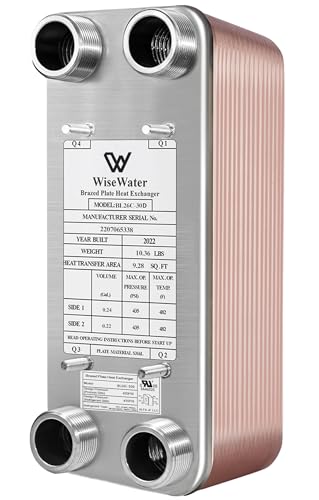
- 30 plates in a compact 5" x 12" body
- 316L stainless steel with copper brazing
- 270k to 380k BTU capacity range
Best For: Wood boiler setups needing compact size and strong output
Efficiency Leader
VEVOR 30-Plate Brazed Exchanger

- 316L stainless steel with 99% copper brazing
- Up to 99% heat efficiency and 260-360K BTU/hr
- Helium leak tested with mounting brackets included
Best For: Efficiency-focused installations with a need for secure mounting
Compact 20-Plate Pick – 4"x12" 20-Plate Brazed Exchanger
If you’re comparing plate heat exchangers for wood boilers, this 4″ x 12″ 20-plate unit is a compact option built for water-to-water heat transfer. It uses 316L stainless steel plates brazed with copper and is rated for a wide range of heating jobs, including wood boiler use, floor heating, and snow melting.
Best For: Smaller wood boiler setups, domestic hot water, and other compact hydronic applications where space and straightforward hookup matter.
Pros:
- 20 brazed plates in a compact 4″ x 12″ body
- 316L stainless steel construction with copper brazing
- Listed for wood boiler, hydronic heating, and snow melting use
- 1″ MPT connections for flexible hookup
Cons:
- Lower capacity than the 40-plate version
- Best suited to smaller demand applications
This is the simpler, smaller-capacity choice in the lineup, so it makes sense when you want reliable heat transfer without oversizing the exchanger.
Outdoor Furnace Value – 5"x12" 20-Plate Wood Furnace Exchanger
For buyers shopping plate heat exchangers for wood boilers, this 5″ x 12″ brazed 20-plate model is a straightforward outdoor wood furnace option. The supplied notes point to 316L stainless steel construction and UL listing, making it a practical pick when you want a purpose-fit exchanger for a wood-fired system.
Best For: Outdoor wood furnace owners who want a simple brazed plate exchanger in a larger 5″ x 12″ format.
Pros:
- Designed for outdoor wood furnace use
- 316L stainless steel construction
- UL listed according to the product notes
- 1″ MPT connection size
Cons:
- Very limited spec details in the supplied notes
- No plate count or capacity listed in the notes
This is a clean, no-frills choice if you mainly want a wood-furnace-compatible exchanger and don’t need a long list of extra features.
High-Capacity Choice – 4"x12" 40-Plate Brazed Exchanger
If you need more output from plate heat exchangers for wood boilers, this 4″ x 12″ 40-plate model is the higher-capacity option in the group. The notes list 316L stainless steel plates brazed with copper, plus use cases that include outdoor wood furnaces, hydronic heating, and wood boiler systems.
Best For: Larger wood boiler systems and higher-demand hydronic setups that need more plate count and heat transfer capacity.
Pros:
- 40 brazed plates for increased heat transfer area
- Rated at 350,000 to 380,000 BTU capacity in the notes
- 316L stainless steel with copper brazing
- Listed for wood boiler, outdoor wood furnace, and hydronic use
Cons:
- Higher-capacity unit may be more than smaller systems need
- Large output can be overkill for simple domestic applications
This model is the strongest fit when the priority is moving more heat, especially in systems where the exchanger has to keep up with a bigger wood-fired load.
Heavy-Duty 40-Plate Model – 5"x12" 40-Plate Wood Furnace Exchanger
Among plate heat exchangers for wood boilers, this 5″ x 12″ 40-plate unit is the higher-spec outdoor furnace option in the list. The supplied notes keep it simple, but they do confirm 316L stainless steel construction and UL listing, which are the key points most buyers will want to verify first.
Best For: Wood furnace owners who want a 40-plate exchanger in a 5″ x 12″ footprint.
Pros:
- 40-plate design for higher heat transfer potential
- 5″ x 12″ footprint for outdoor wood furnace applications
- 316L stainless steel construction
- UL listed according to the notes
Cons:
- Supplied notes provide very few technical specifics
- No BTU rating or connection details listed in the notes
If you want the larger 40-plate format and are mainly choosing by furnace compatibility, this model is a solid starting point for further spec checking.
Compact High-Capacity Pick – 3"x8" 26-Plate 210k BTU Hydronic Exchanger
If you want plate heat exchangers for wood boilers that balance size and output, this 3″x8″ 26-plate model is built for hydronic heating jobs where compact equipment still needs strong transfer performance. Its 316L stainless steel plates and copper brazing are designed for durability, while the 3/4″ MPT connections make it straightforward to fit into a range of heating setups.
Best For: Wood boiler and outdoor furnace systems that need a compact exchanger with solid BTU capacity for hydronic heating.
Pros:
- 316L stainless steel construction with 99.9% copper brazing for a rugged, leak-resistant design
- Rated for roughly 180,000 to 210,000 BTU/hr depending on the application
- 26-plate layout in a compact 3″x8″ body for efficient heat transfer
- Suitable for wood boilers, outdoor wood furnaces, floor heating, and solar heating
Cons:
- 3/4″ MPT ports may be limiting if your system uses larger piping
- Best performance depends on proper sizing and flow setup for your application
This is a practical pick when you need a smaller plate exchanger with respectable output and broad hydronic compatibility. The compact format makes it easier to work into tight installs, but the 3/4″ connections mean it is best matched to systems designed around that size.
Compact Efficiency Pick – 3"x8" 10-Plate Compact Brazed Exchanger
For buyers comparing plate heat exchangers for wood boilers, this 10-plate 3″x8″ unit focuses on efficiency in a compact package. It uses 316L stainless steel plates with copper brazing, and its asymmetric fishbone pattern with counter-flow design is intended to maximize heat transfer while keeping pressure drop low.
Best For: Smaller wood boiler, radiant floor, solar, or DIY hydronic systems that value compact size and efficient heat transfer.
Pros:
- Asymmetric fishbone plate pattern and counter-flow technology for high heat transfer rates
- 316L stainless steel with copper brazing in an oxygen-free environment
- Compact 3″x8″ size with 10 plates for tight installations
- UL listed and backed by a 1-year manufacturer warranty
Cons:
- 10 plates may be better suited to lighter-duty or smaller-capacity applications
- 3/4″ MNPT connections may not match larger piping without adapters
This model is a good fit when space is limited and efficiency matters more than sheer size. The lower plate count and compact footprint make it appealing for smaller hydronic systems, but it is not the most robust choice if your wood boiler setup needs maximum capacity.
High-Output Large-Format Pick – 5"x12" 20-Plate 330k BTU Hydronic Exchanger
If you need plate heat exchangers for wood boilers with more capacity, this 5″x12″ 20-plate unit is the largest option in this roundup and is rated for substantially higher output. The 316L stainless steel construction, copper brazing, and 1 1/4″ MPT connections make it well suited to larger hydronic systems where higher flow and broader heating demand are part of the setup.
Best For: Larger wood boiler, outdoor furnace, or district heating applications that need higher BTU capacity and larger connections.
Pros:
- Higher stated capacity range of about 170,000 to 330,000 BTU/hr
- Large 5″x12″ body with 20 brazed plates for efficient heat transfer
- 1 1/4″ MPT connections better suited to larger hydronic piping
- 316L stainless steel and 99.9% copper brazing for durability
Cons:
- Physically larger than the other options, so it needs more installation space
- May be more exchanger than smaller wood boiler systems require
This is the strongest match if your priority is moving more heat through a wood boiler loop and you have the space to accommodate a larger exchanger. Its bigger ports and higher BTU range make it the most capable pick here, but it should be sized carefully for the system it serves.
Custom-Built Performance – RIYI BL16 Stainless Brazed Plate Exchanger
If you need plate heat exchangers for wood boilers that can be matched to a specific setup, this RIYI unit stands out for its configurable materials, fittings, and plate count. It is built as a copper-brazed stainless steel exchanger with options for 304 or 316 stainless, making it easy to tune for different heating and corrosion requirements.
Best For: Custom installations where fitting type, corrosion resistance, and heat-transfer size need to be selected to match the system.
Pros:
- Choice of 304 or 316 stainless steel for different corrosion needs
- Flange, threaded, or quick-connect fitting options for easier integration
- Plate count can be configured from 10 to 200 for load matching
- Vacuum-brazed construction is designed for leak-proof integrity and thermal cycling
Cons:
- Customization means buyers need to know their system requirements in advance
- Large plate-count range may make selection less straightforward
- Primarily suited to users comfortable specifying the right configuration
For a wood-boiler application, this model is strongest when you want to size and connect the exchanger around an existing hydronic setup rather than settle for a fixed configuration. Its flexibility is the main advantage, especially if corrosion resistance or interface compatibility is a priority.
Best Heavy-Duty Pick – AB 30-Plate Wood Boiler Exchanger
For buyers comparing plate heat exchangers for wood boilers, this AB unit is built around a compact 30-plate design with 316L stainless steel and copper brazing. It is aimed at practical heating jobs where you want strong transfer performance, straightforward threaded hookup, and a unit that can handle demanding temperature and pressure conditions.
Best For: Wood boiler and hydronic heating systems that need a compact exchanger with strong output and simple installation.
Pros:
- 30 brazed plates in a compact 5″ x 12″ size
- 316L stainless steel with 99.9% copper brazing for durability
- Rated for 270,000 to 380,000 BTU depending on application
- Threaded 1 1/4″ MPT connection supports quick hookup
Cons:
- Fixed 30-plate format gives less sizing flexibility than configurable models
- Best suited to users who already know their required capacity
- No mounting accessories are highlighted in the supplied notes
This is a strong all-around choice if you want a proven brazed exchanger with a clear capacity range and a straightforward physical layout. It fits well where wood-boiler heat needs to move efficiently into a water or hydronic circuit without a lot of extra complexity.
Efficiency Leader – VEVOR 30-Plate Brazed Exchanger
If your goal is to compare plate heat exchangers for wood boilers on efficiency and installation confidence, the VEVOR model brings several practical strengths. It uses 316L stainless steel, copper brazing, and a 30-plate layout, while also adding leak testing and included brackets for a more secure install.
Best For: Users who want a high-efficiency exchanger with mounting support and tested leak resistance.
Pros:
- 316L stainless steel with 99% copper brazing for durability
- Up to 99% heat efficiency with 260-360K BTU per hour output
- Helium leak testing and vacuum brazing for reliability
- Includes 304 stainless steel brackets for stable mounting
Cons:
- Fixed 30-plate design may not suit every sizing need
- Detailed certification and mounting features may be more than some simple installs require
- Some listed specs are broader than wood-boiler users may need for a basic heating swap
For a wood-boiler or hydronic application, this exchanger is appealing if you want efficiency-focused hardware plus hardware support for mounting. The combination of tested leak resistance and included brackets makes it especially practical when you want fewer surprises during installation.
How We Picked the Best Plate Heat Exchangers for Wood Boilers
We focused on Plate Heat Exchangers for Wood Boilers that match common hydronic and outdoor furnace setups, with attention to plate count, port size, pressure drop, and construction materials. We also favored models that fit common application needs like radiant floors, domestic hot water loops, swimming pools, and snow-melt systems.
Quick Comparison
In general, more plates can mean greater heat transfer capacity, while larger ports may reduce restriction in higher-flow systems. Smaller exchangers are often a better fit for compact or lower-demand installs, while larger 5"x12" units tend to suit higher-output boiler loops.
Key Buying Factors for Plate Heat Exchangers for Wood Boilers
Plate Count and Heat Load
Match the exchanger to your boiler output and the load you’re serving. Undersized units can limit performance, while oversized units may add cost and plumbing complexity without improving comfort.
Port Size and Flow
Port diameter affects how easily water moves through the system. Larger ports are usually better for higher flow rates and longer piping runs, while smaller ports can work well in compact systems with moderate demand.
Material and Corrosion Resistance
Most buyers should look for stainless steel brazed constructions with copper or stainless brazing. If your system includes treated water, glycol, or mixed-use heating, material compatibility matters for long-term durability.
Application Match
Some units are better suited to radiant heat, while others are designed for outdoor wood furnaces or multi-use hydronic systems. Make sure the exchanger aligns with your specific source side and load side temperatures.
Who Should Buy Which Plate Heat Exchangers for Wood Boilers?
If you need a compact solution for a smaller loop, a lower-plate-count unit may be enough. If you’re handling a larger wood boiler, pool heating, or multiple zones, a higher-capacity model with larger ports is usually the safer choice. For buyers who want flexibility, mid-size 5"x12" exchangers often offer the best balance of size, flow, and output.
For best results, confirm pressure and temperature ratings, verify port threading, and plan for service access during installation. A properly sized exchanger can improve heat transfer, simplify system separation, and help your wood boiler run more efficiently.
