A damp basement can lead to musty odors, condensation, mold growth, and damage to stored belongings. The right dehumidifier removes excess moisture efficiently while fitting your room size, drainage setup, and noise expectations.
We selected 10 basement-focused models ranging from compact 32- and 34-pint units to high-capacity options rated for up to 6,000 square feet. Use the comparison and buying advice below to narrow your choices by performance, convenience, and long-term operating cost.
Best 10 Dehumidifiers for Basements Picks for 2026
Most Efficient Pick
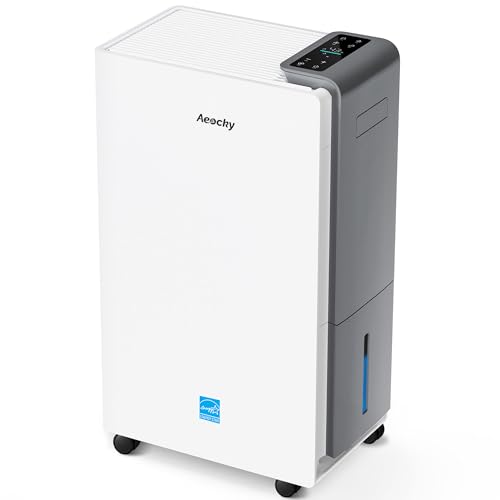
- ENERGY STAR Most Efficient 2025 certified
- Rated for spaces up to 5,500 sq. ft.
- Operates in temperatures down to 65°F
Best For: Large basements and efficiency-focused households
Best Value Features

- Rated for areas up to 2,600 sq. ft.
- Includes continuous-drain hose and auto-restart
- Three operating modes plus a 24-hour timer
Best For: Medium basements and general household use
Heavy-Duty Efficiency Pick
AEOCKY 105-Pint Commercial Dehumidifier

- Rated for spaces up to 6,000 sq. ft.
- Up to 105 pints per day in stated conditions
- ENERGY STAR Most Efficient 2024 certified
Best For: Very large basements and commercial spaces
Best Pumped Drainage
avylo 90-Pint Basement Dehumidifier

- Built-in pump with 15-foot lift
- Rated for areas up to 5,000 sq. ft.
- ENERGY STAR Most Efficient 2025 certified
Best For: Large basements needing unattended pumped drainage
Best Large-Capacity Pick
Waykar 80-Pint Basement Dehumidifier

- Covers spaces up to 5,000 sq. ft.
- 30%–80% adjustable humidity control
- Tank and hose support flexible drainage
Best For: Large basements and high-humidity areas
Best Compact Value
34-Pint Basement and Bedroom Dehumidifier

- Designed for spaces up to 2,000 sq. ft.
- 30%–80% humidity setting range
- Quiet 41 dB operation with rolling casters
Best For: Typical basements and multi-room household use
Best Feature-Rich Option
KNKA 80-Pint Basement Dehumidifier

- Rated for spaces up to 5,500 sq. ft.
- AUTO, DRY, and 30%–80% setting modes
- 1.45-gallon tank plus included drain hose
Best For: Large basements needing flexible, monitored operation
Best Whole-Basement Coverage
4500 Sq. Ft. 45-80 Pint Dehumidifier

- Covers up to 4,500 sq. ft.
- Hose or 1.72-gallon tank drainage
- 40 dB operation with adjustable airflow
Best For: Large, moisture-prone basements and garages
Best Compact Energy Saver
Waykar 34-Pint Basement Dehumidifier

- Covers spaces up to 2,000 sq. ft.
- 2025 ENERGY STAR Most Efficient certification
- 38 dB operation with two drainage options
Best For: Medium basements, offices, and bedrooms
Best Smart Controls
4500 Sq. Ft. Energy Star Dehumidifier

- Adjustable 45-80 pint output
- Five modes, humidity sensors, and 24-hour timer
- 40 dB operation with hose or tank drainage
Best For: Large basements needing automated moisture control
Most Efficient Pick – AEOCKY 80-Pint Dehumidifier
For shoppers comparing dehumidifiers for basements, the AEOCKY RHEA-001 stands out for its ENERGY STAR Most Efficient 2025 certification, large rated coverage, and low-temperature operating capability. Its stated performance reaches up to 56 pints per day in warm, damp basement conditions.
Best For: Large basements and homeowners prioritizing certified energy efficiency.
Pros:
- ENERGY STAR Most Efficient 2025 certified.
- Rated for homes up to 5,500 square feet.
- Designed to keep operating in temperatures as low as 65°F.
- Smart humidity sensing and power-off memory support convenient operation.
Cons:
- Its large-capacity design may be more than needed for smaller spaces.
- The supplied information does not specify a built-in pump or included drain hose.
Choose this model when efficiency and broad basement coverage matter most. Its compressor design and humidity-control features make it a strong fit for demanding, long-term moisture management.
Best Value Features – 32-Pint Basement Dehumidifier
This 32-pint unit is a practical option for dehumidifiers for basements when you want straightforward controls, flexible drainage, and easy mobility. It is rated for areas up to 2,600 square feet and includes both a removable tank and a gravity-drain hose.
Best For: Medium-size basements, laundry areas, and households wanting simple scheduled operation.
Pros:
- Removes up to 32 pints of moisture per day under stated test conditions.
- Offers DEHU, continuous, and laundry-drying modes.
- Includes a 39.4-inch drain hose, auto-restart, and auto-defrost.
- Quiet operation is rated at 39–42 dB.
Cons:
- The 2-liter tank may require frequent emptying without continuous drainage.
- Its coverage and capacity are lower than the larger models in this roundup.
With caster wheels, handles, child lock, and washable filtration, this model emphasizes everyday convenience. It is a sensible fit for moderate basement moisture rather than very large or severely damp spaces.
Heavy-Duty Efficiency Pick – AEOCKY 105-Pint Commercial Dehumidifier
For very large or persistently damp basements, the AEOCKY RHEA-002 offers the highest stated capacity in this roundup. It is designed for spaces up to 6,000 square feet and is certified ENERGY STAR Most Efficient 2024.
Best For: Extra-large basements, commercial areas, and demanding moisture conditions.
Pros:
- Rated up to 105 pints per day in humid summer conditions.
- Stated capacity reaches 83 pints per day in warm, damp basement conditions.
- ENERGY STAR Most Efficient 2024 certified.
- Uses smart humidity control and power-off memory.
Cons:
- Its commercial-scale capacity may be excessive for ordinary small basements.
- The supplied notes do not confirm included hose or pump details.
This is the choice for shoppers who need maximum extraction and broad coverage. Its high-output compressor system and efficiency certification make it particularly compelling where a smaller residential unit would struggle.
Best Pumped Drainage – avylo 90-Pint Basement Dehumidifier
The avylo ADC018 is a strong option among dehumidifiers for basements when continuous drainage is a priority. Its built-in pump, 15-foot lift, and included 15-foot hose support unattended operation, while the unit is rated for areas up to 5,000 square feet.
Best For: Large basements where a floor drain is inconvenient or elevated drainage is needed.
Pros:
- ENERGY STAR Most Efficient 2025 certified.
- Removes up to 90 pints per day under stated test conditions.
- Built-in pump provides a 15-foot lift and includes a 15-foot drain hose.
- Offers a 2.11-gallon tank, auto shutoff, child lock, and 5-year warranty.
Cons:
- A floor-drain pipe is not included.
- At 38.6 pounds, it is less portable than smaller basement units.
Its pump-equipped drainage system is the key advantage for basements without a convenient nearby drain. Add the quiet 41 dB operation and automatic humidity control, and it becomes a well-equipped choice for extended use.
Best Large-Capacity Pick – Waykar 80-Pint Basement Dehumidifier
For large, persistently damp areas, this Waykar is one of the more capable dehumidifiers for basements. It is rated for spaces up to 5,000 square feet and removes up to 80 pints of moisture per day under specified high-humidity conditions. ENERGY STAR certification, adjustable humidity control, and flexible drainage make it practical for extended use.
Best For: Large basements, homes, RVs, and other spaces that need high-capacity moisture removal.
Pros:
- 80-pint capacity designed for spaces up to 5,000 square feet.
- Adjustable humidity range from 30% to 80% RH.
- Includes a 4.3-liter tank and drain hose for manual or continuous drainage.
- ENERGY STAR certified, with auto-defrost and overload protection.
Cons:
- The water tank is relatively small for an 80-pint unit, so continuous drainage may be preferable during heavy use.
- Its large-room capacity may be more than needed for small rooms.
Choose this model when coverage and moisture-removal capacity are priorities. Its 42 dB operation, auto-swing airflow, and 24-hour timer add convenience, while the included hose helps reduce emptying frequency.
Best Compact Value – 34-Pint Basement and Bedroom Dehumidifier
This 34-pint model offers a practical balance for smaller basements and mixed household use. It is designed to cover up to 2,000 square feet, includes automatic humidity control from 30% to 80%, and can switch to a higher-fan DRY mode for bathrooms or laundry areas.
Best For: Typical basements, bedrooms, bathrooms, laundry rooms, and homes that need a movable mid-capacity unit.
Pros:
- Removes up to 34 pints of moisture per day and is intended for spaces up to 2,000 square feet.
- Offers adjustable humidity control, a 24-hour timer, and a dedicated DRY mode.
- Includes a 6.56-foot drain hose for continuous drainage.
- Rolling casters, child lock, and operation rated at 41 dB support convenient household use.
Cons:
- The 0.66-gallon tank will require more frequent emptying during heavy humidity.
- Its stated coverage is smaller than the large-capacity models in this roundup.
This is a sensible choice when you want one portable unit for several rooms rather than maximum basement capacity. The automatic restart after bucket emptying and continuous-drain option make it easier to operate with minimal supervision.
Best Feature-Rich Option – KNKA 80-Pint Basement Dehumidifier
The KNKA combines high moisture-removal capacity with multiple operating modes and expanded drainage options. Rated for up to 5,500 square feet, it can remove up to 80 pints per day in stated high-humidity conditions and includes AUTO, DRY, and SETTING modes for different basement and household needs.
Best For: Large basements and users who want high capacity, continuous drainage, and detailed humidity monitoring.
Pros:
- 80-pint capacity with stated coverage up to 5,500 square feet.
- Built-in 1.45-gallon tank and included 6.56-foot drain hose support extended operation.
- AUTO, DRY, and SETTING modes allow humidity targets from 30% to 80% RH.
- Real-time display, humidity indicator light, child lock, washable filter, and 360-degree casters add convenience.
Cons:
- The optional 2.64-gallon external tank is sold separately.
- Humidity readings are taken at the air inlet and may differ slightly from an external hygrometer.
- The product notes specify a 220-volt rating, so electrical compatibility should be confirmed before purchase.
With its large stated coverage and 1.45-gallon internal tank, this KNKA is suited to demanding basement applications, especially when a floor drain is available. Its 40–45 dB noise rating and selectable display lighting also make it more adaptable for living spaces.
Best Whole-Basement Coverage – 4500 Sq. Ft. 45-80 Pint Dehumidifier
For large, persistently damp areas, this is one of the more capable dehumidifiers for basements. It is designed to cover up to 4,500 square feet and offers a 45-80 pint dehumidification range, making it suitable for basements, garages, gyms, and other high-humidity spaces.
Best For: Large basements and open areas where continuous drainage, broad coverage, and adjustable airflow are priorities.
Pros:
- Covers up to 4,500 square feet with a 45-80 pint moisture-removal range.
- Includes a drain hose option, a 1.72-gallon tank, and automatic shutoff when full.
- 90-degree adjustable airflow, sleep mode, humidity sensing, and Energy Star certification add flexibility.
- Runs at a stated 40 dB and includes auto defrost and overload protection.
Cons:
- The larger capacity and coverage may be more than needed for small rooms.
- Manual emptying is still required when continuous drainage is not practical.
Choose this model when your basement is large or especially moisture-prone and you want the convenience of hose drainage. Its adjustable outlet and quiet operation also make it adaptable for laundry areas and shared living spaces.
Best Compact Energy Saver – Waykar 34-Pint Basement Dehumidifier
This Waykar model is a practical choice among dehumidifiers for basements when you need coverage for a medium-size area without a bulky unit. It removes up to 34 pints per day and is designed for spaces up to 2,000 square feet, including basements, offices, bedrooms, and living rooms.
Best For: Medium-size basements and households prioritizing compact design, low energy use, and quiet operation.
Pros:
- Designed for spaces up to 2,000 square feet with 34 pints-per-day capacity.
- 2025 ENERGY STAR Most Efficient certification and stated energy savings.
- Offers continuous hose drainage or a 0.62-gallon tank, plus dehumidifying, drying, and continuous modes.
- Runs as quietly as 38 dB and includes automatic defrost, tank shutoff, and memory restart.
Cons:
- The smaller 0.62-gallon tank may require frequent emptying without the hose.
- Its 2,000-square-foot rating may not suit very large or heavily damp basements.
For a typical finished or moderately sized basement, the Waykar balances capacity with portability and efficiency. Its low noise rating and compact format make it especially suitable when the unit will operate near bedrooms or home offices.
Best Smart Controls – 4500 Sq. Ft. Energy Star Dehumidifier
This large-capacity unit is built for homeowners who want broad moisture control with automated operation. Among dehumidifiers for basements, it stands out for its 4,500-square-foot coverage, adjustable 45-80 pint output, humidity sensors, five working modes, and programmable 24-hour timer.
Best For: Large basements and utility areas where automatic humidity management and flexible scheduling are useful.
Pros:
- Provides adjustable 45-80 pint dehumidification for areas up to 4,500 square feet.
- Smart sensors, real-time humidity readings, five modes, and a 24-hour timer support customized operation.
- Includes continuous hose drainage or a removable tank with automatic overflow shutoff.
- Stated 40 dB operation, sleep mode, auto defrost, and child lock improve everyday usability.
Cons:
- Its high-capacity design may be unnecessary for smaller rooms or lightly damp spaces.
- Continuous drainage requires a suitable floor drain or placement near an appropriate outlet.
This model makes the most sense when basement conditions change throughout the day and you want the unit to adjust automatically. The timer, sensor-based control, and dual drainage setup reduce hands-on management during extended operation.
How We Picked These Dehumidifiers for Basements
We focused on models marketed for basement use and compared their stated extraction capacity, recommended coverage, Energy Star positioning, drainage options, controls, and suitability for continuous operation. The selection includes smaller units for moderate moisture and larger models for expansive, persistently damp, or partially finished basements.
Because real-world performance depends on temperature, humidity, insulation, and air circulation, advertised square-foot ratings should be treated as a starting point rather than a guarantee. A basement with severe water intrusion may require waterproofing or professional remediation in addition to dehumidification.
Quick Comparison
| Capacity range | Best suited to | What to look for |
|---|---|---|
| 32–34 pints per day | Small to medium basements, bedrooms, and utility areas | Easy tank removal, hose drainage, and accurate humidity controls |
| About 80 pints per day | Large or consistently damp residential basements | Continuous drainage, efficient operation, and a washable filter |
| Up to 90 pints per day | Very damp spaces and demanding moisture loads | Built-in pump, long hose, automatic restart, and sturdy construction |
| Commercial or 6,000-square-foot class | Large unfinished areas or unusually high humidity | Durability, drainage reliability, serviceability, and operating cost |
Key Buying Factors for Dehumidifiers for Basements
Capacity and Room Size
Choose capacity according to both square footage and moisture severity. A smaller unit may work well in a moderately humid basement, while a larger model is preferable for wet foundations, laundry areas, frequent condensation, or open-plan spaces. Oversizing can reduce run time, but it does not fix leaks or standing water.
Drainage Options
Manual tank emptying is acceptable for occasional use, but a hose connection is far more convenient for continuous operation. If the drain is above the unit or there is no suitable floor drain, choose a model with a built-in pump. Confirm that the included hose length and fittings match your installation.
Energy Use and Controls
Energy Star certification or high-efficiency labeling can help reduce operating costs, especially when the unit runs daily. A built-in humidistat, automatic shutoff, timer, adjustable fan speeds, and automatic restart make the appliance easier to manage. Look for a washable filter and a clear indicator when cleaning is needed.
Noise, Temperature, and Placement
Basements used as bedrooms, offices, or living areas benefit from quieter operation. Cold basements may also need a low-temperature or automatic defrost feature to prevent frost buildup. Leave the recommended clearance around the intake and exhaust, and keep the unit level.
Who Should Buy Which Dehumidifiers for Basements?
Choose a 32- or 34-pint model for a smaller, moderately damp basement or when portability between rooms matters most. Move up to an 80-pint unit for a large basement, persistent humidity, or frequent tank filling. A pump-equipped model is the practical choice when gravity drainage is unavailable. For extensive unfinished areas or severe moisture loads, consider the commercial or 90-pint class, but verify electrical requirements, drainage, noise, and ongoing energy costs before buying.