APUS Tankless Water Heater review for buyers who want a compact natural gas unit with high flow and steady temperature control.
It is best understood as a space-saving indoor heater for households that need on-demand hot water without a bulky tank.
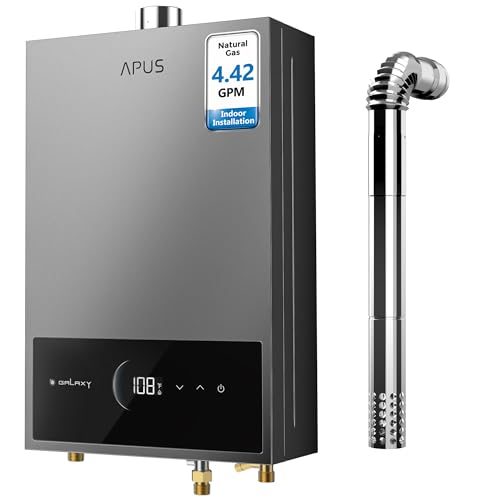
APUS Tankless Water Heater Review Summary
The APUS Tankless Water Heater is a strong fit for buyers who care most about capacity, temperature steadiness, and footprint.
Based on the listing, it combines a 95,000 BTU heating rating, up to 4.42 GPM flow, smart digital temperature control, and a small wall-mounted profile, which makes it appealing for households replacing a storage tank with a more efficient-looking indoor option.
Verdict: this is a practical whole-home-style tankless heater for moderate to higher demand rather than a minimalist point-of-use unit.
If you want fast hot water recovery, compact dimensions, and a natural gas setup with safety features and freeze protection, it has the right feature mix.
If your household has very low hot-water demand or you need a simpler plug-and-play appliance, it may be more heater than you need.
Review Scorecard
| Category | Score | Buyer assessment |
|---|---|---|
| Heating capacity | 9/10 | 95,000 BTU and up to 4.42 GPM suggest strong output for a compact gas unit. |
| Temperature control | 9/10 | The listed smart CPU and sensor system targets stable water within a narrow range. |
| Efficiency potential | 8/10 | The listing claims up to 98% thermal efficiency and 0.81 UEF. |
| Space savings | 9/10 | The small wall-mounted form factor is one of its clearest advantages. |
| Safety and protection | 8/10 | Multiple safety protections and automatic shutdown features are listed. |
| Installation fit | 7/10 | Indoor natural gas use is straightforward in the right home, but not universally simple. |
| Overall buyer value | 8/10 | A well-rounded spec sheet for buyers prioritizing compact gas hot-water performance. |
Key Features and Specifications of APUS Tankless Water Heater
This APUS unit is an indoor natural gas tankless water heater designed to deliver hot water on demand.
The headline figures are a 95,000 BTU heating capacity and up to 4.42 GPM flow, with the listing saying it can handle simultaneous use for two showers plus one sink under the right conditions.
The temperature-control story is just as important as the raw output.
APUS says the heater uses high-precision sensors and smart CPU technology to hold water temperature within about 1 degree Fahrenheit of the setpoint, with adjustments from 95°F to 140°F.
For buyers who dislike the temperature swings common in undersized systems, that is a meaningful feature.
Key listed details:
- Brand: APUS
- Fuel type: natural gas
- Use: indoor tankless water heater
- Heating capacity: 95,000 BTU
- Max flow: up to 4.42 GPM
- Low-flow start: 0.66 GPM
- Temperature range: 95°F to 140°F
- Efficiency claim: up to 98% thermal efficiency
- UEF: 0.81
- Noise claim: 36 dB
- Power: 120V AC connection
- Dimensions: 20.55″ H x 13.27″ W x 5.91″ D
- Safety: multiple-layer protection, automatic shutdown, freeze protection
- Coverage: 2-year coverage listed
The compact size is a major selling point.
At just over 20 inches tall and about 13 inches wide, this is built for buyers who want to free up floor space.
The stated quiet operation also matters in a home setting because tankless heaters often live closer to living spaces than old-style tanks.
The freeze-protection note is worth reading carefully.
The listing says the unit has built-in intelligent freeze protection, but it also warns that if ambient temperatures approach or fall below 41°F for extended periods, or if the heater will be unused for a long time, it should be drained to prevent damage.
That is a useful reminder that tankless convenience still comes with seasonal maintenance awareness.
Pros and Cons of APUS Tankless Water Heater
Pros
- High output for the size. The 95,000 BTU rating and 4.42 GPM claim make it look capable for multiple simultaneous fixtures.
- Stable temperature control. The smart sensor and CPU system are aimed at reducing hot-cold swings.
- Space-saving build. The compact wall-mounted design is a real advantage in utility rooms, closets, or tight indoor installs.
- Efficiency-focused positioning. The listed 98% thermal efficiency and 0.81 UEF make it attractive to buyers comparing tankless options.
- Safety features included. Automatic shutdown and layered protection are useful on a gas appliance.
Cons
- Indoor natural gas only. This is not the right pick if your home is set up for electric or propane-only use.
- Output depends on real-world conditions. The 4.42 GPM claim is strong on paper, but actual performance depends on inlet temperature and demand.
- Requires proper installation planning. A tankless heater with this capacity is not an impulse upgrade.
- Freeze guidance adds maintenance responsibility. Buyers in colder spaces will need to pay attention to the drain and protection instructions.
Who Should Buy APUS Tankless Water Heater?
This APUS Tankless Water Heater makes sense for households that want a compact indoor gas heater with enough output to support regular family use.
It is a good fit if you are replacing a tank, want better wall-mounted space efficiency, and care about keeping shower temperatures steady when more than one tap runs at once.
It also suits buyers who like practical control features.
The temperature range, digital display, and smart regulation system are all aimed at people who want a set-and-forget hot-water experience rather than a basic burner that only focuses on raw heat.
You should consider skipping it if your home does not already support natural gas indoor installation, if your usage is very light, or if you want the simplest possible water-heating setup.
Buyers in freezing climates should also be realistic about the maintenance instructions and the need to keep the unit protected when not in use.
Performance and Installation Fit of APUS Tankless Water Heater
Flow Capacity in Real Homes
The 4.42 GPM figure is the number that will matter most to many buyers, because tankless systems succeed or fail on whether they can keep up with simultaneous demand.
APUS positions this model as strong enough for two showers and a sink, which suggests it is aimed at households that have moved beyond point-of-use needs.
Temperature Stability and Comfort
The claimed 1°F temperature control is one of the best arguments for this heater.
Even if the real-world result varies, the listing makes a clear promise: steadier water with fewer sudden changes.
For families, that matters more than flashy digital controls because the main complaint with many undersized systems is inconsistency.
Space, Noise, and Daily Use
The compact dimensions and 36 dB noise claim work together.
A quiet, small unit is easier to live with in a home because it can disappear into the background instead of dominating the mechanical space.
That makes it more appealing for renovations where every inch counts.
Safety and Cold-Weather Precautions
The automatic shutdown protections are welcome, but the freeze warning should not be ignored.
Tankless systems can be excellent, but they expect the owner to respect environmental limits.
If you live somewhere cold or the heater will sit idle for long periods, the drain guidance is part of the ownership equation.
Alternatives to APUS Tankless Water Heater
If you want a comparable natural gas tankless option, look at established lines such as Rinnai tankless water heaters, Rheem tankless water heaters, and EcoSmart tankless water heaters.
These brands are commonly searched by buyers who want to compare capacity, install requirements, and warranty-style positioning before choosing a heater.
Rinnai is often the comparison point for buyers who want a familiar premium gas-tankless name.
Rheem is useful for shoppers who want a broad catalog and a more mainstream plumbing brand.
EcoSmart is worth a look if your decision path may eventually shift toward electric or if you want to compare tankless categories side by side.
The APUS unit stands out most on the combination of compact size, listed flow, and temperature-stability claims.
If those are your priorities, it belongs in the comparison set.
If you want the deepest brand track record or a broader selection of installation configurations, the alternatives above are the next sensible searches.
Is APUS Tankless Water Heater Worth It?
Yes, if you want a compact indoor natural gas tankless heater with strong output and steady temperature control.
The APUS Tankless Water Heater looks worth considering for buyers who need real household hot-water capacity without the footprint of a tank, and who are comfortable with gas installation requirements and freeze-protection care.
If your home is a good installation match, this is a sensible buy for practical performance rather than gimmicks.
If you need electric power, very simple setup, or a lighter-duty point-of-use unit, look elsewhere.
