Finding reliable deep-cycle power on a budget means balancing capacity, chemistry, durability, and included battery-management features. The options in this roundup span compact AGM batteries, larger lead-acid models, and high-capacity LiFePO4 batteries.
Use the comparisons below to match battery size and technology to your actual power needs, charging setup, available space, and expected cycle life.
Best 10 Deep Cycle Batteries Under 300 Picks for 2026
Best Mobility Pick
Interstate 12V 35Ah SLA AGM Battery

- 35Ah sealed AGM design
- Compact Group U1/GT9L size
- 12-month performance warranty
Best For: Wheelchairs, scooters, and compact mobility equipment
Best Dual-Purpose Lithium
12V 300Ah LiFePO4 Smart Battery

- 300Ah capacity and 5,000+ cycles
- 1,500A starting-current mode
- App monitoring and 200A BMS
Best For: RV, marine, backup, and off-grid systems
Best AGM Value
Renogy 12V 100Ah Deep Cycle AGM Battery

- 100Ah sealed AGM capacity
- Series and up to 4P parallel support
- Two-year prorated warranty
Best For: RV, solar, cabin, and backup power
Best Cold-Weather Lithium
12V 300Ah Self-Heating LiFePO4 Battery

- Automatic low-temperature heating
- 300Ah capacity with app monitoring
- 200A BMS and multiple protections
Best For: Cold-weather RV, marine, solar, and backup use
High-Capacity AGM Pick

- 200Ah 12V AGM capacity
- Maintenance-free, spill-resistant design
- Low self-discharge below 3% monthly
Best For: Solar, RV, and backup-power systems needing high capacity
Long-Life Lithium Pick

- 24-pound Group 31-compatible design
- Built-in 100A Smart BMS
- Claims up to 15,000 deep cycles
Best For: Frequent cycling in RV, marine, solar, and off-grid systems
Marine Dual-Purpose Pick
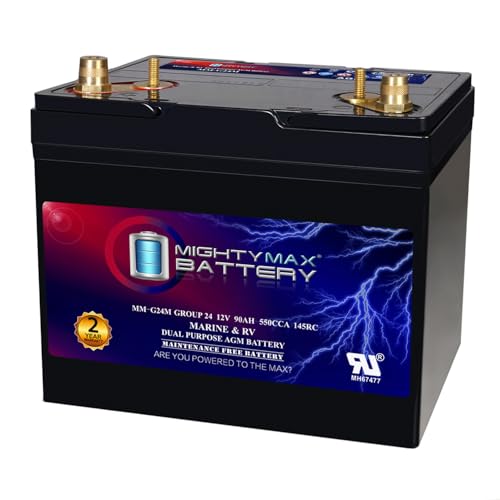
- 90Ah deep-cycle capacity
- 550 CCA and 700 MCA starting power
- Spill-proof, maintenance-free AGM build
Best For: Marine starting and accessory power in boats
High-Output Pick
NebuQuic 12V 300Ah LiFePO4 Battery

- EV-grade A+ cells with 300Ah capacity
- 200A BMS for high-rate applications
- 4,000+ cycles at 100% depth of discharge
Best For: High-demand RV, solar, marine, and backup-power systems
Expansion Pick
ECIENWELL 12V 300Ah Lithium Battery

- 3840Wh output in a lighter package
- IP65 protection for outdoor applications
- Expandable up to a stated 61.44kWh system
Best For: Expandable RV, solar, marine, and off-grid installations
Cold-Weather Pick
ECOBOSS 12V 300Ah LiFePO4 Battery

- 15,000+ stated cycle life and 10-year warranty
- 200A smart BMS with 100A maximum charging
- Charging cutoff below 32°F
Best For: Outdoor, RV, marine, solar, and off-grid systems in variable temperatures
Best Mobility Pick – Interstate 12V 35Ah SLA AGM Battery
If you need deep cycle batteries under 300 for a wheelchair, scooter, or similar mobility device, the Interstate DCM0035 is a compact 12V, 35Ah AGM option. Its sealed, spill-proof construction is designed for rechargeable deep-discharge use.
Best For: Electric wheelchairs, scooters, and compatible compact mobility equipment.
Pros:
- Maintenance-free, spill-proof AGM and VRLA design
- Compact Group U1/GT9L form factor with insert terminals
- Backed by a 12-month performance warranty
Cons:
- Only 35Ah of capacity, limiting runtime for larger loads
- Not intended as a golf cart battery
This is a practical replacement when compatibility and easy maintenance matter more than maximum capacity. Confirm the terminal style and device requirements before ordering.
Best Dual-Purpose Lithium – 12V 300Ah LiFePO4 Smart Battery
Among deep cycle batteries under 300, this 12V 300Ah LiFePO4 model stands out for combining energy storage with starting capability. It offers app monitoring, a 200A BMS, temperature protection, and expansion potential for RV, solar, and off-grid systems.
Best For: RVs, boats, home backup, and off-grid users who want high capacity plus occasional starting power.
Pros:
- 300Ah capacity with over 5,000 claimed cycles in normal mode
- Power mode delivers up to 1,500A instantaneous starting current
- App tracks voltage, current, power, state of charge, and cycle count
- Supports solar, generator, and 14.6V LiFePO4 charging
Cons:
- Large 55.2-pound battery requires substantial installation space
- Manual and charging requirements should be reviewed before use
Its smart monitoring and dual-mode design make it unusually versatile for a 12V system. Check your charger, available space, and wiring configuration before building an expanded battery bank.
Best AGM Value – Renogy 12V 100Ah Deep Cycle AGM Battery
For buyers comparing deep cycle batteries under 300, the Renogy 100Ah AGM battery offers a straightforward sealed lead-acid solution for solar, RV, and backup applications. Its maintenance-free AGM construction avoids the setup demands associated with flooded batteries.
Best For: RVs, cabins, solar systems, and backup users who prefer AGM chemistry over lithium.
Pros:
- 100Ah capacity with stable deep-cycle discharge
- Sealed AGM design with minimal troubleshooting
- Supports series connections without a stated limit and parallel connections up to 4P
- Two-year prorated material and workmanship warranty
Cons:
- At 63.9 pounds, it is heavier than comparable lithium batteries
- Lead-acid chemistry generally requires more space and weight planning
This battery is a sensible choice when safety, familiar AGM technology, and flexible system wiring are priorities. Its weight makes installation and transport worth planning in advance.
Best Cold-Weather Lithium – 12V 300Ah Self-Heating LiFePO4 Battery
This self-heating 12V 300Ah LiFePO4 battery is a strong option among deep cycle batteries under 300 for RVs, marine systems, and off-grid storage. Its heating feature helps manage charging in freezing conditions, while app monitoring provides real-time operating information.
Best For: Cold-weather RV, marine, solar, and household backup installations needing long-duration power.
Pros:
- Automatic heating activates below 32°F when charging current exceeds 10A
- Integrated BMS protects against overcharge, over-discharge, overcurrent, shorts, and temperature extremes
- App displays capacity, voltage, current, power, alerts, and temperature
- Supports lithium charger, solar, or generator charging
Cons:
- Self-heating requires a charger and more than 10A of charging current
- Not suitable for golf cart use when connected in series
- At about 54.7 pounds, it remains a substantial battery to install
The self-heating function makes this model particularly useful where freezing temperatures could interrupt charging. Verify charger compatibility and follow the manufacturer’s operating instructions before installation.
High-Capacity AGM Pick – 200Ah Deep Cycle AGM Battery
For shoppers comparing deep cycle batteries under 300, the Renogy 12V 200Ah AGM battery offers substantial storage in a maintenance-free lead-acid design. Its AGM construction, low self-discharge rate, and upright-installation requirement make it a practical fit for compatible solar, RV, and backup-power setups.
Best For: Solar storage, RV power, and other applications needing high 12V capacity without routine electrolyte maintenance.
Pros:
- 200Ah rated capacity at the 20-hour reference rate.
- Maintenance-free AGM construction with valve-regulated technology.
- Low monthly self-discharge rate of below 3% at 77°F.
- Two-year prorated material and workmanship warranty.
Cons:
- Heavy at 127.9 pounds.
- Should be installed upright; upside-down installation is not allowed.
- Lead-acid AGM chemistry is less cycle-focused than the lithium option in this roundup.
This is a capacity-oriented choice for buyers who want a single large AGM battery and can accommodate its weight and installation position. Confirm the 20.5 x 9.4 x 8.8-inch dimensions and charging setup before purchase.
Long-Life Lithium Pick – 100Ah LiFePO4 Battery
Among deep cycle batteries under 300, this 12V 100Ah LiFePO4 model stands out for low weight, extensive cycle-life claims, and built-in battery management. It is designed as a Group 31 replacement and includes low-temperature charging protection for RV, marine, solar, and off-grid use.
Best For: Buyers prioritizing lightweight installation, frequent cycling, and long-term use in RV, marine, solar, or backup systems.
Pros:
- Weighs 24 pounds and is designed to fit BCI Group 31 battery boxes.
- Built-in 100A Smart BMS protects against overcharge, over-discharge, over-current, and short circuits.
- Automatic charging cutoff below 32°F helps protect the cells in cold conditions.
- Supports configurations up to 4S4P and claims up to 15,000 cycles at 60% depth of discharge.
Cons:
- Requires LiFePO4-compatible charging equipment, such as a 14.6V charger.
- Its 100Ah capacity is half that of the 200Ah AGM option.
- Cold-temperature protection stops charging below 32°F, so winter charging plans matter.
For repeated daily cycling, the lightweight construction and stated service life can make this a compelling upgrade over lead-acid designs. Verify charger compatibility, battery-box clearance, and the requirements of any series or parallel configuration.
Marine Dual-Purpose Pick – 90Ah AGM Marine Battery
For deep cycle batteries under 300 that also need engine-starting ability, the Mighty Max MM-G24M combines 90Ah capacity with 550 CCA and 700 MCA. Its Group 24M marine format, spill-proof AGM construction, and rugged ABS case suit boats and other vibration-prone applications.
Best For: Boat owners who need one maintenance-free battery for starting an engine and powering marine electronics or accessories.
Pros:
- Dual-purpose design provides deep-cycle capacity and starting power.
- Delivers 550 CCA and 700 MCA for engine starting.
- Maintenance-free, spill-proof AGM construction with vibration resistance.
- Claims up to 700 cycles at 50% depth of discharge.
Cons:
- At 90Ah, it offers less storage capacity than the 100Ah and 200Ah alternatives.
- Weighs about 52.2 pounds, making it heavier than the lithium battery.
- Warranty information in the supplied notes differs between a two-year limited warranty and a one-year manufacturer warranty.
This battery is a strong match when starting performance matters as much as accessory runtime. Check the available battery compartment and confirm the applicable warranty terms before ordering.
High-Output Pick – NebuQuic 12V 300Ah LiFePO4 Battery
For shoppers comparing deep cycle batteries under 300, this NebuQuic model stands out with a 300Ah capacity, EV-grade A+ cells, and a 200A BMS designed for demanding loads. Its compact format and low-temperature protection make it adaptable for RV, solar, marine, and off-grid setups.
Best For: High-demand RV, solar, truck, kayak, and backup-power applications.
Pros:
- EV-grade A+ cells and 4P4S construction support consistent power output.
- 200A BMS provides multiple protections and supports high-rate charging and discharging.
- Rated for 4,000+ cycles at 100% depth of discharge and a stated 10+ year service life.
- Low-temperature protection activates below -4°F, while the battery weighs about one-third as much as lead-acid alternatives.
Cons:
- The 300Ah capacity may be more than needed for smaller installations.
- The supplied notes do not specify an IP water-resistance rating.
Choose this battery if you prioritize a high current rating, compact installation, and long-term cycle life. Its 200A BMS is particularly useful for heavier-duty equipment, while the five-year after-sales service adds support.
Expansion Pick – ECIENWELL 12V 300Ah Lithium Battery
Among deep cycle batteries under 300, the ECIENWELL 12V 300Ah model is a strong option for buyers who want substantial energy storage in a lighter, maintenance-free package. It offers 3840Wh of output, IP65 protection, and support for large expandable systems.
Best For: RVs, trolling motors, solar storage, off-grid living, and expandable backup systems.
Pros:
- Provides 3840Wh of energy with a compact 54.45-pound design.
- 200A BMS protects against overcharging, over-discharging, overloads, overheating, and short circuits.
- Supports up to 4P4S expansion for a stated maximum 61.44kWh energy system.
- IP65 waterproof construction and a claimed 4,000+ cycles at 100% depth of discharge suit outdoor use.
Cons:
- At 15.12 × 7.64 × 10.03 inches, it still requires dedicated installation space.
- The supplied notes do not provide a low-temperature charging cutoff specification.
This is a practical choice when capacity expansion and outdoor flexibility matter. Its IP65 rating, broad application list, and long stated service life make it well suited to larger RV, solar, and off-grid builds.
Cold-Weather Pick – ECOBOSS 12V 300Ah LiFePO4 Battery
If you are comparing deep cycle batteries under 300 for outdoor use, this ECOBOSS battery combines 300Ah capacity with a 200A smart BMS, IP65 protection, and clearly specified temperature safeguards. It is designed for solar, RV, marine, backup-power, and off-grid applications.
Best For: Outdoor systems that need cold-weather charging protection and expandable capacity.
Pros:
- Claims 15,000+ cycles and a 10-year warranty description.
- Smart 200A BMS supports up to 200A continuous discharge and 100A maximum charging.
- Low-temperature cutoff stops charging below 32°F and resumes at 41°F.
- IP65 protection and 4S4P expansion support outdoor and larger-scale installations.
Cons:
- At 57.1 pounds, it is heavier than some comparable lithium batteries.
- The listed dimensions are relatively large at 20.47 × 9.32 × 8.7 inches.
- The supplied notes do not identify the manufacturer by name beyond the ECOBOSS brand listing.
ECOBOSS is especially compelling for buyers who want detailed temperature operating limits and a very high stated cycle count. Check the available installation space carefully, since its larger dimensions may matter in compact RV or marine compartments.
How We Picked the Best Deep Cycle Batteries Under 300
We focused on batteries priced below $300 that offer useful capacity, practical form factors, and features suited to common off-grid and mobile applications. The selection includes AGM lead-acid and LiFePO4 lithium models so you can compare lower upfront cost with lighter weight, deeper usable capacity, and longer service life.
We also considered battery-management systems, low-temperature protection, monitoring options, terminal design, stated cycle life, starting capability, and compatibility with solar, RV, marine, backup-power, and golf-cart setups. Always confirm the manufacturer’s specifications before purchase, particularly charge voltage, charger compatibility, dimensions, and maximum continuous current.
Quick Comparison
| Battery type | Typical strengths | Best suited for |
|---|---|---|
| AGM lead-acid | Lower upfront cost, simple installation, dependable performance | Marine use, RVs, alarms, small solar systems, and backup power |
| LiFePO4 lithium | Lower weight, deeper usable discharge, fast charging, long cycle life | Solar storage, camping, golf carts, mobile power, and frequent cycling |
| Smart lithium | Battery monitoring, integrated protection, and system visibility | Users who want app data or more control over battery health |
Key Buying Factors for Deep Cycle Batteries Under 300
Capacity and Usable Energy
Voltage alone does not determine runtime. Compare amp-hours and watt-hours, then account for usable discharge. Lithium batteries generally provide more usable capacity than similarly rated lead-acid batteries because they can typically be discharged more deeply without the same level of wear.
Chemistry and Weight
AGM batteries are familiar, relatively affordable, and straightforward to use, but they are heavy and may require more capacity headroom. LiFePO4 batteries cost more initially but usually offer better cycle life, lower weight, and more consistent voltage.
Protection and Charging
A lithium model should include a suitable BMS with overcharge, over-discharge, overcurrent, and temperature safeguards. Low-temperature charging protection matters for cold-weather use. Verify that your charger, solar controller, inverter, and alternator support the battery chemistry.
Fit and Connections
Check physical dimensions, terminal placement, cable size, mounting orientation, and enclosure clearance. A high-capacity battery is not useful if it cannot fit safely or connect properly to your equipment.
Who Should Buy Which Deep Cycle Batteries Under 300?
Choose a compact AGM model for alarms, small electronics, and modest backup loads. A 90Ah or 100Ah AGM battery makes sense for budget-conscious RV, marine, and solar users who do not need frequent deep cycling. Choose a 200Ah AGM model when you need more lead-acid capacity and have room for its greater weight.
For regular cycling, extended off-grid use, or weight-sensitive installations, a 100Ah LiFePO4 battery is often the most balanced choice. Larger 300Ah lithium batteries are better for high-demand solar storage, golf carts, cabins, and backup systems, provided the charger and inverter can handle their capacity and current limits. Models with app monitoring are especially useful when you want to track voltage, state of charge, temperature, and battery performance from a phone.