Waiting for hot water wastes time and sends unused water down the drain. A demand hot water recirculation system can shorten that wait, but the right kit depends on your plumbing and how you want the pump to run.
These five options include remote-activated and digital under-sink kits. Use the guide below to compare their controls, included parts, and installation requirements before choosing.
Best 5 Demand Hot Water Recirculation System Picks for 2026
Remote-Control Pick

- Included remote for on-demand starts
- Built-in thermostat with two sensors
- Allow 2–3 minutes from a cold start
Best For: Households wanting remote-activated circulation
Timer Kit Pick
Stainless Steel Bypass Pump Kit

- Programmable timer for regular routines
- 304 stainless steel bypass valve
- Not compatible with tankless heaters
Best For: Tank-heater homes with predictable schedules
Digital Thermostat Pick

- Digital timer and temperature setting
- Designed for the farthest faucet
- Listed for tank and tankless heaters
Best For: Buyers wanting adjustable under-sink controls
Best for Flexible Heater Setups
VEVOR Digital Under-Sink Recirculating Pump
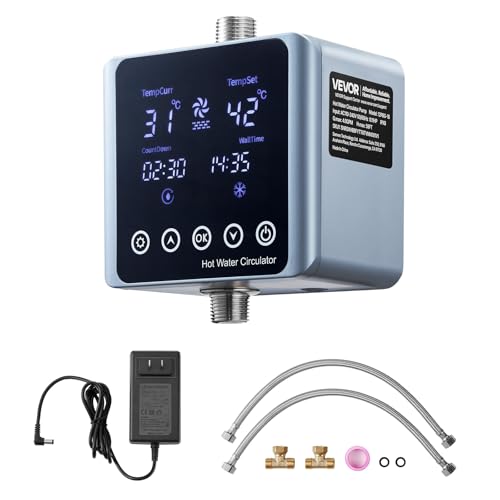
- Digital thermostat and timer
- Up to 4 GPM and 59-ft head
- Tank and tankless compatible
Best For: Programmable under-sink circulation across different heater types
Best for Manual or Automatic Modes
HBS24-12T Digital Recirculating Pump

- Manual and constant-temperature modes
- Up to 5.28 GPM flow
- Includes 10-foot power cord
Best For: Under-sink setups needing manual and automatic operation
Remote-Control Pick – HBS24-12E Recirculating Pump
If you want a demand hot water recirculation system you can start only when needed, the HBS24-12E includes a remote controller. The maker says to start it about 2–3 minutes before using hot water from a cold start; it can also run continuously.
Best For: Households that prefer remote-activated circulation over a preset schedule.
Pros:
- Included remote starts the pump without leaving it running constantly.
- Built-in thermostat uses two temperature sensors.
- Rated at 6.1 GPM with a maximum lifting height of 39.3 feet.
Cons:
- Hot water may still take 2–3 minutes from a cold start.
- This version does not include the 60-minute extension feature.
The remote is the main reason to choose this model: it gives you direct control, provided you can start it shortly before you need hot water.
Timer Kit Pick – Stainless Steel Bypass Pump Kit
This demand hot water recirculation system pairs a programmable timer with a thermal bypass valve, so you can schedule circulation before regular morning showers. It is designed for standard tank-type water heaters and does not require a dedicated return line.
Best For: Homeowners with a tank-type water heater and predictable hot-water routines.
Pros:
- Programmable timer can run the pump ahead of scheduled use.
- Includes a 304 stainless steel bypass valve and 20-inch PEX supply lines.
- Kit includes adapters and Teflon tape for installation.
Cons:
- Not compatible with tankless water heaters.
- A preset timer is less flexible for unpredictable hot-water use.
Choose this kit if your routine makes scheduling useful. Check your heater type first: the stated tankless incompatibility is a firm limitation.
Digital Thermostat Pick – HBS24-12T Under-Sink Pump
For a demand hot water recirculation system with adjustable temperature and timing, the HBS24-12T combines a digital display, built-in thermostat, and timer. It is designed to sit beneath the farthest faucet in a plumbing loop and is listed for both tank and tankless water heaters.
Best For: Buyers who want under-sink installation and control over temperature and operating times.
Pros:
- Digital controls offer scheduled operation and a selectable temperature setting.
- Smart temperature mode shuts the pump off when water reaches the set temperature.
- Listed for tank and tankless heaters; rated maximum flow is 5.28 GPM.
Cons:
- Requires space beneath the farthest faucet in each loop.
- Check the listed hose and fitting sizes against your plumbing before installation.
This model offers more setup control than a simple switch-activated pump. Its fit depends on having a suitable under-sink location and compatible connections.
Best for Flexible Heater Setups – VEVOR Digital Under-Sink Recirculating Pump
The VEVOR kit is a demand hot water recirculation system to consider if you want digital scheduling and temperature control at the sink farthest from your heater. Its built-in thermostat and check valve help circulate water until the selected temperature is reached, then shut the pump off.
Best For: Homes seeking an under-sink kit compatible with tank or tankless water heaters.
Pros:
- Digital screen, timer, thermostat, and memory for your last settings.
- Rated for up to 4 GPM flow and 59 feet of head.
- Installs under the farthest faucet without pipe modifications, according to the supplied instructions.
Cons:
- Requires corded power at the installation location.
- Temperature- and timer-based operation is not the same as a dedicated push-button demand control.
This is a practical choice when programmable operation and broad heater compatibility matter more than push-button activation. Check that your under-sink space and outlet placement suit the installation.
Best for Manual or Automatic Modes – HBS24-12T Digital Recirculating Pump
The HBS24-12T is a demand hot water recirculation system option for buyers who want a choice between manual and temperature-controlled operation. It mounts under the farthest faucet in a loop and uses a digital display, thermostat, and timer to manage circulation.
Best For: Households that want manual control alongside an automatic constant-temperature mode.
Pros:
- Offers manual and constant-temperature operating modes.
- Rated for up to 5.28 GPM flow and 39.3 feet of head.
- Includes a 10-foot cord, connection hoses, brass tee, and washers.
- Built-in check valve and automatic freeze-protection feature.
Cons:
- Requires corded power near the under-sink installation point.
- The stated 2–3-minute cold-start wait is not instantaneous at the faucet.
The manual mode makes this kit worth a look if you do not want to rely solely on a temperature schedule. Its automatic mode instead restarts circulation when water falls below the set point and stops at the selected temperature.
How We Picked the Best Demand Hot Water Recirculation System
We focused on the differences buyers can use to narrow the field: activation method, thermostat and timer controls, included hoses or supply lines, and where the pump and valve are intended to go. The product names identify some useful features, but they do not establish measured wait times, noise levels, or compatibility with every plumbing layout. Check the current listing and installation manual for those details before ordering.
Quick Comparison
The HBS24-12E is the option to investigate first if you want remote activation; note that the selected version is labeled as having no 60-minute extension. The unnamed stainless-steel sensor-valve kit emphasizes its 304 stainless steel valve and 20-inch PEX supply lines. The generic Digital Smart kit, the VEVOR Digital Smart kit, and the HBS24-12T all list a built-in thermostat, timer, digital screen, and under-sink installation. Compare their manuals and included components rather than assuming similarly named controls work identically.
Key Buying Factors for a Demand Hot Water Recirculation System
Activation and Run Time
Decide whether you want to trigger circulation when needed or schedule it around predictable routines. A remote can suit irregular use; a timer may suit consistent mornings and evenings. Thermostats can help control when the pump stops circulating, but temperature settings and operating behavior vary. If you specifically want water circulated only after a button press, verify that the kit supports that mode: a timer-equipped pump is not necessarily a true on-demand system.
Plumbing Compatibility
Check whether your home has a dedicated hot-water return line or whether the kit uses a crossover or sensor valve beneath a sink. Confirm the intended installation location, pipe connections, available clearance, and access to power. If a kit routes cooled water through the cold line, ask whether a brief period of warm water at a cold tap would bother you. Also check the manufacturer’s requirements if you use a tankless heater or have a thermostatic mixing valve.
What Is in the Box
Measure the distance to your existing shutoff valves before relying on included 15-inch hoses or 20-inch supply lines. Verify connector sizes, valve material, power-cord reach, and whether any fittings must be purchased separately. Listed hose length alone does not guarantee a straightforward installation.
Who Should Buy Which Demand Hot Water Recirculation System?
Start with the HBS24-12E if remote operation is your priority and its stated run-time behavior suits you. Consider the stainless-steel sensor-valve kit if its valve and longer included PEX lines fit your layout. Choose among the generic Digital Smart, VEVOR, and HBS24-12T kits if you prefer a digital display with thermostat and timer controls; let verified compatibility, included parts, and warranty terms break the tie. If you already have a dedicated return line, confirm that any under-sink kit is designed for it before buying.