The best pipe cutters make clean, controlled cuts with less effort than a hacksaw and leave tubing ready for fitting or joining. The right choice depends on the material, outside diameter, workspace, and cutting volume.
This roundup compares compact tubing cutters, ratcheting plastic-pipe tools, heavy-duty steel models, and powered options so you can match the cutter to your plumbing, repair, or fabrication work.
Best 10 Pipe Cutters Picks for 2026
Best Close-Quarters Pick
RIDGID Model 101 Tubing Cutter

- Compact for tight spaces
- Cuts several tubing materials
- Includes a spare cutter wheel
Best For: Small-diameter tubing and confined plumbing areas
Best Heavy-Duty Range

- Handles tubing up to 2 inches
- Six rollers support stable cuts
- Includes a deburring reamer
Best For: Broad-range metal tubing work and maintenance
Best Feature-Rich Tubing Cutter
RIDGID Model 150 Tubing Cutter

- Cuts tubing from 1/8 to 1-1/8 inches
- Includes a fold-away reamer
- Offers tool-free wheel changes
Best For: Repeated cuts on small metal tubing and conduit
Best PVC and PEX Pick
Klein Tools Ratcheting Pipe Cutter

- Cuts PVC, CPVC, and PEX
- Supports one-handed ratcheting cuts
- Handles pipe up to 2 inches ID
Best For: Plastic-pipe installation and repair
Best for Easy Setup
RIDGID Model 118 AUTOFEED Cutter

- Cuts 1/4- to 1-1/8-inch metal tubing
- Compact 2-in-1 close-quarters design
- AUTOFEED supports easier operation
Best For: Professionals working with small metal tubing in restricted spaces
Best Large Plastic-Pipe Pick
LIBRATON 2-1/2-Inch Ratchet Cutter

- Cuts plastic pipe and hose up to 63 mm
- Ratchet drive helps reduce hand effort
- Tool-free quick-change blade system
Best For: Cutting larger PVC, PEX, and related plastic pipe or hose
Best Powered Copper-Tubing Pick

- Automatically adjusts from 3/8 to 1 inch
- 500 RPM motor enables fast cutting
- Works in spaces 1-1/2 inches from a wall
Best For: Fast, low-clearance copper-pipe cutting with an M12 battery
Best Heavy-Duty Pick
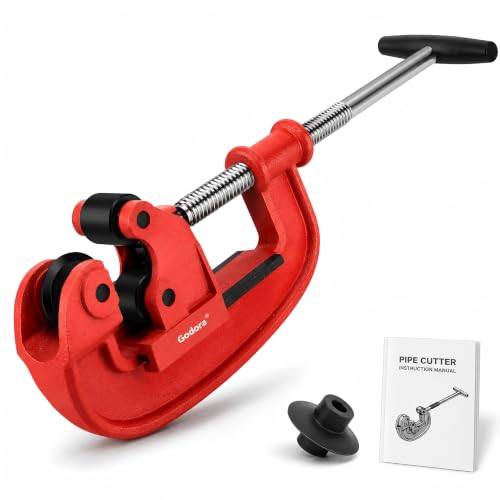
- Cuts 1–3 inch iron and steel pipe
- Ball-bearing feed for smooth rotation
- Includes an extra cutting wheel
Best For: Large steel and iron pipe jobs
Best Ratcheting Option

- Cuts PVC, PEX, and hoses up to 2-1/2 inches
- Ratchet mechanism reduces hand strain
- Lightweight aluminum-alloy and ABS handle
Best For: Plastic plumbing and hose cutting
Best Versatile Set

- Handles tube sizes from 1/8 to 2 inches
- Includes mini and full-size cutters
- Adds a high-speed-steel deburring tool
Best For: Mixed-size copper, aluminum, and PVC work
Best Close-Quarters Pick – RIDGID Model 101 Tubing Cutter
For tight plumbing spaces and small-diameter tubing, the RIDGID Model 101 is a compact pipe cutter designed for controlled manual cutting. Its 1/4- to 1-1/8-inch capacity covers several common metal and plastic tubing applications.
Best For: Plumbers and DIY users working in confined spaces with copper, aluminum, brass, or plastic tubing.
Pros:
- Compact design made for close-quarters work
- Works with multiple tubing materials
- Knurled feed screw helps control cutting pressure
- Includes a spare cutter wheel and lifetime defect warranty
Cons:
- Limited to tubing from 1/4 to 1-1/8 inches
- Less suitable for larger pipe sizes
This is a practical choice when access is the main challenge. Its narrow size and lightweight steel construction prioritize maneuverability over broad capacity.
Best Heavy-Duty Range – TOLESA 2-Inch Pipe Cutter
The TOLESA is a wide-range pipe cutter for users who need to handle tubing from 3/16 to 2 inches outside diameter. Its aluminum-alloy body, six ball-bearing rollers, and included reaming tool support stable cuts and cleaner finished edges.
Best For: Plumbing, HVAC, automotive, and maintenance work involving copper, aluminum, stainless steel, and other metal tubing.
Pros:
- Broad 3/16- to 2-inch cutting range
- Six rollers help stabilize the pipe during cutting
- Includes an inside-and-outside deburring tool
- Aluminum-alloy body is compact and lightweight for its capacity
Cons:
- Designed for metal pipe and tubing rather than plastic pipe
- Small burrs may still occur before reaming
Choose this model when versatility and size range matter more than having a specialized close-quarters tool. The integrated reamer adds useful finishing capability after each cut.
Best Feature-Rich Tubing Cutter – RIDGID Model 150 Tubing Cutter
RIDGID 31622 Model 150 Constant Swing Tubing Cutter, 1/8-Inch to 1-1/8-Inch Tube Cutter
Check Price On AmazonThe RIDGID Model 150 combines a 1/8- to 1-1/8-inch capacity with features intended to make repeated tubing cuts easier. Its enclosed feed screw helps resist clogging, while the ergonomic knob and fold-away reamer add convenience on the job.
Best For: Users cutting copper, brass, aluminum tubing, or thin-wall conduit who want quick wheel changes and built-in reaming.
Pros:
- Wide small-tubing range starting at 1/8 inch
- Enclosed feed screw helps reduce clogging and jamming
- Tool-free cutter wheel changes with the X-CEL pin
- Includes a fold-away reamer and spare wheel
Cons:
- Not intended for large pipe sizes beyond 1-1/8 inches
- Heavier and longer than a highly compact close-quarters cutter
With its built-in reamer, spare wheel, and quick-change design, this is a strong everyday option for users who value convenience during multiple tubing cuts.
Best PVC and PEX Pick – Klein Tools Ratcheting Pipe Cutter
For plastic pipe installations, the Klein Tools 50080 is a ratcheting pipe cutter built for one-handed operation. It cuts Schedule 40 and 80 PVC, CPVC, and PEX up to 2 inches inside diameter, with a jaw designed to hold different pipe sizes.
Best For: Homeowners, plumbers, handymen, and electricians cutting PVC, CPVC, and PEX pipe.
Pros:
- Ratcheting action supports one-handed cutting
- Handles PVC, CPVC, and PEX
- Cuts up to 2-inch inside-diameter pipe
- Soft-molded handles provide a comfortable grip
Cons:
- Designed for plastic pipe rather than metal tubing
- Heavier than some compact manual tubing cutters
This is the most suitable choice in the group for common plastic-pipe installation work. Its ratcheting mechanism and optimized jaw make it convenient when repeated cuts or limited hand positioning are concerns.
Best for Easy Setup – RIDGID Model 118 AUTOFEED Cutter
For compact plumbing work, this RIDGID tubing cutter is a specialized option among pipe cutters. It handles 1/4- to 1-1/8-inch copper, brass, and aluminum tubing, while its 2-in-1 close-quarters design and AUTOFEED function help simplify cuts where workspace is limited.
Best For: Professionals cutting smaller metal tubing in tight spaces.
Pros:
- Works with copper, brass, and aluminum tubing from 1/4 to 1-1/8 inches.
- Compact close-quarters design suits restricted work areas.
- AUTOFEED and ergonomic grip support convenient operation.
Cons:
- Its 1-1/8-inch maximum capacity is smaller than larger pipe cutters.
- Designed for metal tubing rather than PVC or PEX pipe.
The RIDGID Model 118 is a focused choice when access and maneuverability matter more than broad diameter coverage. Choose it for small metal-tubing jobs, particularly in professional plumbing applications.
Best Large Plastic-Pipe Pick – LIBRATON 2-1/2-Inch Ratchet Cutter
For larger plastic pipe and hose, this LIBRATON ratcheting tool offers a 2-1/2-inch capacity. Its SK5, Teflon-coated blade and ratcheting drive are designed for PVC, CPVC, PP-R, PEX, PE, and rubber hose, making it one of the more versatile pipe cutters for home and trade use.
Best For: Home handymen, plumbers, electricians, and mechanics cutting plastic pipe and hose up to 63 mm.
Pros:
- Handles pipe and hose up to 2-1/2 inches or 63 mm in outside diameter.
- Ratchet action and spring-loaded ergonomic handle help reduce cutting effort.
- Quick-change blade system allows tool-free blade replacement.
- Safety lock helps secure the cutter during storage.
Cons:
- Replacement blade is not included.
- The blade is consumable and service life varies by material.
- Proper alignment is important for straight cuts, especially on thin pipe.
The LIBRATON is a practical high-capacity choice when you need to cut several types of plastic pipe or hose. Its ratcheting mechanism favors controlled, lower-effort cuts, while the replaceable blade helps support continued use.
Best Powered Copper-Tubing Pick – Milwaukee M12 Cordless Cutter
If speed is a priority, the Milwaukee 2471-20 brings cordless power to copper-tubing work. This M12 pipe cutter automatically adjusts across 3/8- to 1-inch Type K, L, and M copper pipe, with a 500 RPM motor and a sealed, water-resistant head for plumbing applications.
Best For: Plumbers and maintenance users who need fast cuts on copper pipe in low-clearance areas.
Pros:
- Automatically adjusts for 3/8- to 1-inch copper pipe.
- 500 RPM motor is designed to work faster than manual cutters or saws.
- Low-clearance design works with piping as close as 1-1/2 inches from a wall.
- Compatible with Milwaukee M12 REDLITHIUM batteries.
Cons:
- Battery and charger are not included; this is a power-tool-only package.
- Intended for copper pipe rather than plastic pipe or larger metal tubing.
- Cordless operation requires a compatible M12 battery.
The Milwaukee is a strong fit for repetitive copper cuts where speed and access are more important than a manual tool’s simplicity. Existing M12 users get the most convenient setup, but new users need to account for the separate battery requirement.
Best Heavy-Duty Pick – 1–3 Inch Steel Pipe Cutter
For larger iron and steel pipe, this heavy-duty pipe cutter offers a 1- to 3-inch outside-diameter range, smooth bearing-assisted feeding, and an extra-long handle for added leverage. Its alloy steel wheel is designed to produce straight, burr-free cuts without rework.
Best For: Plumbers, metalworkers, construction work, and DIY projects involving iron or steel pipes.
Pros:
- Handles larger 1- to 3-inch iron and steel pipes.
- Ball-bearing feed mechanism supports smooth, controlled rotation.
- Extra-long handle adds leverage and includes a replacement cutting wheel.
Cons:
- Not suitable for copper or aluminum pipes.
- At 6.25 pounds, it is heavier than compact pipe cutters.
This is a practical choice when cutting capacity and leverage matter more than portability. Choose it for steel and iron pipe work, but use a different cutter for softer nonferrous materials.
Best Ratcheting Option – 2-1/2 Inch PVC Pipe Cutter
This ratcheting pipe cutter is built for plastic plumbing materials, including PVC, PEX, PPR, PE, rubber pipe, and hoses up to 2-1/2 inches in outside diameter. Its SK5 blade and ratchet mechanism help create smooth cuts with less hand and wrist strain.
Best For: Plumbing projects that involve PVC, PEX, plastic hoses, and other supported nonmetallic pipes.
Pros:
- Supports pipe and hose diameters up to 2-1/2 inches.
- Ratchet design applies cutting pressure progressively.
- SK5 blade and aluminum-alloy body balance durability with lighter weight.
Cons:
- Designed for plastic and rubber materials rather than metal pipe.
- Requires careful alignment and a tightened blade for straight cuts.
For plastic pipe installations, the ratchet action makes this a more comfortable alternative to a basic squeeze cutter. Follow the alignment guidance to help maintain a clean, even cut.
Best Versatile Set – Dual-Size Tube Cutter Kit
This tube cutter set is a flexible option for mixed small- and medium-diameter work. It includes a large cutter for 3/16- to 2-inch outside-diameter pipe, a mini cutter for 1/8- to 7/8-inch pipe, and a high-speed-steel deburring tool for finishing cut edges.
Best For: Professionals and DIY users who work with copper, aluminum, PVC, and varied tube sizes.
Pros:
- Covers two useful size ranges from 1/8 inch to 2 inches.
- Includes a dedicated deburring tool for post-cut cleanup.
- Heat-treated alloy steel construction is designed for durability.
Cons:
- Maximum capacity is 2 inches, smaller than a large 3-inch pipe cutter.
- Includes multiple tools rather than a single compact cutter.
The combination of two cutters and a deburring tool makes this a strong all-around kit when material and tube diameter vary. It is especially useful when clean, finished edges are part of the job.
How We Picked These Pipe Cutters
We focused on cutting range, material compatibility, handling, adjustment method, durability, and the quality of features that affect real-world use. The selection includes tools for copper, brass, aluminum, PVC, CPVC, PEX, PPR, plastic hose, and steel pipe, rather than treating every cutter as interchangeable.
We also considered whether a cutter suits tight spaces, repeated cuts, occasional household repairs, or heavier professional work. Replaceable blades, spare cutting wheels, reaming tools, ratcheting mechanisms, and battery requirements were included where they meaningfully affect ownership.
Quick Comparison
| Best For | Recommended Type | What to Look For |
|---|---|---|
| Copper and small metal tubing | Compact or constant-swing tubing cutter | Accurate adjustment and a clean cutting wheel |
| Tight installation spaces | Close-quarters cutter | Short handle, compact body, and smooth operation |
| PVC, CPVC, PEX, and hose | Ratcheting plastic-pipe cutter | Correct capacity, sharp replaceable blade, and secure locking |
| Large or rigid pipe | Heavy-duty steel cutter | Rated diameter range, sturdy frame, and replacement blades |
| Fast repeated copper cuts | Powered cutter | Compatible battery platform, speed control, and access clearance |
Key Buying Factors for Pipe Cutters
Material and Diameter
Check the pipe’s outside diameter, not just its nominal size. A copper tubing cutter and a ratchet PVC cutter use different blade designs, and neither should be assumed suitable for steel or rigid plastic. Choose a tool whose rated range comfortably covers your pipe size.
Cutting Access
Close-quarters models are valuable when tubing is installed near walls, fittings, or other obstructions. A larger framed cutter may be easier to turn in open space, while a powered model can save time when many cuts are required.
Effort and Cut Quality
Ratcheting handles reduce hand strain on plastic pipe. For metal tubing, a precise adjustment screw and sharp wheel help prevent crushing, excessive burrs, or an uneven cut. After cutting, deburr metal tubing and inspect plastic pipe for deformation before making a joint.
Maintenance and Ownership
Replaceable wheels or blades extend tool life. Look for spare parts availability, a reaming feature when needed, comfortable grips, and a locking mechanism that protects the blade during storage. Powered tools should also be evaluated with the cost of batteries and chargers.
Who Should Buy Which Pipe Cutters?
Homeowners handling occasional copper repairs should favor a compact, easy-to-adjust tubing cutter. Plumbers working in confined spaces will benefit from a close-quarters design, while professionals making frequent copper cuts may prefer the speed of a powered cutter.
For PVC, CPVC, PEX, and hose, choose a ratcheting cutter sized for the largest pipe you expect to handle. If your work includes steel or unusually large diameters, select a dedicated heavy-duty pipe cutter instead of forcing a general-purpose tubing tool beyond its rating. A multi-piece set makes sense for varied household or workshop tasks, provided each included cutter matches the materials you use.