The right solar charge controller can make a portable power setup safer, more efficient, and easier to monitor. The best choice depends on your panel wattage, battery chemistry, system voltage, and available space.
We compared 10 portable solar charge controllers across MPPT and PWM designs, current ratings, weather resistance, display options, connectivity, and battery compatibility to help you choose with confidence.
Best 10 Portable Solar Charge Controllers Picks for 2026
Best Smart Monitoring

- 15A MPPT controller for 12V/24V systems
- Bluetooth app monitoring and configuration
- Synchronized charging and configurable load output
Best For: Compact systems needing detailed app-based monitoring
Best USB-C Portable Option
Togo POWER 60W Solar Charge Controller

- USB-C output rated up to 60W
- DC7909 and Anderson solar inputs
- Compact 0.16-lb design for travel
Best For: Charging USB electronics in portable outdoor setups
Best High-Capacity Smart Controller
Victron SmartSolar MPPT 100/50

- 50A MPPT charging for 12V/24V systems
- 100V solar input rating
- Bluetooth monitoring with synchronized-controller support
Best For: Higher-output systems needing expandable smart charging
Best Weatherproof 12V Controller
SOLPERK 8A Solar Charge Controller

- IP67 waterproof housing for outdoor use
- 8A controller for 12V batteries and panels
- LED status lights and six listed safety protections
Best For: Small exposed 12V vehicle, boat, or RV setups
Compact MPPT Pick
SunRock 10 10A MPPT Controller

- MPPT charging for 12V systems
- LCD display with LED status light
- SAE connectors and multiple protections
Best For: Portable 12V AGM, gel, lead-acid, or LiFePO4 setups
Weather-Ready Choice
SOLPERK 10A 12V MPPT Controller

- Compact MPPT design for 12V batteries
- IP67 waterproof rating noted
- SAE plug-and-play connection
Best For: Simple outdoor 12V battery charging with LED monitoring
USB-Ready Value
12V 20A PWM Controller with LCD
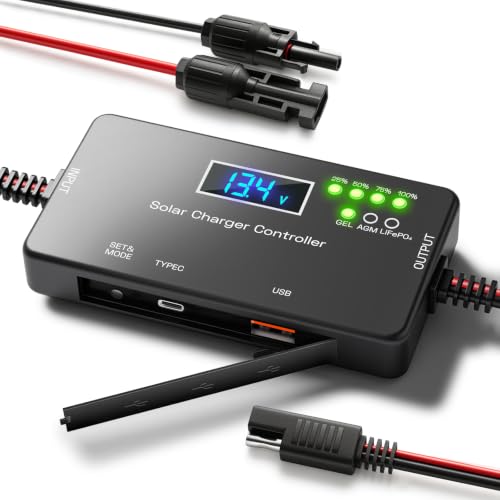
- Supports panels up to 300W
- LCD shows voltage and charge level
- 22W USB-C and 18W USB charging
Best For: 12V outdoor setups needing direct phone and light charging
Best 12V Compact Pick
SUNAPEX 10A MPPT Solar Charge Controller
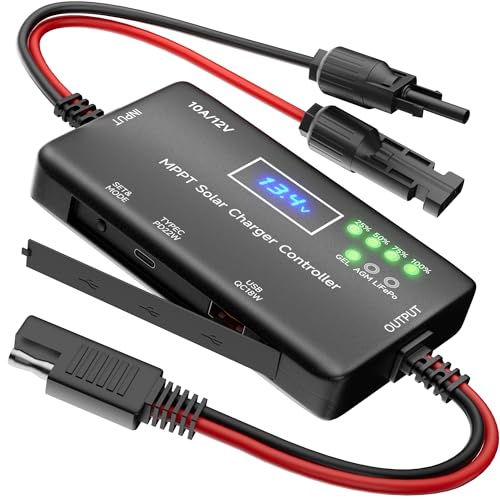
- 12V-only controller with 10A charging
- LCD, LED, USB, and Type-C outputs
- Supports AGM, Gel, lead-acid, and LiFePO4
Best For: Portable 12V solar setups with direct device charging
Best Plug-and-Play Value
iSunergy 20A 12V/24V MPPT Controller

- Supports both 12V and 24V batteries
- 20A capacity with SAE extension cables
- LCD, LED, and IP45-rated construction
Best For: Portable dual-voltage AGM, Gel, and LiFePO4 systems
Best Simple Pick

- App-based remote monitoring and custom settings
- 20A MPPT support for 12V and 24V systems
- Compatible with multiple AGM, lead-acid, and LiFePO4 types
Best For: Users wanting app control and adjustable charging parameters
Best Smart Monitoring – Victron SmartSolar MPPT 75/15
For portable solar charge controllers in a compact battery-charging setup, the Victron SmartSolar MPPT 75/15 combines MPPT tracking with Bluetooth connectivity. Its 15A rating and 12/24V support make it a practical choice for smaller solar systems where monitoring and configurable charging matter.
Best For: Users who want app-based monitoring, adjustable settings, and efficient charging for a compact 12V or 24V solar-battery system.
Pros:
- MPPT tracking is designed to maximize available solar power, including during partial shading.
- Bluetooth and the VictronConnect app provide real-time data, performance history, settings, firmware updates, and alarms.
- Supports synchronized operation with multiple SmartSolar MPPT controllers.
- Configurable load output can disconnect loads when battery voltage falls too low.
Cons:
- The 15A rating is intended for smaller systems rather than high-output installations.
- Its compact display setup relies on app connectivity for detailed monitoring.
Choose this controller when smart monitoring and MPPT efficiency are more important than maximum current capacity. The compact housing and 0.58 kg weight also suit portable installations.
Best USB-C Portable Option – Togo POWER 60W Solar Charge Controller
This Togo POWER unit is a portable solar charge controller focused on directly charging USB devices rather than managing a conventional battery bank. With DC7909 and Anderson inputs plus USB-A and USB-C outputs, it offers a compact way to keep electronics powered away from an outlet.
Best For: Travelers and outdoor users who need portable solar charging for USB-powered devices while keeping those devices away from the panel.
Pros:
- USB-C output supports up to 60W, while USB-A supports up to 24W.
- DC7909 and Anderson inputs work with compatible solar panels.
- Supports simultaneous charging of multiple devices.
- Includes temperature, overcharge, overcurrent, overload, and short-circuit protection.
Cons:
- It is designed for USB device charging, not described as a traditional battery charge controller.
- Output and compatibility depend on the connected panel and device.
- The product details list one total USB port despite describing both USB-A and USB-C outputs, so confirm the port configuration before buying.
At just 4.13 by 2.05 by 0.98 inches and 0.16 lb, this is one of the more travel-friendly portable solar charge controllers. It is best suited to phones, tablets, and other compatible USB electronics.
Best High-Capacity Smart Controller – Victron SmartSolar MPPT 100/50
For larger portable solar charge controllers and higher-output battery systems, the Victron SmartSolar MPPT 100/50 provides a 50A rating with 12/24V support. It combines MPPT tracking, Bluetooth configuration, and load management in a more substantial enclosure than the smaller 15A model.
Best For: Higher-output 12V or 24V systems that need 50A charging capacity, app-based control, and expandable synchronized charging.
Pros:
- 50A MPPT capacity suits more demanding solar-battery installations.
- 100V solar input rating provides room for compatible panel configurations.
- VictronConnect enables real-time data, 30-day history, configuration, firmware updates, and alarms.
- Can synchronize with multiple SmartSolar MPPT controllers and manage low-voltage load disconnect.
Cons:
- The 1.5 kg controller is less lightweight than compact portable alternatives.
- No built-in display is listed, so detailed system information depends on Bluetooth app access.
- Its larger capacity may be unnecessary for small portable panels or low-demand systems.
This is the stronger choice when a portable installation needs substantial charging capacity and room to expand. Verify panel and battery compatibility with the 100V and 50A specifications before installation.
Best Weatherproof 12V Controller – SOLPERK 8A Solar Charge Controller
The SOLPERK 8A is a straightforward option among portable solar charge controllers for 12V outdoor battery setups. Its IP67 waterproof construction, SAE connector, LED status indicators, and support for several battery types make it suited to exposed installations on vehicles, boats, and other outdoor equipment.
Best For: Outdoor 12V systems using rechargeable LiFePO4, AGM, GEL, or other compatible batteries where weather resistance and simple status feedback are priorities.
Pros:
- IP67 waterproof construction helps protect against rain, snow, and dust.
- Provides protection against reverse current, overheating, short circuits, overcharging, over-voltage, and reverse polarity.
- LED indicators show charging status and whether the battery is fully charged.
- Uses no battery power when there is no sunlight, according to the supplied specifications.
Cons:
- The 8A capacity and 12V-only design limit it to smaller, compatible systems.
- It does not list Bluetooth monitoring or advanced app configuration.
- Correct red-positive and black-negative wiring is required during installation.
With a 0.12 kg weight and an easy-connect SAE interface, the SOLPERK is a practical low-current controller for outdoor 12V applications. Its one-year warranty and lifetime technical support add reassurance for basic installations.
Compact MPPT Pick – SunRock 10 10A MPPT Controller
For portable solar charge controllers serving a 12V setup, the SunRock 10 combines MPPT charging with a compact design, LCD monitoring, and SAE plug-and-play connections. It supports PV input from 15V to 30V Voc and is intended only for 12V batteries.
Best For: Portable 12V systems using AGM, gel, lead-acid, or LiFePO4 batteries.
Pros:
- MPPT charging with a claimed tracking efficiency of up to 100%.
- LCD display and LED indicator help monitor panel and battery status.
- Includes two 130mm SAE extension cables for flexible setup options.
- Built-in protection against overcharge, over-temperature, over-voltage, over-current, short circuits, discharge, and reverse polarity.
Cons:
- Compatible only with 12V batteries.
- PV Voc must stay within the specified 15V minimum and 30V maximum range.
- The controller should not be submerged despite its outdoor waterproof design.
The SunRock 10 is a practical choice when portability, visible status information, and MPPT performance matter. Follow the required connection order—battery first, then solar panel—and verify panel voltage before installation.
Weather-Ready Choice – SOLPERK 10A 12V MPPT Controller
The SOLPERK is one of the more straightforward portable solar charge controllers for 12V battery systems. Its compact waterproof design, SAE port, LED indicators, and multiple protection functions make it suited to simple outdoor solar installations.
Best For: Users who want a compact, easy-to-connect controller for a 12V AGM, lead-acid, gel, deep-cycle, sealed, flooded, or LiFePO4 battery.
Pros:
- MPPT design is claimed to be 30% more efficient than PWM controllers.
- Compact, portable form factor with an IP67 waterproof rating noted in the product highlight.
- Three indicator lights show panel connection, battery connection, and full-battery status.
- SAE port supports simple plug-and-play installation.
Cons:
- Designed for 12V batteries only.
- Uses indicator lights rather than the more detailed LCD readout found on some controllers.
- Rated at 10A, limiting its suitability for higher-current systems.
Choose the SOLPERK when uncomplicated installation and compact outdoor use are priorities. Its LED system provides basic status information, while the built-in protections add reassurance for routine 12V charging.
USB-Ready Value – 12V 20A PWM Controller with LCD
This 20A PWM unit stands out among portable solar charge controllers by pairing an LCD with direct device-charging ports. It supports 12V LiFePO4, AGM, and gel batteries, accepts solar panels up to 300W, and uses quick-connect wiring for RV, boat, shed, and outdoor applications.
Best For: 12V users who want battery monitoring and built-in USB-C and USB fast charging for phones, tablets, or camping lights.
Pros:
- Supports up to 300W of solar input in a 12V system.
- LCD shows battery voltage and charge levels at 25%, 50%, 75%, and 100%.
- Includes 22W USB-C PD and 18W USB QC3.0 charging ports.
- Six listed protections include overcharge, over-voltage, short circuit, reverse polarity, over-temperature, and nighttime anti-leakage.
Cons:
- PWM charging is less efficient in design than MPPT alternatives.
- Not compatible with 24V or 36V batteries.
- Battery must be connected before the solar panel during setup.
The main advantage here is versatility: the controller combines clear battery information with convenient device charging. It is a strong fit for compact 12V gear, provided you do not need MPPT operation or a higher-voltage battery system.
Best 12V Compact Pick – SUNAPEX 10A MPPT Solar Charge Controller
For portable solar charge controllers built around a 12V battery, the SUNAPEX combines a compact design with an LCD status display, USB and Type-C outputs, and four-stage charging. It is compatible with 12V lead-acid, Gel, AGM, and LiFePO4 batteries, but it must not be used with 24V or 36V battery packs.
Best For: Portable 12V solar setups that need direct device charging and simple battery monitoring.
Pros:
- Supports 12V AGM, Gel, lead-acid, and LiFePO4 batteries.
- LCD and LED indicators show battery voltage, current, and charging status.
- Includes USB and Type-C outputs for compatible devices.
- Offers overcharge, reverse-polarity, short-circuit, and over-temperature protection.
Cons:
- Limited to 12V battery systems and 10A charging.
- Not compatible with solar panels that have built-in controllers.
- Requires correct polarity and the specified connection sequence.
The SUNAPEX is a practical choice when portability, straightforward status checks, and built-in device charging matter more than support for larger or higher-voltage systems.
Best Plug-and-Play Value – iSunergy 20A 12V/24V MPPT Controller
The iSunergy is one of the more flexible portable solar charge controllers here because it supports both 12V and 24V battery systems. Its SAE connections, included extension cables, LCD display, and IP45 protection suit compact solar installations, provided the solar panel voltage limits are observed.
Best For: Users who want a portable 20A controller for either 12V or 24V AGM, Gel, or LiFePO4 systems.
Pros:
- Works with 12V and 24V battery systems.
- 20A rating supports more charging capacity than a 10A unit.
- Includes two 6.7-inch SAE extension cables for flexible setup.
- Provides LCD and LED monitoring plus overheat, overcharge, and reverse-polarity protection.
Cons:
- Panel open-circuit voltage must stay below 30V with a 12V battery or 60V with a 24V battery.
- Uses three-stage charging rather than the four-stage approach of some alternatives.
- The battery must be connected before the solar panel.
With dual-voltage support and useful included cables, this iSunergy model is a strong middle-ground option for portable systems that may change between 12V and 24V configurations.
Best Simple Pick – Bateria Power Sunrock 20Pro
For portable solar charge controllers with remote oversight, the Bateria Power Sunrock 20Pro adds phone-app monitoring and customizable charging settings to a 20A, 12V/24V MPPT design. It supports several battery types, but the solar input must not exceed 60V and the unit is not intended for higher-voltage batteries.
Best For: Solar users who want app-based monitoring and adjustable charging parameters for 12V or 24V batteries.
Pros:
- Phone app enables remote monitoring of the controller and panel productivity.
- Customizable settings support specialized battery or usage requirements.
- Automatically supports 12V and 24V systems with a 20A MPPT rating.
- Works with AGM, Gel, sealed, flooded, lead-acid, and LiFePO4 batteries.
Cons:
- Not suitable for batteries above 24V.
- Solar input cannot exceed 60V.
- Requires battery-first installation and app setup for its smart features.
The Sunrock 20Pro stands out when remote visibility and user-adjustable charging matter. Its broader battery compatibility and 20A output make it more adaptable than a basic 12V controller.
How We Picked the Best Portable Solar Charge Controllers
We focused on controllers suited to compact solar systems, including camping kits, RVs, emergency backup setups, boats, and small off-grid installations. Our comparison considers charging technology, rated amperage, supported 12V or 24V systems, maximum photovoltaic input, battery compatibility, protection features, installation practicality, and monitoring options.
MPPT models generally offer better energy harvesting when panel voltage differs significantly from battery voltage or when conditions are less than ideal. PWM models can still be a sensible low-cost choice for smaller, straightforward systems with matched panel and battery voltages.
Quick Comparison
| What to Compare | Best For | What to Check |
|---|---|---|
| MPPT versus PWM | Efficiency versus simplicity | Panel voltage, battery voltage, and budget |
| Current rating | Matching controller capacity | Panel power divided by battery voltage, with headroom |
| Battery support | Lead-acid or lithium setups | LiFePO4, AGM, gel, and user-selectable profiles |
| Monitoring | Convenient system checks | LCD, LED indicators, or Bluetooth app access |
| Durability | Outdoor and mobile use | Water resistance, terminals, connectors, and ventilation |
Key Buying Factors for Portable Solar Charge Controllers
Match the Controller to Your Panel and Battery
Confirm the controller supports your battery voltage, usually 12V or 24V, and keep the panel’s open-circuit voltage below the controller’s maximum PV rating. The controller’s current rating should also exceed the array’s expected charging current. A little capacity headroom is preferable to running continuously at the limit.
Choose MPPT or PWM Deliberately
MPPT is usually the better fit for higher-voltage panels, variable sunlight, cold-weather operation, or users who want to maximize available energy. PWM may be adequate for a small matched panel and battery system where low cost and simple wiring matter most.
Verify Battery Chemistry and Protection
Look for a dedicated LiFePO4 setting if you use lithium iron phosphate batteries. For AGM, gel, or flooded lead-acid batteries, confirm the controller provides the appropriate charging profile. Reverse-polarity, overcurrent, overcharge, short-circuit, and temperature protections are valuable safeguards in portable systems.
Consider Installation and Monitoring
For mobile use, waterproof construction, secure terminals, compact dimensions, and compatible solar connectors can matter as much as efficiency. An LCD or Bluetooth connection is useful when you need to check voltage, charging current, battery status, or fault conditions without opening the system.
Who Should Buy Which Portable Solar Charge Controllers?
Choose a compact low-current controller for a small panel, trickle-charging application, or lightweight camping kit. An MPPT controller is the stronger choice for users prioritizing energy yield, running a higher-voltage panel, or building a more capable RV or backup system. Select a 20A or larger model when your panel array and battery bank require additional charging capacity.
If the controller will be exposed to rain, spray, dust, or frequent transport, prioritize a waterproof enclosure and robust connectors. If several people will use the system or you need quick troubleshooting, choose a model with an LCD or wireless app. Before installation, always follow the manufacturer’s wiring sequence and confirm every voltage and polarity rating.
