If you are looking for a tankless RV water heater review that focuses on real buyer tradeoffs, the RIWORY 65,000 BTU RV Tankless Water Heater is built around one clear promise: faster, steadier hot water in a replacement format that aims to fit common RV openings.
This RIWORY 65,000 BTU RV Tankless Water Heater review is most useful if you want a propane on-demand upgrade for a camper, travel trailer, or motorhome and care more about recovery, fit, and safety features than gimmicks.
RIWORY 65,000 BTU RV Tankless Water Heater Review Summary
The strongest case for this unit is straightforward: it is designed as a practical tankless replacement for many RV setups, with a claimed 65,000 BTU output, up to 3.9 GPM, dual water outlet support, and a 15×18 door size option.
That combination makes it a fit for owners who want longer showers, less waiting, and a more modern hot-water setup without jumping into a heavily custom project.
It is especially relevant for buyers replacing older tank heaters from brands like Suburban, Dometic, or Atwood, or for anyone who wants a propane heater that tries to balance comfort, safety, and installation convenience.
The listing also emphasizes anti-freezing protection, altitude tolerance, and a 12V DC electrical setup, which are all meaningful for RV use.
Review Scorecard
| Category | Score | Buyer assessment |
|---|---|---|
| Hot water output | 9/10 | 65,000 BTU and 3.9 GPM are strong on paper for an RV tankless unit. |
| RV fit and replacement value | 8/10 | The 15×18 door size and compatibility claims support upgrade-minded buyers. |
| Installation practicality | 8/10 | The included guide and accessory bundle reduce friction for a DIY install. |
| Safety features | 9/10 | The listed protections are broad and well aligned with RV risk factors. |
| Cold-weather readiness | 8/10 | Anti-freeze protection is a useful feature for seasonal and shoulder-season trips. |
| Ease of ownership | 7/10 | The on-demand format should help daily convenience, but RV tankless systems still require proper setup. |
Key Features and Specifications of RIWORY 65,000 BTU RV Tankless Water Heater
The key specification is the claimed 14,000 to 65,000 BTU operating range, with a maximum flow rate of 3.9 GPM.
For RV buyers, that is the headline feature because it speaks directly to how quickly the heater can deliver usable hot water.
The unit uses propane and DC 12V power, which is the normal direction for many RV tankless systems.
It also advertises automatic frequency conversion and staged combustion technology for higher combustion efficiency, with the listing claiming up to 90% efficiency.
That claim should be treated as the manufacturer’s positioning, but it does show the product is aimed at efficiency-conscious RV owners.
Compatibility is another important point.
The listing says the door components come in 15×15, 15×18, and 18×18 sizes, with this version centered on the 15×18 door.
It is marketed as a replacement or upgrade for Suburban, Dometic, and Atwood 4-16 gallon tank heaters, as well as other tankless brands.
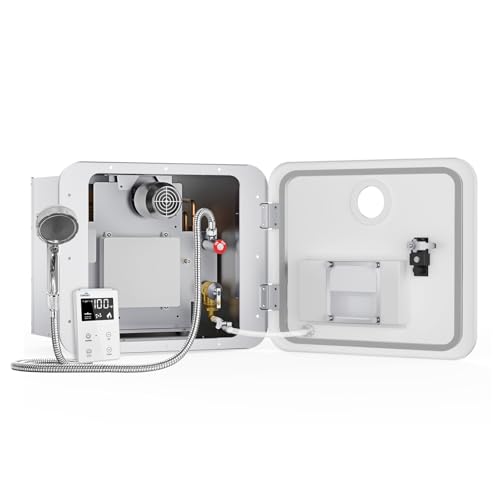
The package is unusually complete for a kit-style RV appliance.
Included items are listed as:
- Water heater unit
- Door assembly
- Pressure relief valve
- 196-inch wall remote controller
- Weather stripping
- Plumbing tape
- Mounting screw bag
- Gloves
The safety list is also extensive.
The listing references 10 protection features, including:
- CSA-certified pressure relief valve
- UL-certified thermal cut-out
- Top-mounted forced fan
- Anti-freeze protection
- Anti-scald protection
- Anti-dry combustion technology
- Waterproof design
For buyers comparing RV appliances, that bundle matters because it suggests the unit is not just a heater, but a replacement kit designed to reduce the number of extra parts you need to source separately.
Pros and Cons of RIWORY 65,000 BTU RV Tankless Water Heater
Pros
- Strong hot-water output for an RV-oriented tankless unit
- Dual water outlet design may help with flexibility in setup
- Broad replacement compatibility is useful for retrofit buyers
- Safety feature set is unusually detailed
- Installation kit includes multiple extras instead of only the bare unit
- Anti-freeze protection is relevant for colder travel conditions
Cons
- Tankless RV heaters are still installation-sensitive, even with a guide
- Performance depends on correct RV plumbing and power setup
- The listing makes efficiency claims that are hard to verify from specs alone
- Compatibility claims are broad, so buyers still need to confirm opening size and layout
Who Should Buy RIWORY 65,000 BTU RV Tankless Water Heater?
This product makes the most sense for RV owners replacing an aging tank heater who want a more modern on-demand setup.
If you already know you want propane hot water without the wait time of a tank, the listed output, fit options, and included hardware make this a practical candidate.
It is also a reasonable fit for campers who travel in mixed conditions and value anti-freeze protection and safety controls.
The altitude claim may matter if your routes include higher elevations, though buyers should still make sure the rest of their RV system is ready for that use case.
You should probably skip it if you want the simplest possible appliance swap, if you are not comfortable checking measurements carefully, or if your RV plumbing and venting situation is already tight.
Tankless replacement projects are usually more demanding than they first appear, even when the seller provides a useful installation guide.
How the RIWORY 65,000 BTU RV Tankless Water Heater Fits Real RV Use
Hot Water on Demand
The most compelling part of this product is the move from stored hot water to on-demand heating.
That matters in RV life because showers, dishwashing, and handwashing often happen in bursts rather than in a long predictable schedule.
A unit rated up to 3.9 GPM is aimed at reducing the feeling of rationing.
Replacement-Friendly Design
The 15×18 door configuration and compatibility claims are the real purchase drivers for retrofit buyers.
If the measurements line up, this can be a more practical upgrade path than trying to redesign the hot-water system from scratch.
That said, a buyer still needs to confirm opening size, venting, and plumbing before treating compatibility as guaranteed.
Safety and Cold-Weather Readiness
The safety bundle is one of the reasons this model stands out in listing form.
Anti-freeze, anti-scald, anti-dry combustion, and pressure-relief protections are the kinds of details that matter more in an RV than they do in a house, because the system may be exposed to travel vibration, seasonal storage, and changing climates.
Included Installation Package
The accessory pack improves the value proposition because it reduces the number of separate purchases needed to get started.
The remote controller, tape, stripping, and hardware make this look more like a complete replacement kit than a bare appliance, which is helpful for owners who want a smoother install process.
Alternatives to RIWORY 65,000 BTU RV Tankless Water Heater
If you want to compare before buying, look at other established RV tankless lines such as Furrion RV tankless water heaters, Girard RV tankless water heaters, and Suburban RV water heaters.
These are the kinds of options buyers commonly cross-shop when replacing an RV hot-water system.
If you want a broader search, also check Dometic RV water heaters and Atwood RV water heater replacement.
Those searches help you compare the RIWORY unit against more familiar RV names and decide whether you want tankless behavior or a more traditional replacement path.
Is RIWORY 65,000 BTU RV Tankless Water Heater Worth It?
Yes, if you want a feature-rich RV tankless replacement and your measurements match. The combination of 65,000 BTU output, 3.9 GPM flow, 12V operation, broad compatibility claims, and a full installation bundle makes this a serious candidate for owners upgrading an RV hot-water system.
It is less compelling if you want an easy, universal swap without checking fit carefully.
For the right RV owner, though, the listing points to a well-equipped propane tankless heater that is designed around practical replacement needs rather than just raw heating claims.
