Choosing the right mixing valve can make a radiant floor system more stable, comfortable, and efficient. The best option keeps supply water at a safe, usable temperature without constant adjustments.
Below, you’ll find a focused roundup of boiler mixing valves for radiant floors, with a buying guide to help you match the valve to your loop temperature, connection type, and system layout.
Best 10 Boiler Mixing Valves for Radiant Floors Picks for 2026
Stable 3-Way Control

- Maintains temperature through fluctuations
- 3-way thermostatic mixing valve
- Low-lead brass, NSF/ANSI 61 and NSF 372
Best For: Radiant floor setups needing steady mixed-water control
Certified Service-Friendly Mixer

- Dual ASSE 1070 and 1017 certification
- Straight-thru design eases maintenance
- Available in multiple connection types
Best For: Hydronic installs needing certified, easy-to-service mixing
Adjustable Temperature Pick
Caleffi 521500 3/4-inch Adjustable

- Adjustable 30-65 °C thermostatic control
- Anti-scale valve body
- Dezincification resistant alloy construction
Best For: Radiant systems needing adjustable mixed-water temperature
Lead-Free Union Choice
Honeywell AM101-US-1LF 3/4-inch

- Lead-free with NSF and RoHS compliance
- 3/4-inch sweat union connections
- 70°F to 145°F operating range
Best For: Simple radiant floor installs needing a lead-free union valve
Compact Thermostatic Mixing Valve

- Lead-free brass body with 1/2-inch union connections
- Adjustable outlet range from 80°F to 120°F
- Locking temperature setting with filter washers and check valves
Best For: Smaller radiant floor setups needing a compact, adjustable thermostatic valve
High-Flow Brass Mixing Valve
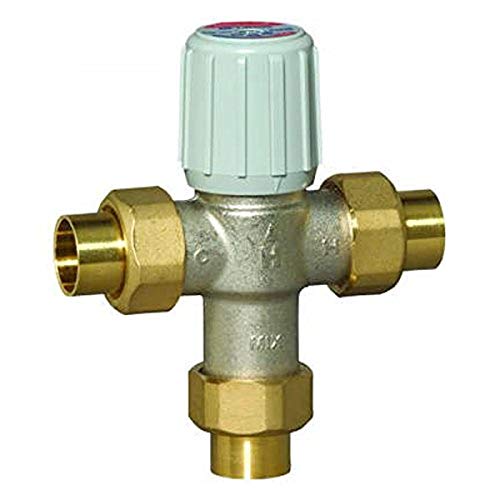
- Dual-purpose mixing or diverting valve
- 70°F to 145°F temperature range
- Lead-free brass body with sweat connections
Best For: Systems needing a wider-range mixing valve with sweat connections
DirectConnect Water Heater Kit

- Kit includes valve, tee, and 8-inch flex connector
- DirectConnect inlet connection type
- Thermostatic mixing valve in a three-piece bundle
Best For: Buyers wanting a bundled DirectConnect mixing valve kit
Point-of-Use Thermostatic Pick
Cash Acme 1/2 Inch HG110 Thermostatic Mixing Valve

- Adjustable 85°F to 130°F outlet range
- Lead-free brass with integral checks
- Tool-free installation for compatible tubing
Best For: Point-of-use hot water safety and compact plumbing installs
Hydronic Low-Temp Option
Radiant Mixing Valve DN20 Brass Thermostatic Valve

- Made for small floor heating circuits
- 35°C to 60°C thermostatic range
- Built-in anti-scald safety device
Best For: Small radiant floor circuits and low-temp hydronic systems
Boiler Source Control Choice
TEMLOCK 3/4 Inch Thermostatic Mixing Valve

- Designed for boilers and radiant floor heating
- Adjustable 100°F to 140°F range
- Includes 3/4-inch sweat fittings and check valves
Best For: Boiler-side hydronic mixing for radiant floors
Stable 3-Way Control – Caleffi 521509A 3/4" Sweat
For boiler mixing valves for radiant floors, this Caleffi thermostatic mixing valve is built to keep supply temperatures steady while compensating for both temperature and pressure fluctuations. Its 3-way design and sweat connections make it a straightforward option when you want reliable mixed-water control in a compact brass body.
Best For: Radiant floor systems that need stable mixed-water temperature with a simple 3/4-inch sweat setup.
Pros:
- Thermostatic design helps maintain temperature despite fluctuations
- 3-way valve layout suits mixing applications
- Low-lead brass construction with NSF/ANSI 61 and NSF 372 compliance
- 3/4-inch sweat inlet and outlet connections
Cons:
- Fixed thermostatic control, not an adjustable temperature range model
- Sweat-only connection style may not fit every install
Overall, this is a solid pick if you want dependable temperature regulation in a lead-conscious brass valve. It fits best in systems where consistent radiant floor supply temperature matters more than broad adjustment flexibility.
Certified Service-Friendly Mixer – Honeywell AM102C1070 1-inch
When comparing boiler mixing valves for radiant floors, the Honeywell AM102C1070 stands out for its proportional thermostatic control and dual ASSE 1070 and 1017 certification. The straight-thru layout, bronze construction, and multiple connection options make it a versatile choice for hydronic mixing applications where maintenance access matters.
Best For: Installations that need certified thermostatic mixing with flexible connection options and easy serviceability.
Pros:
- Dual ASSE 1070 and 1017 certification
- Proportional thermostatic control for mixed-water applications
- Straight-thru design with easy maintenance and element replacement
- Available with sweat, threaded, CPVC, PEX, Propress, and compression connections
Cons:
- Bulkier 1-inch valve may be more than small systems need
- Temperature range is tied to the model description and may not suit every application
For builders and service pros, this Honeywell valve offers a strong mix of certification, serviceability, and installation flexibility. It is especially appealing when the job calls for a proven mixing valve that can adapt to different connection types.
Adjustable Temperature Pick – Caleffi 521500 3/4-inch Adjustable
Caleffi 521500 Adjustable Thermostatic Mixing Valve 3/4 Inch 30-65 °C Anti-scale
Check Price On AmazonThis Caleffi model is a practical choice for boiler mixing valves for radiant floors when you want an adjustable thermostatic valve instead of a fixed setpoint design. It covers a 30-65 °C range, uses an anti-scale construction, and adds a dezincification resistant alloy body for durability in heating systems.
Best For: Systems that benefit from adjustable mixed-water temperature control and anti-scale protection.
Pros:
- Adjustable thermostatic mixing from 30-65 °C
- Anti-scale design helps reduce buildup
- Dezincification resistant alloy body for durability
- Chrome-plated finish and 3/4-inch size
Cons:
- Maximum working pressure and inlet temperature limits should be checked against the system
- Metric temperature range may require more careful setup
If your radiant floor project needs tunable supply temperature, this valve gives you useful adjustment without a complicated design. Its durability-focused materials make it a sensible option for long-term boiler mixing use.
Lead-Free Union Choice – Honeywell AM101-US-1LF 3/4-inch
For boiler mixing valves for radiant floors, this Honeywell lead-free sweat union valve offers a straightforward two-port mixing setup with a broad operating temperature range. The brass exterior, sweat connections, and NSF/RoHS compliance make it a practical fit when you want a simple union-style valve for hydronic work.
Best For: Radiant floor systems that need a lead-free sweat union mixing valve with a wide temperature range.
Pros:
- Lead-free design with NSF and RoHS specification compliance
- 3/4-inch sweat union connections for common hydronic installs
- Wide 70°F to 145°F operating temperature range
- Brass exterior finish and compact 2-port layout
Cons:
- Two-port mixing valve design is less feature-rich than some thermostatic models
- Temperature details are based on operating range rather than an adjustable setpoint description
This Honeywell valve is best when you want a simple, lead-conscious mixing component without extra complexity. It makes sense for installations that prioritize standard 3/4-inch sweat connections and a broad usable temperature span.
Compact Thermostatic Mixing Valve – Watts 1/2" LFMMVM1-US
For boiler mixing valves for radiant floors, this Watts thermostatic mixing valve is a compact option when you need controlled tempered water and a straightforward 1/2-inch connection size. Its lead-free brass body, adjustable outlet range, and locking temperature setting make it a practical pick for installations where stable supply temperature matters.
Best For: Smaller radiant floor setups or mixed-water applications that need a compact, field-adjustable thermostatic valve.
Pros:
- Lead-free brass construction
- Adjustable mixed-outlet range from 80°F to 120°F
- Locking mechanism helps secure the temperature setting
- Includes integral filter washers and check valves
Cons:
- 1/2-inch size may be limiting for larger system layouts
- Temperature range is narrower than some higher-range mixing valves
- Designed for tempered water supply, so verify fit for your hydronic application
This valve stands out for precise temperature control and simple connection details, but the narrower adjustable range means it is best matched to systems that do not need broad outlet-temperature flexibility.
High-Flow Brass Mixing Valve – Honeywell AM100US1LF 1/2"
If you’re comparing boiler mixing valves for radiant floors, this Honeywell model is built around constant temperature performance under changing operating conditions. Its sweat connections, lead-free construction, and dual-purpose mixing or diverting design make it a solid choice for systems that need dependable water-temperature control and a wider temperature range.
Best For: Installations that need a lead-free brass mixing valve with constant-temperature behavior and sweat connections.
Pros:
- Constant water temperature under changing operating conditions
- Dual-purpose mixing or diverting design
- Wide temperature range from 70°F to 145°F
- Lead-free brass with sweat inlet and outlet connections
Cons:
- Sweat connections may not suit every retrofit
- Not a dedicated radiant-floor kit
- Larger and heavier than some compact 1/2-inch valves
Overall, this is a flexible brass mixing valve for systems that benefit from a wider setpoint range and reliable temperature control, though it works best when sweat-style plumbing is already part of the plan.
DirectConnect Water Heater Kit – Honeywell AMX300 Series
Honeywell AMX300 Series DirectConnect Thermostatic Mixing Valves - AMX300T/U AMX300-c2
Check Price On AmazonFor boiler mixing valves for radiant floors, this Honeywell AMX300 Series kit is aimed at easier installation because it includes the valve, tee, and an 8-inch flex connector in one DirectConnect package. That bundled format can simplify setup when you want a thermostatic mixing valve kit rather than sourcing each piece separately.
Best For: Buyers who want a bundled thermostatic mixing valve kit with DirectConnect components included.
Pros:
- Includes valve, tee, and 8-inch flex connector
- DirectConnect inlet connection type
- Thermostatic mixing valve design
- Three-piece kit reduces the need to source parts separately
Cons:
- Outlet connection size is listed as 8 inches, so confirm compatibility before buying
- More of a kit than a standalone valve
- Details are limited compared with fully specified valve-only products
This kit is best viewed as a convenience-focused option: useful when bundled parts and DirectConnect compatibility matter more than having a simple standalone valve listing with full dimensional detail.
Point-of-Use Thermostatic Pick – Cash Acme 1/2 Inch HG110 Thermostatic Mixing Valve
If you need boiler mixing valves for radiant floors or other hot-water safety applications, the Cash Acme HG110 is geared more toward point-of-use temperature control. It delivers tempered water at a factory-set 120°F and can be adjusted from 85°F to 130°F, with lead-free brass construction and integral checks for dependable plumbing use.
Best For: Homes needing a compact thermostatic mixing valve for safe domestic hot water delivery rather than a dedicated hydronic floor-heating mixer.
Pros:
- Factory set to 120°F with adjustment range from 85°F to 130°F
- Lead-free brass body for durability
- Compatible with SharkBite copper tubing, CTS, CPVC, SDR-9 HDPE, and PEX fittings
- Quick installation with no tools, crimping, glue, or soldering required
Cons:
- Designed primarily for potable water safety, not specifically radiant floor manifolds
- 1/2-inch barb connections may not match larger boiler piping setups
This is a practical choice when the priority is scald protection and simple installation. For boiler mixing valves for radiant floors, the fit depends on your system layout, but its adjustable thermostatic control makes it a useful low-effort option in the right setup.
Hydronic Low-Temp Option – Radiant Mixing Valve DN20 Brass Thermostatic Valve
This radiant mixing valve is aimed more directly at boiler mixing valves for radiant floors and other small hydronic circuits. The 3-way DN20 brass thermostatic design is described for hot water circulation, small floor heating circuits, and solar water heater use, with a 35°C to 60°C temperature range and built-in anti-scald control.
Best For: Small radiant floor heating circuits and other low-temperature hydronic systems that need thermostatic blending.
Pros:
- Explicitly described for small floor heating circuits and hydronic applications
- 35°C to 60°C control range for low-temperature water delivery
- Built-in anti-scald safety device
- Brass construction with straightforward DN20 G-thread installation
Cons:
- Limited published specs compared with more established boiler controls
- Plastic components are included alongside brass construction
For buyers shopping boiler mixing valves for radiant floors, this model fits the application more closely than a general domestic mixing valve. Its low-temp range and small-circuit focus make it a sensible match where simple thermostatic blending is the main goal.
Boiler Source Control Choice – TEMLOCK 3/4 Inch Thermostatic Mixing Valve
For boiler mixing valves for radiant floors, the TEMLOCK valve is the most directly positioned of the three. It is designed for in-line temperature control at the hot water source, including boilers, solar water heaters, and radiant floor heating systems, with an adjustable 100°F to 140°F range and lead-free brass construction.
Best For: Boiler-side temperature mixing in radiant floor and other hydronic hot-water systems.
Pros:
- Explicitly intended for boilers, solar heaters, and radiant floor heating systems
- Adjustable 100°F to 140°F temperature range
- 3/4-inch sweat fittings with integral check valves included
- Lead-free brass and multiple compliance listings including ASME, NSF, and ASSE
Cons:
- Not intended for point-of-use sinks or showers
- Requires sweat connections, so installation is less plug-and-play than barb-style options
If you want a mixing valve that aligns with boiler-side hydronic control, this is the strongest match in the lineup. Its source-mounted design and radiant-floor compatibility make it a practical choice when choosing boiler mixing valves for radiant floors.
How We Picked These Boiler Mixing Valves for Radiant Floors
We focused on valves that are commonly used in hydronic heating, with attention to temperature control range, lead-free or low-lead construction, connection style, and whether the valve suits a point-of-source or system-mixing application. We also favored models with practical installation formats such as sweat, union, threaded, crimp, and direct-connect configurations.
Quick Comparison
The main difference between these Boiler Mixing Valves for Radiant Floors is how they connect and how much temperature control they offer. Some are compact 1/2-inch or 3/4-inch thermostatic valves for smaller zones, while others are better suited to higher-flow applications or easier service access. A few are designed for anti-scald use, but the core buying question is still the same: can the valve reliably blend hot boiler water down to a stable radiant-floor supply temperature?
Key Buying Factors for Boiler Mixing Valves for Radiant Floors
Temperature Range
Radiant floors usually need lower water temperatures than baseboard or radiator systems. Look for a valve with an adjustable range that overlaps your target supply temperature, rather than one calibrated mainly for domestic hot water or anti-scald use.
Flow Capacity and Size
Match the valve size to your loop demand and system flow rate. Undersized valves can restrict circulation, while oversized models may be harder to control accurately in small-zone installations.
Connection Type
Choose a connection that fits the rest of the hydronic system: sweat, threaded, union, crimp, or barb. The best boiler mixing valve is the one that integrates cleanly with your piping without unnecessary adapters.
Materials and Serviceability
Low-lead or lead-free brass is a smart choice for durability and compliance. If maintenance matters, look for a valve with accessible internals, union connections, or a design that makes replacement straightforward.
Thermostatic Control Style
Thermostatic valves are the most common choice because they respond automatically as inlet temperatures change. For radiant floors, that consistency matters more than manual-only adjustment.
Who Should Buy Which Boiler Mixing Valves for Radiant Floors?
If you’re building or updating a small radiant zone, a compact 1/2-inch or 3/4-inch thermostatic valve is often the easiest fit. For larger systems or mixed hydronic layouts, prioritize higher-flow models with union or sweat connections and a broader operating range. If your priority is simple setup and dependable blending, choose a straightforward thermostatic design sized for your piping and target supply temperature.
In short, the best choice depends on how much heat you need to blend, how your system is piped, and how much service access you want later. For most buyers, the right boiler mixing valve for radiant floors is the one that matches flow, temperature, and connection style without forcing compromises.
