Choosing the right mixing valve can make a big difference in comfort, safety, and system performance. The best thermostatic boiler mixing valves help keep outlet water steady while reducing scald risk.
In this roundup, we focus on practical options for different plumbing connections, flow needs, and installation styles so you can find a good match faster.
Best 10 Thermostatic Boiler Mixing Valves Picks for 2026
Commercial-Grade Union Thermostatic Valve

- 13 gpm flow rating for higher-demand systems
- Locking cap and thermostat control both hot and cold water
- Lead-free copper silicon alloy with filter washers and check valves
Best For: Higher-flow installations needing a union-style thermostatic mixing valve
Quick-Install Tempered Water Valve
Cash Acme 1/2 Inch HG110 Crimp

- Factory set at 120 degrees F, adjustable from 85 to 130 degrees F
- Tool-free install with broad SharkBite-style compatibility
- Lead-free brass body with integral checks
Best For: Retrofit installs needing fast, adjustable tempered-water control
Compact Bath and Lavatory Mixer

- Adjustable outlet range from 80 to 120 degrees F
- Double throttling design controls both hot and cold water
- Lead-free brass body with locking temperature setting
Best For: Bath and lavatory systems needing compact tempered-water control
Compact Triple-Listed Tempering Valve

- Triple-listed with a lead-free brass body
- Factory set at 120 degrees F, adjustable from 85 to 130 degrees F
- Tool-free install with SharkBite-compatible piping
Best For: Small plumbing jobs needing easy-install temperature control
Under-Sink Protection
Watts USG-B-M2 3/8" Thermostatic Mixing Valve

- Lead-free brass body
- Tamper-resistant locking nut
- Built-in check valves
Best For: Compact under-sink point-of-use tempering
Boiler Source Control
TEMLOCK 3/4" Thermostatic Mixing Valve

- 100-140°F adjustable range
- 3/4-inch sweat fittings
- Integral check valves included
Best For: Source-side boiler, solar, and radiant water blending
Top Pick
1/2" F1807-PEX TMV for steady whole-home control

- ASSE, UPC, and NSF certified brass build
- Stable 80°F–120°F outlet temperature
- Up to 10 GPM with 1/2" F1807-PEX connections
Best For: Certified, high-flow installs needing consistent mixed water
Budget-Friendly Pick
Antrader push-fit thermostatic valve
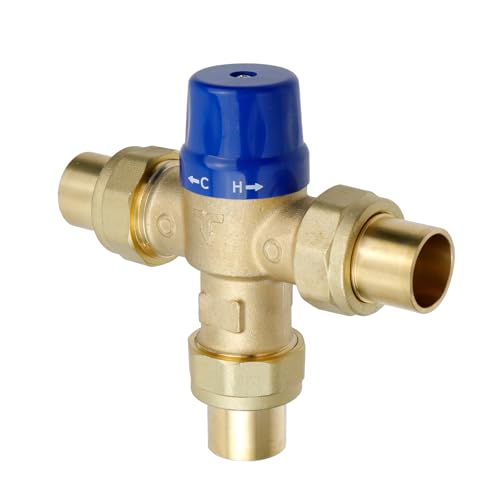
- Lead-free brass with a thermostatic valve core
- Automatic hot-water cutoff if cold water fails
- Simple marked temperature guidance
Best For: Basic household setups needing simple scald protection
Most Versatile
QWORK brass valve with adapters

- Solid brass body with 1/2 NPT male connections
- Includes three G1/2-to-1/2 NPT adapters
- Adjusts from 68°F to 122°F with clear markings
Best For: Mixed plumbing setups that benefit from adapter compatibility
Commercial-Grade Union Thermostatic Valve – Watts 3/4 Union Inlet, 13 gpm
If you need thermostatic boiler mixing valves for a higher-flow installation, this Watts model is built around a 3/4-inch union inlet and a 13 gpm rating. It uses a thermostat to control both hot and cold water, with an adjustment cap that locks in your setting. The lead-free copper silicon alloy body, integral filter washers, and check valves make it a practical choice when you want a straightforward, code-conscious mixing setup.
Best For: Higher-flow systems that need a union-style thermostatic mixing valve with lockable temperature adjustment.
Pros:
- 13 gpm capacity suits larger demand setups
- Thermostat controls both hot and cold water
- Locking adjustment cap helps hold the setting
- Integral filter washers and check valves are included
Cons:
- Threaded connection style may not match every piping layout
- No lead copper silicon alloy construction may be more than needed for small jobs
- Heavier, more commercial-leaning design than a basic compact valve
Overall, this Watts valve is a solid fit when your priority is dependable temperature control and higher flow rather than a minimalist install. Its built-in protection features and listed certifications add to its appeal for system-level use.
Quick-Install Tempered Water Valve – Cash Acme 1/2 Inch HG110 Crimp
This Cash Acme option is a handy pick if you want thermostatic boiler mixing valves that are simple to install and adjustable for safe outlet temperatures. It delivers water at 120 degrees F or lower from all outlets, while allowing the water heater to be set at 140 degrees F or higher. The lead-free brass body, integral checks, and broad fitting compatibility make it a strong fit for retrofit work.
Best For: Retrofit installs where quick connection and adjustable temperature control matter most.
Pros:
- Factory set at 120 degrees F and adjustable from 85 to 130 degrees F
- No tools, crimping, glue, or soldering required
- Compatible with SharkBite copper tubing, CTS, CPVC, SDR-9 HDPE, and PEX
- Lead-free brass construction for durability
Cons:
- Barb connections may not suit every plumbing layout
- 1/2-inch size limits it to smaller connection needs
- Designed around potable water use rather than broader specialty applications
For buyers who want a straightforward thermostatic mixing valve with broad compatibility, this model stands out for ease of installation. Its adjustable temperature range also gives you flexibility while still targeting scald protection.
Compact Bath and Lavatory Mixer – Watts 1/2-Inch LFMMVM1-US
The Watts LFMMVM1-US is a compact thermostatic mixing valve designed for baths or lavatories in residential, commercial, or institutional settings. It uses a double throttling design to control both hot and cold supply, and the solid wax hydraulic thermostat helps maintain a mixed outlet range of 80 to 120 degrees F. With solder union connections and a lead-free brass body, it’s a practical fit when you want stable tempered water in a smaller 1/2-inch package.
Best For: Bath or lavatory applications that need compact, lead-free temperature regulation.
Pros:
- Adjustable mixed outlet range from 80 to 120 degrees F
- Double throttling design controls both hot and cold water
- Lead-free brass construction with locking temperature setting
- ASSe 1070, 1069, and 1017 listed for added confidence
Cons:
- 1/2-inch size may be too small for higher-flow needs
- Solder union connections require a more involved install
- Best suited to tempered water supply, not general-purpose mixing everywhere
This Watts model is a sensible choice when compact size and repeatable temperature control matter more than installation convenience. Its listed safety credentials and locking mechanism make it especially appealing for controlled water delivery.
Compact Triple-Listed Tempering Valve – Cash Acme HG110-D 24511
This Cash Acme thermostatic mixing valve is built for buyers who want a safe, adjustable outlet temperature in a compact brass body. It is triple-listed and factory set at 120 degrees F, with an adjustable range from 85 to 130 degrees F. The SharkBite-compatible connection style and no-tools installation approach make it especially appealing for straightforward plumbing upgrades.
Best For: Small plumbing jobs that need a compact, adjustable, triple-listed mixing valve.
Pros:
- Triple-listed for added specification confidence
- Factory set at 120 degrees F, adjustable from 85 to 130 degrees F
- Compatible with multiple SharkBite-style piping materials
- No tools, crimping, glue, or soldering required for install
Cons:
- Smaller size may limit it to lower-demand applications
- Inlet and outlet connection types are specific to its design
- Bronze finish and compact form factor may not suit every visible installation
For projects that value easy installation and adjustable outlet temperatures, this Cash Acme valve is a useful option. Its triple-listed status and lead-free brass build help round out a feature set aimed at practical, everyday use.
Under-Sink Protection – Watts USG-B-M2 3/8" Thermostatic Mixing Valve
If you need thermostatic boiler mixing valves for a compact under-sink setup, this Watts valve is built for controlled point-of-use temperature blending. Its lead-free brass body, compression connections, and ASSE 1070 compliance make it a straightforward pick for installations where safety and consistency matter.
Best For: Under-sink hot water tempering where a small, code-conscious valve is needed.
Pros:
- Lead-free brass body construction
- Tamper-resistant locking nut helps prevent accidental adjustments
- Built-in check valves help stop hot-to-cold migration
- Includes a cap for three-port application
Cons:
- 3/8-inch compression sizing limits it to smaller plumbing runs
- Designed for point-of-use applications, not boiler-source blending
This is a focused, under-sink thermostatic mixing valve rather than a general hydronic boiler valve, but it fits well where compact control and anti-misadjustment features are priorities. If your job calls for a small ASSE 1070-compliant tempering solution, it’s a practical option.
Boiler Source Control – TEMLOCK 3/4" Thermostatic Mixing Valve
For thermostatic boiler mixing valves used at the hot-water source, this TEMLOCK model is aimed at maintaining a steadier outlet temperature in domestic hot water, solar, and radiant applications. It is designed for inline control at the boiler or heater, with adjustable output from 100-140°F and integral check valves included.
Best For: Boiler, solar hot water, and radiant floor systems that need source-side temperature blending.
Pros:
- Adjustable 100-140°F temperature range
- Designed for installation at the hot water source
- 3/4-inch sweat fittings for boiler-side connections
- Integral check valves included
Cons:
- Not intended for point-of-use sinks or showers
- Buyer should watch for counterfeit seller warnings noted by the manufacturer
This valve is the most source-side oriented option in the group, making it a better fit when the goal is to temper water leaving a boiler or heater. Its broader application focus and included fittings make it useful for hydronic and domestic hot water setups that need adjustable control.
Compact Under-Counter – H.C. BT-T40LF-38 3/8" Thermostatic Mixing Valve
If you want a compact option among thermostatic boiler mixing valves, this H.C. under-counter valve is built for small plumbing runs where control and reliability matter. It uses a lead-free brass body, compression connections, and integral checks with screens to help prevent cross flow and catch debris.
Best For: Small under-counter installations that need a lead-free, code-conscious tempering valve.
Pros:
- Lead-free brass body for compliant installations
- Integral checks with screens help reduce cross flow and debris
- Temperature stem is easy to adjust
- Locking nut helps prevent accidental adjustment
Cons:
- Minimum flow is 0.25 GPM, so ultra-low-flow use may be limited
- 3/8-inch size is best for compact applications, not larger boiler piping
This is a straightforward small-format tempering valve for setups that need safe temperature control without a lot of complexity. For tight spaces and compliant under-counter installs, it covers the essentials well.
Top Pick – 1/2" F1807-PEX TMV for steady whole-home control
If you’re comparing thermostatic boiler mixing valves for showers, baths, and multiple fixtures, this 1/2" F1807-PEX model is built around stable temperature control and broad compatibility. It’s a lead-free brass TMV rated to ASSE, UPC, and NSF standards, with a 150 PSI rating and up to 10 GPM flow for residential or commercial use.
Best For: Installations that need certified safety, steady mixed-water temperature, and enough flow for several fixtures.
Pros:
- Meets ASSE 1070, ASSE 1017, UPC, and NSF standards.
- Maintains stable outlet temperature from 80°F to 120°F despite pressure fluctuations.
- Handles up to 180°F supply water and 10 GPM flow.
- 1/2" F1807-PEX connections support crimp, clamp, push-fit, or expansion setups.
Cons:
- Limited to 1/2" plumbing connections.
- Temperature range is focused on mixing applications rather than wider system control.
Overall, this is the most well-rounded option here if you want a thermostatic mixing valve with strong safety credentials and practical high-flow performance. It’s especially appealing for projects where consistent outlet temperature matters more than advanced adjustability.
Budget-Friendly Pick – Antrader push-fit thermostatic valve
This Antrader thermostatic mixing valve is a simple, practical choice for household water heater systems where you want safer shower temperatures without a lot of extra complexity. It uses lead-free brass construction, a thermostatic valve core, and a push-fit style design aimed at easy use in standard 3-way mixing applications.
Best For: Basic home water-heater setups that need a straightforward thermostatic mixing valve with scald protection.
Pros:
- Lead-free brass body with a plastic adjustment knob.
- Thermostatic valve core helps balance hot and cold water for safer showering.
- Automatic hot-water cutoff in case of cold-water failure adds burn protection.
- Marked temperature ranges for hot and cold supply guidance.
Cons:
- Temperature adjustment details are more basic than higher-end valves.
- Connection specifics are less versatile than adapter-based models.
If you want a no-frills valve for safer mixed water at home, this Antrader unit covers the essentials. It’s best suited to users who prioritize simple thermostatic protection over broader installation flexibility.
Most Versatile – QWORK brass valve with adapters
For buyers comparing thermostatic boiler mixing valves across different plumbing layouts, this QWORK brass valve stands out for flexibility. It offers 1/2 NPT male connections and includes three adapters, plus a temperature adjustment range from 68°F to 122°F for use at wash basins, showers, kitchens, and more.
Best For: Installations that need adapter support and a wider range of connection compatibility.
Pros:
- Solid brass one-piece body for durability.
- Includes three G1/2 straight thread to 1/2 NPT adapters.
- Adjustable from 68°F to 122°F, with a red-button override above 100°F.
- Fahrenheit temperature markings make settings easy to read.
Cons:
- Uses only 2 ports, so it’s not the same style as a 3-port mixing valve.
- Temperature range is narrower than some dedicated thermostatic mixing applications.
This is a strong pick when compatibility matters as much as temperature control. The included adapters make it easier to fit into different plumbing setups without needing a more specialized valve.
How We Picked These Thermostatic Boiler Mixing Valves
We looked for valves that serve real-world heating and hot-water applications, with attention to temperature control range, connection type, materials, flow capacity, and certification details where available. We also favored models that suit common residential and light commercial installations without forcing unnecessary complexity.
Quick Comparison: What Matters Most
When comparing Thermostatic Boiler Mixing Valves, the main tradeoff is usually capacity versus installation fit. Larger union or sweat-connected valves tend to work well for higher-flow systems, while compact under-sink or point-of-use models are better for localized temperature control. Also check whether you need brass, lead-free construction, integral checks, or adapter-compatible ports.
Key Buying Factors for Thermostatic Boiler Mixing Valves
Connection Style
Match the valve to your existing plumbing: sweat, NPT, PEX, crimp, barb, push-fit, or union connections. The wrong connection type can add cost and installation time, even if the valve itself is otherwise a strong choice.
Temperature Control Range
Look for an adjustable outlet range that fits your application. For anti-scald protection, a narrower and more stable adjustment range is often preferable. For broader heating or distribution needs, flexibility may matter more than fine-tuned point-of-use precision.
Flow Capacity
Flow rating matters if the valve will serve multiple fixtures or a larger hot-water zone. Higher-capacity Thermostatic Boiler Mixing Valves are a better fit for whole-home or higher-demand systems, while lower-flow models are often ideal for sinks, lavatories, and compact installs.
Materials and Compliance
Brass and lead-free alloys are common for durability and potable-water use. Certifications such as ASSE, UPC, or NSF can be valuable if you need code-friendly components or want added confidence in safety and performance.
Who Should Buy Which Thermostatic Boiler Mixing Valves?
If you need a higher-flow valve for broader distribution, choose a full-size union or sweat-connected model. If your goal is under-sink or point-of-use temperature control, a compact valve with barbs, crimp, or push-fit connections is usually easier to install. For retrofit jobs, adapter-friendly designs can save time and reduce plumbing changes. In short, pick Thermostatic Boiler Mixing Valves based on connection compatibility first, then balance flow, temperature range, and certification needs.
