Choosing the right mixing valve can improve comfort, protect users from scalding, and help stabilize hot water delivery across a busy property.
This roundup focuses on commercial domestic hot water mixing valves that balance temperature control, connection type, and installation flexibility for real-world use.
Best 10 Commercial Domestic Hot Water Mixing Valves Picks for 2026
Tank Booster Pick
Cash Acme 3/4" Tank Booster Thermostatic Valve
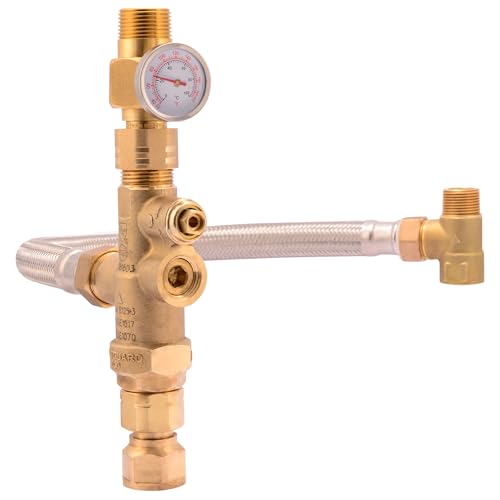
- Tempered output with 120°F control, adjustable to 140°F
- Push-to-connect install for PEX, PE-RT, CPVC, and copper
- Lead-free brass with residential and commercial certifications
Best For: Water heater systems that need an easy-install, certified tempering valve
Compact Flow Pick
Leonard Valve 1/2" Brass Mixing Valve, 0.25–8.5 gpm

- Brass construction for plumbing applications
- 0.25 to 8.5 gpm flow range
- Compact 1/2-inch MNPT outlet and press inlet
Best For: Smaller installations that need a simple brass valve with flexible flow
Under-Sink Safety Pick
Watts USG-B-M2 3/8" Thermostatic Mixing Valve

- Lead-free brass body construction
- Built-in check valves limit hot/cold migration
- Tamper-resistant locking nut helps prevent misadjustment
Best For: Point-of-use under-sink tempering where stability matters
Quick-Install Pick
Cash Acme HG110 1/2" Thermostatic Mixing Valve

- Factory set to 120°F, adjustable from 85°F to 130°F
- Compatible with SharkBite copper, CTS, CPVC, HDPE, and PEX
- Lead-free brass with integral checks and easy service
Best For: Fast-install tempering applications that need adjustable scald protection
Premium Recirculation Pick
Honeywell AM101-US-1 Thermostatic Mixing Valve

- Holds constant water temperature under changing conditions.
- Designed for systems with recirculation and proportional control.
- Supports energy savings through lower supply temperatures.
Best For: Recirculation-focused domestic hot water systems needing steady mixed temperature
Compact High-Flow Choice
1/2" FNPT Thermostatic Mixing Valve

- Certified to ASSE, UPC, and NSF standards.
- Maintains stable 80-120F output with pressure changes.
- Rated up to 10 GPM for residential or commercial use.
Best For: Compact installs that still need certified temperature control and decent flow
High-Capacity Commercial Option
3/4" Sweat Union Thermostatic Mixing Valve

- Handles up to 12 GPM for multi-fixture demand.
- Maintains stable 80-120F output with a fast thermal actuator.
- Built with lead-free brass and major safety certifications.
Best For: Higher-demand commercial or residential systems needing stronger flow capacity
Commercial-Grade Precision
3/4" FNPT Thermostatic Mixing Valve
- 3/4" FNPT threaded connections
- Up to 12 GPM max flow
- ASSE, UPC, and NSF certified
Best For: Higher-flow residential or light commercial installs
Compact Soldered Option
1/2" Sweat Union Thermostatic Mixing Valve
- 1/2" sweat union connections
- Up to 10 GPM max flow
- ASSE, UPC, and NSF certified
Best For: Installations that need a compact soldered valve
PEX-Friendly Choice
1/2" F1807-PEX Thermostatic Mixing Valve

- PEX-ready F1807 connections
- Up to 10 GPM max flow
- ASSE, UPC, and NSF certified
Best For: PEX-based systems needing a 1/2" mixing valve
Tank Booster Pick – Cash Acme 3/4" Tank Booster Thermostatic Valve
If you need commercial domestic hot water mixing valves for a tank-style water heater setup, this Cash Acme tank booster is built to blend hot and cold water into tempered output. It’s designed for domestic and commercial applications and includes a temperature gauge, lead-free brass construction, and push-to-connect compatibility for common piping materials.
Best For: Water heater setups that need adjustable tempered water with broad compatibility across PEX, PE-RT, CPVC, and copper.
Pros:
- Thermostatic mixing valve helps regulate output to 120°F, with adjustment up to 140°F.
- Push-to-connect installation supports PEX, PE-RT, CPVC, and copper without soldering, glue, or crimping.
- Lead-free DZR brass body is certified for residential and commercial use.
- Includes a temperature gauge and is listed to ASSE, CSA, NSF standards.
Cons:
- Built around tank booster use, so it may not fit every plumbing layout.
- 3/4-inch connections may require matching system components.
This is a practical option when you want a certified, easy-to-install mixing valve that helps deliver safer tempered water from a water heater. The included gauge and push-to-connect design make it especially appealing for straightforward retrofit or upgrade work.
Compact Flow Pick – Leonard Valve 1/2" Brass Mixing Valve, 0.25–8.5 gpm
Leonard Valve 1/2" MNPT Inlet Type Mixing Valve, Brass, 0.25 to 8.5 gpm - 270-LF
Check Price On AmazonFor commercial domestic hot water mixing valves in tighter plumbing setups, this Leonard Valve model is a compact brass mixing valve with a 0.25 to 8.5 gpm flow range. Its 1/2-inch MNPT outlet and press inlet make it a straightforward fit where a smaller-form-factor valve is preferred.
Best For: Smaller hot water mixing applications that need a brass valve with a wide adjustable flow range.
Pros:
- Brass construction suits demanding plumbing applications.
- Wide 0.25 to 8.5 gpm range offers flexibility for different flow needs.
- Compact 1/2-inch connection size can suit smaller installations.
- Simple valve design keeps the focus on basic mixing-valve function.
Cons:
- Supplied notes do not list temperature settings or adjustment range.
- Fewer installation and certification details are provided in the product notes.
This is a utilitarian option for buyers who mainly need a brass mixing valve with a broad flow window and standard connection sizes. It makes the most sense when the job calls for a compact valve rather than a feature-heavy assembly.
Under-Sink Safety Pick – Watts USG-B-M2 3/8" Thermostatic Mixing Valve
This Watts under-sink valve is a focused choice among commercial domestic hot water mixing valves when you need controlled water at a point-of-use fixture. It uses lead-free brass body construction, built-in check valves, and a tamper-resistant locking nut to help keep settings from shifting accidentally.
Best For: Under-sink installations that benefit from tamper resistance and built-in backflow control.
Pros:
- Lead-free brass body construction.
- Built-in check valves help prevent hot-to-cold and cold-to-hot migration.
- Tamper-resistant locking nut helps prevent accidental misadjustments.
- Includes a cap for three-port application.
Cons:
- 3/8-inch under-sink size is specialized rather than universal.
- Product notes do not provide a temperature adjustment range.
For point-of-use tempering, this valve is aimed at stability and protection rather than broad system flexibility. It’s a strong fit if your priority is keeping an under-sink setup controlled and resistant to unintended changes.
Quick-Install Pick – Cash Acme HG110 1/2" Thermostatic Mixing Valve
If you want commercial domestic hot water mixing valves that are easy to service and install, this Cash Acme HG110 is built for fast work with barb connections and integral checks. It delivers tempered water at 120°F or lower, while still allowing the water heater to be set at 140°F or higher, and its lead-free brass body is made for everyday plumbing reliability.
Best For: Installations that need a quick, tool-light thermostatic valve with adjustable temperature control.
Pros:
- Factory set to 120°F and adjustable from 85°F to 130°F.
- Compatible with SharkBite copper tubing, CTS, CPVC, SDR-9 HDPE, and PEX fittings.
- Lead-free brass construction supports durability.
- Tool-light installation and removal are designed for quick service.
Cons:
- Barb connections may not match every plumbing configuration.
- Temperature range is narrower than some system-level mixing options.
This valve stands out for straightforward installation and practical scald protection at the outlet. It’s a solid choice when you want a compact thermostatic valve that balances compatibility, adjustability, and simple maintenance.
Premium Recirculation Pick – Honeywell AM101-US-1 Thermostatic Mixing Valve
Honeywell Braukmann Sparco AM101-US-1 Sparco Thermostatic Mixing Valve, 3/4' Union-Sweat 100-145F
Check Price On AmazonIf you need one of the more proven commercial domestic hot water mixing valves for stable output, this Honeywell Braukmann Sparco model is built to hold temperature steady under changing demand. Its thermostatic, proportional design is aimed at systems with recirculation and helps control hot water down to shutoff while supporting lower supply temperatures for energy savings.
Best For: Recirculation-heavy domestic hot water systems that need constant delivery temperature and energy-conscious operation.
Pros:
- Constant water temperature under changing operating conditions.
- Works in systems with recirculation.
- Proportional valve design controls hot and cold water together.
- Can help improve energy savings through lower supply temperatures.
Cons:
- Temperature range is set at 100-145F, so it is less adjustable than broader-range TMVs.
- Union-sweat installation may be less convenient than threaded connections for some setups.
This is a practical choice when stable mixed water and recirculation compatibility matter more than added features. It is best suited to systems where consistent output and controlled hot water delivery are the priority.
Compact High-Flow Choice – 1/2" FNPT Thermostatic Mixing Valve
This 1/2-inch model is a straightforward option among commercial domestic hot water mixing valves when you want certified protection in a compact size. It automatically adjusts hot water flow to maintain stable 80-120F output, and its 10 GPM capacity makes it suitable for multiple fixtures in residential or commercial use.
Best For: Smaller piping setups that still need certified scald protection and dependable mixed-water control.
Pros:
- Meets ASSE 1070, ASSE 1017, UPC, and NSF standards.
- Maintains stable 80-120F output despite pressure changes.
- Supports up to 10 GPM for simultaneous fixture use.
- 1/2" FNPT connections simplify installation.
Cons:
- Lower maximum flow than the 3/4-inch option in this roundup.
- Temperature range and connection size may be too small for larger-volume systems.
For compact installs, this valve balances certification, temperature control, and decent flow in a size that is easier to fit. It is a practical pick when you need reliable mixed water without stepping up to a larger connection size.
High-Capacity Commercial Option – 3/4" Sweat Union Thermostatic Mixing Valve
When a commercial domestic hot water mixing valve needs more throughput, this 3/4-inch sweat union model is built for higher flow without giving up temperature stability. It uses a fast-reacting thermal actuator to maintain 80-120F output, supports up to 12 GPM, and is designed for residential or commercial plumbing where multiple fixtures may run at once.
Best For: Higher-demand plumbing setups that need stronger flow capacity and stable tempered water delivery.
Pros:
- Supports up to 12 GPM for multiple fixtures.
- Maintains stable 80-120F output with a thermal actuator.
- Meets ASSE 1070, ASSE 1017, UPC, and NSF standards.
- ¾-inch sweat union connections suit secure soldered installation.
Cons:
- Sweat union installation requires soldered plumbing connections.
- Temperature range is fixed rather than highly adjustable.
This is the strongest flow-focused option in the set and makes sense where higher demand is more important than compact size. It is a solid fit for systems that want certified protection, solid pressure rating, and easier multi-fixture performance.
Commercial-Grade Precision – 3/4" FNPT Thermostatic Mixing Valve
If you need commercial domestic hot water mixing valves that balance flow capacity with reliable temperature control, this 3/4″ thermostatic model is a strong fit. It is built for mixed-use systems where stable outlet temperature, scald protection, and code-minded certification matter.
Best For: Higher-flow residential or light commercial installs needing a 3/4″ FNPT valve with broad certification support.
Pros:
- Lead-free brass construction with ASSE 1017, ASSE 1070, UPC, and NSF compliance.
- Handles up to 12 GPM, making it suitable for multiple fixtures at once.
- Maintains a stable 80°–120°F output with fast-reacting thermostatic control.
- 3/4″ FNPT connections simplify setup in compatible plumbing systems.
Cons:
- 3/4″ FNPT sizing may not suit smaller branch lines.
- Best fit for applications that can use its higher flow capacity.
Overall, this valve stands out for buyers who want a certified, higher-flow mixing solution with straightforward threaded connections. It is a practical choice when consistent delivery across several fixtures is a priority.
Compact Soldered Option – 1/2" Sweat Union Thermostatic Mixing Valve
For commercial domestic hot water mixing valves in smaller lines, this 1/2″ sweat union model offers solid temperature control in a compact, soldered format. It is designed for stable mixed-water delivery and dependable scald protection in everyday fixture use.
Best For: Installations that call for a 1/2″ sweat connection and a compact thermostatic valve.
Pros:
- Lead-free brass body with ASSE 1017, ASSE 1070, UPC, and NSF compliance.
- Supports up to 10 GPM for showers, sinks, baths, and lavatories.
- Stable 80°–120°F outlet control with thermostatic scald protection.
- 1/2″ sweat union connections provide a secure soldered installation.
Cons:
- 10 GPM capacity is lower than the 3/4″ option in this group.
- Sweat connections require soldering and compatible piping.
This is a practical pick when you want a certified valve in a compact form factor and your piping layout favors sweat connections. It makes sense for smaller hot-water branches that still need dependable mixing performance.
PEX-Friendly Choice – 1/2" F1807-PEX Thermostatic Mixing Valve
If your project uses PEX tubing, this 1/2″ thermostatic model is one of the more convenient commercial domestic hot water mixing valves to work into a modern plumbing layout. It combines certified temperature control with PEX-oriented connections for quicker installation options.
Best For: PEX-based systems that need a certified 1/2″ thermostatic mixing valve.
Pros:
- Lead-free brass construction with ASSE 1017, ASSE 1070, UPC, and NSF compliance.
- Up to 10 GPM flow supports multiple fixtures in residential or commercial use.
- Maintains stable 80°–120°F outlet temperature and handles up to 180°F supply water.
- F1807-PEX connections support crimp, clamp, push-fit, or expansion setups.
Cons:
- 1/2″ size may be limiting for higher-demand runs.
- PEX-focused connections may not suit non-PEX piping methods.
For installers working with PEX, this valve offers a straightforward mix of certification, flow, and installation flexibility. It is especially appealing when you want a modern connection style without giving up thermostatic control.
How We Picked the Best Commercial Domestic Hot Water Mixing Valves
We focused on Commercial Domestic Hot Water Mixing Valves that offer practical temperature regulation, common connection styles, and a fit for typical domestic hot water distribution setups. Priority went to models with clear temperature ranges, recognized certifications where listed, and designs suited to both light commercial and residential-style systems.
Quick Comparison
Broadly, these valves split into two groups: point-of-use models for sinks and smaller fixtures, and higher-capacity thermostatic mixing valves for whole-system or branch-line applications. Some options emphasize union, sweat, FNPT, or PEX compatibility, which makes matching the valve to existing piping a key part of the decision.
Key Buying Factors for Commercial Domestic Hot Water Mixing Valves
Temperature Range and Stability
Look for a valve that can hold the mixed-water temperature where you need it, especially if your system serves varying fixture types. Stable control matters more than a wide range if the goal is consistent output and scald protection.
Connection Type and Installation Fit
Check whether your plumbing uses sweat, FNPT, PEX, union, crimp, or barb connections. The right connection type reduces install time, lowers the chance of adapter stacking, and helps ensure the valve fits without unnecessary rework.
Flow Capacity
Flow rate should match the demand of the fixture or zone. Smaller under-sink valves are appropriate for limited fixtures, while larger thermostatic valves are better suited to branches or systems with higher simultaneous demand.
Certifications and Compliance
For many commercial applications, certifications such as ASSE, UPC, and NSF are important indicators that the valve is intended for potable water use and temperature-mixing duties. Always confirm local code requirements before purchasing.
Serviceability
In commercial settings, easy access to checks, unions, or service parts can matter as much as the initial specification. A valve that is easier to maintain can reduce downtime over the long term.
Who Should Buy Which Commercial Domestic Hot Water Mixing Valves?
If you need a compact option for a sink, prep station, or small fixture branch, choose a point-of-use model with the right inlet style and modest flow rating. If you are serving multiple fixtures or a broader domestic hot water loop, a larger thermostatic valve with union or threaded connections is usually the better fit.
For buyers prioritizing code alignment and straightforward spec matching, the most versatile options are the ones with clear certification listings, common connection standards, and a temperature range that aligns with your usage pattern.
