Choosing the right mixing valve can make domestic hot water safer, more consistent, and easier to manage across the home or jobsite.
Below, we’ve narrowed the field to 10 of the best lead free domestic hot water mixing valves for 2026, with a focus on temperature control, installation style, and everyday reliability.
Best 10 Lead Free Domestic Hot Water Mixing Valves Picks for 2026
Tank Booster Pick
Cash Acme 3/4 Inch Tank Booster Water Heater
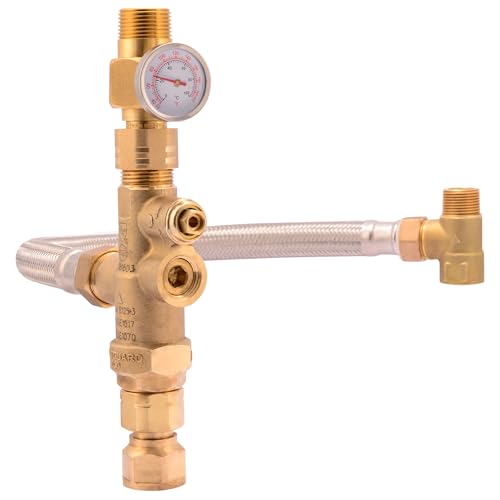
- Lead-free DZR brass body
- Push-to-connect installation
- Certified for residential and commercial use
Best For: Tank boosting with simple install and certified lead-free construction
Sweat Union Choice
Honeywell 2474288 Lead-Free Sweat Union Mixing Valve

- Lead-free brass construction
- 3/4 inch sweat connections
- 70°F to 145°F operating range
Best For: Sweat-connected systems needing a basic adjustable mixing valve
Under-Sink Guard
Watts USG-B-M2 3/8" Thermostatic Mixing Valve

- Lead-free brass body
- Built-in check valves
- Tamper-resistant locking nut
Best For: Compact point-of-use installs under sinks
Source Mixing Specialist
TEMLOCK 3/4" Thermostatic Mixing Valve

- Lead-free brass body
- Integral check valves included
- Adjustable 100°F to 140°F
Best For: Source-side domestic hot water and hydronic systems
Residential Anti-Scald Pick
Watts LFMMVM1-US 1/2" Thermostatic Mixing Valve

- Lead free brass construction
- 80 to 120°F adjustable mixed outlet
- Locking temperature setting with check valves
Best For: Tempered water at baths or lavatories
Under-Lavatory Control Pick
Sloan Optima MIX-135-A Thermostatic Water Mixing Valve

- Lead-free brass body
- Tamper-resistant adjustment stem
- Built for Sloan Optima under-lavatory use
Best For: Sloan Optima faucet installations needing controlled outlet temperature
High-Flow Utility Pick
Watts LFMMV-M1-UT 3/4 Union Thermostatic Mixing Valve

- Lead free copper silicon alloy body
- 3/4-inch union inlet for higher flow
- Locking cap plus filter washers and check valves
Best For: Higher-flow domestic hot water mixing applications
Quick-Connect Scald Protection
Cash Acme 1/2 Inch HG110 Thermostatic Mixing Valve

- Lead-free brass body for potable water use
- Factory set to 120°F, adjustable to 85°F-130°F
- Tool-free install with compatible tubing systems
Best For: Fast-install residential hot water mixing and scald protection
High-Flow Union Valve
3/4" Sweat Union Thermostatic Mixing Valve

- Lead-free brass with ASSE, UPC, and NSF certifications
- Handles up to 12 GPM for multi-fixture use
- 80°F-120°F output with 150 PSI rating
Best For: Residential or commercial systems needing higher flow and certified control
Compact Threaded Control
Powers LFE480-01 1/2" Threaded Mixing Valve

- Lead-free copper silicon alloy body
- ASSE 1070 for domestic hot water use
- Compact 1/2-inch threaded connections, 4 GPM
Best For: Smaller domestic hot water systems with moderate flow needs
Tank Booster Pick – Cash Acme 3/4 Inch Tank Booster Water Heater
If you need lead free domestic hot water mixing valves for a tank booster setup, this Cash Acme model is built to temper water at the source. It uses a thermostatic mixing valve and gauge to blend hot and cold water to a controlled output, with a typical 120°F setting and an adjustable range up to 140°F.
Best For: Residential or commercial tank boosting where easy installation and lead-free construction matter.
Pros:
- Lead-free DZR brass construction
- Push-to-connect installation for PEX, PE-RT, CPVC, and copper
- Includes temperature gauge and works with gas, electric, tankless, and power vent heaters
- ASSE 1017/1070, CSA B125.3, NSF/ANSI 372, and NSF/ANSI 61 certified
Cons:
- Designed as a tank booster, so it is not a general under-sink mixing valve
- Requires compatibility with its 3/4 inch connection format
This is a practical choice when scald control, certification, and quick installation are the priorities. It is especially useful if you want a source-side solution that can be set for tempered domestic hot water delivery.
Sweat Union Choice – Honeywell 2474288 Lead-Free Sweat Union Mixing Valve
This Honeywell valve is a straightforward option if you are comparing lead free domestic hot water mixing valves for a sweat-connected system. It is a 3/4 inch mixing valve with a stated operating range of 70°F to 145°F, which makes it suitable for applications that need adjustable tempered water.
Best For: Sweat union installations where a lead-free brass mixing valve is needed.
Pros:
- Lead-free mixing valve design
- 3/4 inch sweat inlet and outlet connections
- Wide operating temperature range from 70°F to 145°F
- NSF and RoHS listed
Cons:
- Product details are limited compared with more feature-rich models
- Not described with point-of-use-specific features or accessories
It is a practical pick for buyers who want a basic lead-free valve with sweat connections and a broad temperature range. The simple format makes it easier to match to existing brass plumbing layouts.
Under-Sink Guard – Watts USG-B-M2 3/8" Thermostatic Mixing Valve
For point-of-use plumbing, this Watts model stands out among lead free domestic hot water mixing valves because it is sized for under-sink use and includes built-in protection against hot-to-cold migration. The thermostatic valve is designed to blend water through 3/8 inch compression connections and features a tamper-resistant locking nut for more stable adjustment.
Best For: Under-sink or point-of-use installations that need compact temperature control.
Pros:
- Lead-free brass body construction
- Built-in check valves help prevent cross-flow between hot and cold lines
- Tamper-resistant locking nut reduces accidental misadjustment
- ASSE 1070 listed
Cons:
- Small 3/8 inch compression size limits it to compact applications
- Not intended as a whole-house source mixing valve
This is a strong choice when you want a compact, code-focused valve for a sink or similar point-of-use setup. Its built-in check valves and locking feature add practical control in tight spaces.
Source Mixing Specialist – TEMLOCK 3/4" Thermostatic Mixing Valve
This TEMLOCK valve is aimed at source-side temperature control, making it a good fit if you are shopping lead free domestic hot water mixing valves for boilers, solar water heaters, or radiant floor heating. It is adjustable from 100°F to 140°F, uses lead-free brass, and includes integral check valves for inline domestic hot water control.
Best For: Hot water source applications that need adjustable tempered water and integral check valves.
Pros:
- Lead-free brass construction
- 3/4 inch sweat fittings for source-side installation
- Integral check valves included
- Designed for boilers, solar water heaters, and radiant floor heating systems
Cons:
- Not intended for point-of-use sinks or showers
- Multiple application claims may be more than some buyers need
Buy this when you want a thermostatic valve dedicated to in-line hot water source control rather than fixture-level mixing. The combination of adjustable output and included check valves makes it practical for domestic hot water system setups.
Residential Anti-Scald Pick – Watts LFMMVM1-US 1/2" Thermostatic Mixing Valve
For lead free domestic hot water mixing valves in baths or lavatories, this Watts thermostatic mixing valve is built for straightforward tempered-water delivery. It uses a double-throttling design to control both hot and cold supply lines, with an adjustable 80 to 120°F mixed outlet range and a locking temperature setting for added control.
Best For: Residential, commercial, or institutional sink and bath applications that need adjustable tempered water.
Pros:
- Lead free brass body suits potable hot water mixing use
- Double throttling design controls both hot and cold supply
- Adjustable 80 to 120°F outlet range with locking mechanism
- Includes integral filter washers and check valves
Cons:
- 1/2-inch size may not suit larger flow demands
- Maximum pressure is limited to 150 PSI
- Built for tempered water points like baths and lavatories, not general high-flow distribution
This is a practical, code-oriented choice if you want a compact lead free mixing valve with published certification and simple temperature adjustment. The tradeoff is capacity: it fits smaller fixture-level applications best.
Under-Lavatory Control Pick – Sloan Optima MIX-135-A Thermostatic Water Mixing Valve
Among lead free domestic hot water mixing valves, this Sloan Optima model is aimed at under-lavatory installations where outlet temperature needs to stay controlled and consistent. It is designed for use with Sloan Optima faucets, senses temperature fluctuations quickly, and includes a tamper-resistant adjustment stem with lock nut.
Best For: Under-lavatory installations paired with Sloan Optima faucets that need anti-scald temperature control.
Pros:
- Certified lead-free brass body with corrosion-resistant internal components
- Designed to compensate for water temperature and pressure changes
- Tamper-resistant adjustment helps prevent unwanted changes
- ASSE 1070 and CSA B125 listed
Cons:
- Intended for Sloan Optima faucet compatibility
- 3/8-inch connections may limit broader system use
- 125 PSI maximum operating pressure is lower than some alternatives
This is a focused solution rather than a general-purpose mixing valve. If you need a matched under-sink valve for a Sloan Optima setup, its control features and certification make it a strong fit.
High-Flow Utility Pick – Watts LFMMV-M1-UT 3/4 Union Thermostatic Mixing Valve
If you need lead free domestic hot water mixing valves for a higher-flow application, this Watts 3/4-inch model is built around a thermostatic element that controls both hot and cold water. It uses an adjustment cap with locking feature plus integral filter washers and check valves, and it is listed to ASSE 1070, 1069, and 1017.
Best For: Higher-flow mixing applications that need a lead-free alloy body and a 3/4-inch connection.
Pros:
- Lead free copper silicon alloy construction
- 3/4-inch union inlet size supports higher flow use
- Locking adjustment cap helps hold the set temperature
- Integral filter washers and check valves included
Cons:
- Heavier and larger than compact 1/2-inch valves
- Listed dimensions and thread details are less straightforward than smaller fixtures
- Primarily suited to thermostatic hot/cold mixing rather than specialized faucet integration
This model makes sense when you want a lead-free, code-listed valve with more capacity than a typical small fixture mixer. Its larger format is a benefit for flow, but it may be more valve than you need for simple lavatory setups.
Quick-Connect Scald Protection – Cash Acme 1/2 Inch HG110 Thermostatic Mixing Valve
If you want lead free domestic hot water mixing valves that are easy to install and focused on scald protection, this Cash Acme HG110 is built for fast connection with compatible tubing systems. It is factory set to 120°F, adjustable from 85°F to 130°F, and is designed to deliver safe water from outlets while letting the water heater run hotter.
Best For: Quick-install residential setups where tool-free installation and adjustable outlet temperature matter.
Pros:
- Lead-free brass construction for durable, potable-water use
- Factory set at 120°F, with an adjustable 85°F to 130°F range
- Compatible with SharkBite copper tubing, CTS, CPVC, SDR-9 HDPE, and PEX fittings
- No tools, crimping, glue, or soldering required for installation
Cons:
- Barb connections may not suit every plumbing configuration
- Single 1/2-inch size limits use in larger-flow systems
This is a practical choice if you need a lead-free mixing valve that emphasizes convenience and standard scald control. Its biggest advantage is the combination of easy installation and a wide adjustable temperature range for domestic hot water use.
High-Flow Union Valve – 3/4" Sweat Union Thermostatic Mixing Valve
For lead free domestic hot water mixing valves in systems that need more capacity, this 3/4-inch sweat union model is built for residential and commercial use. It offers ASSE, UPC, and NSF certifications, a 150 PSI rating, and stable 80°F to 120°F output with support for up to 12 GPM.
Best For: Higher-flow domestic hot water systems that need certified temperature control and soldered sweat connections.
Pros:
- Lead-free brass body with ASSE 1070, ASSE 1017, UPC, and NSF compliance
- High-flow design supports up to 12 GPM
- Stable 80°F to 120°F output with scald protection and thermal actuator
- 3/4-inch sweat union connections for secure installation
Cons:
- Sweat installation requires soldering
- May be more valve than needed for smaller, single-fixture applications
This valve stands out when you need a higher-capacity mixing solution with certification and pressure margin. It is a strong fit for systems serving multiple fixtures, especially where a soldered sweat union setup is preferred.
Compact Threaded Control – Powers LFE480-01 1/2" Threaded Mixing Valve
If you are comparing lead free domestic hot water mixing valves for a smaller domestic hot water application, the Powers LFE480-01 offers a compact threaded design with ASSE 1070 compliance. It is rated for 4 GPM, works with hot supply water up to 180°F, and provides a 80°F to 120°F output range for domestic hot water use.
Best For: Compact domestic hot water setups that need threaded connections and moderate flow.
Pros:
- Lead-free copper silicon alloy body
- ASSE 1070 standard for domestic hot water applications
- Compact 1/2-inch threaded inlet and outlet connections
- 80°F to 120°F temperature range with 4 GPM flow rate
Cons:
- 4 GPM capacity is modest for larger demand scenarios
- Threaded installation may not suit every plumbing setup
This model is best when space is limited and the system only needs moderate flow. Its compact footprint and threaded design make it a straightforward option for smaller domestic hot water mixing needs.
How We Picked the Best Lead Free Domestic Hot Water Mixing Valves
We focused on valves that are clearly positioned for domestic hot water use, use lead-free materials, and offer practical features buyers actually need, such as thermostatic control, anti-scald protection, and common connection types. We also considered flow capacity, outlet temperature range, and whether a model makes sense for point-of-use, point-of-source, or broader residential/commercial applications.
Quick Comparison
As you compare Lead Free Domestic Hot Water Mixing Valves, start with where the valve will be installed. Under-sink and point-of-use models are better for a single fixture or small branch line. Larger union, sweat, or threaded valves are better suited to water heaters, recirculation setups, and higher-demand systems. Also check the published temperature adjustment range and maximum flow rate so the valve can match the system without bottlenecking performance.
Key Buying Factors for Lead Free Domestic Hot Water Mixing Valves
Connection Type
Sweat, threaded, crimp, barb, and union fittings all serve different plumbing setups. Match the valve to your pipe material and installation method to avoid adapters and reduce labor.
Temperature Range and Accuracy
Look for a valve that covers the outlet temperatures you need for anti-scald protection and comfortable delivery. Wider adjustment ranges offer more flexibility, but stable thermostatic performance matters more than a broad spec sheet.
Flow Capacity
Flow rating should fit the number of fixtures and expected demand. Small point-of-use valves are ideal for sink protection, while larger-capacity valves are better for showers, multiple fixtures, or commercial systems.
Certification and Material Safety
For Lead Free Domestic Hot Water Mixing Valves, confirm lead-free construction and relevant certifications such as ASSE, UPC, or NSF where applicable. These signals matter for code compliance and long-term confidence.
Use Case
Some valves are built for a single sink, while others are designed to temper water at the heater or serve an entire branch. Choosing the right application is often the difference between a smooth install and an undersized system.
Who Should Buy Which Lead Free Domestic Hot Water Mixing Valves?
Homeowners who want safer outlet temperatures at a sink or vanity should look at compact point-of-use models. Plumbers and contractors working on water heaters or multi-fixture branches should favor higher-capacity sweat, union, or threaded valves with stronger certification and easier serviceability. Commercial buyers should prioritize flow rate, parts compatibility, and clear compliance documentation.
If you want the simplest path, match the valve to the installation location first, then narrow by temperature range, certification, and capacity. That approach usually leads to the best long-term fit.
