A compact tankless heater can bring hot water closer to a sink without storing a tankful. But a small cabinet footprint does not guarantee enough heat for your tap: incoming water temperature, flow rate, voltage, and electrical capacity all matter.
These 10 point-of-use models span 120V and 240V options, from 3kW plug-in units to higher-power hardwired choices. Use the guide below to narrow the field before checking the requirements for your installation.
Best 10 Electric Mini Tankless Water Heaters Picks for 2026
Simple Sink Controls
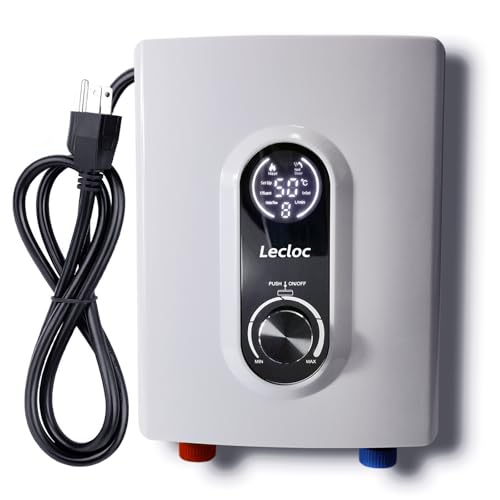
- For one low-flow sink
- Knob setting with LED display
- Not for showers or multiple taps
Best For: Single low-flow sink with simple plug-in controls
Compact Plug-In Pick

- Compact wall-mounted design
- Fahrenheit/Celsius display
- Requires at least a 32A breaker
Best For: Small sink with a compatible electrical circuit
Higher-Power 120V Choice
CAMPLUX 4.5kW Point-of-Use Heater

- For one sink
- 50°F rise at 1.0 GPM specified
- Hardwired 40A circuit required
Best For: Single sink with a suitable 120V hardwired circuit
240V Sink Upgrade
ThermoMate 6kW Tankless Heater
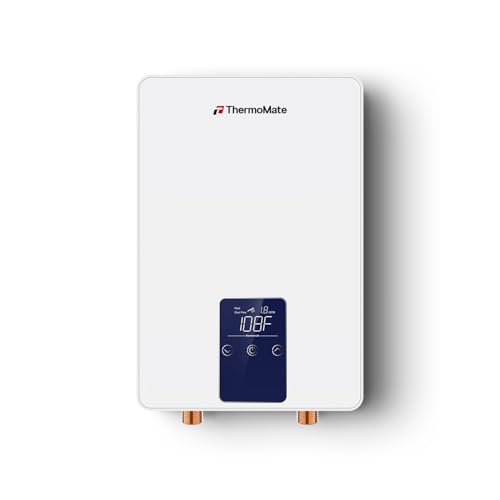
- 6kW, 240V point-of-use model
- About 1.0 GPM at 35°F rise
- Hardwired 30A circuit required
Best For: Sink with a suitable 240V hardwired connection
Best 120V Option
CAMPLUX 3.5kW Point-of-Use Heater

- 120V, 3.5kW single-sink heater
- Self-modulating touch controls
- Needs 32A breaker and 10 AWG wire
Best For: One low-flow sink with a suitable 120V hardwired circuit
Best Thermostatic Control

- 240V, 6.5kW point-of-use model
- Targets within 1°F of set temperature
- Listed flow rate: 1.5 GPM
Best For: Point-of-use hot water with precise temperature control
Best Slim Under-Sink Pick
APUS 4500W Point-of-Use Heater
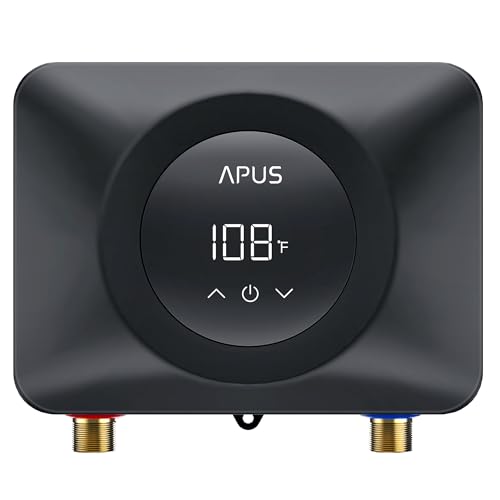
- About 2.6 inches deep
- LED control with 85–131°F settings
- Requires dedicated 240V hardwiring
Best For: One low-flow sink with limited installation space
Best for Precise Temperature Control
Rheem 3.5kW Point-of-Use Heater
- 80°F–140°F thermostat in one-degree steps
- Designed for one low-flow fixture
- Needs a dedicated 120V, 30-amp circuit
Best For: Single sinks needing precise temperature adjustment
Best for Simple Controls

- LED display and single large knob
- 30°C–55°C adjustable setting
- For one low-flow sink, not showers
Best For: Under-sink use with straightforward controls
Best for Compact Wall Mounting
- 7.1 x 9.8 x 2.8-inch wall-mounted body
- LED display with 30°C–55°C knob control
- One low-flow tap only
Best For: Space-limited sinks with modest warm-water needs
Simple Sink Controls – 3kW 120V Plug-In Mini Heater
Among electric mini tankless water heaters, this 3kW plug-in model is a compact choice for warm water at one low-flow sink. Its control knob adjusts the setting from 30°C to 55°C, with an LED display for checking it.
Best For: A single low-flow sink where a 120V plug-in heater and straightforward controls are priorities.
Pros:
- Plug-in design and slim 7.1 × 9.8 × 2.8-inch body.
- Knob control and LED temperature display.
- Includes overheat, leakage, dry-heating, and over-pressure protections.
Cons:
- Not suitable for showers or simultaneous use at multiple taps.
- Outlet warmth depends on incoming water temperature and flow.
This is a practical one-sink option if you keep flow modest; buyers needing a stronger temperature rise should consider a higher-wattage unit.
For shoppers comparing electric mini tankless water heaters for tight spaces, this DOYXC 3kW unit offers a wall-mounted, 110V plug-in design for quick sink tasks. Its digital display can show temperature in Fahrenheit or Celsius.
Best For: A small kitchen, bathroom, or RV sink with a suitable electrical circuit.
Pros:
- Compact 4.5 × 8.5-inch wall-mounted footprint.
- Digital display with selectable Fahrenheit and Celsius readings.
- Includes dry-burn and leakage protection, plus a two-year warranty.
Cons:
- Not designed for showers.
- Requires a breaker rated at least 32 amps despite its plug-in design.
Check the circuit before choosing this model; its compact size does not eliminate its substantial electrical requirement.
The CAMPLUX 4.5kW model stands out among electric mini tankless water heaters for offering more heating power on 120V than the 3kW options here. It is designed for one sink, with touch controls and an LED temperature display.
Best For: A single sink where a dedicated 120V hardwired circuit is available.
Pros:
- Specified 50°F temperature rise at 1.0 GPM.
- Activates at a flow as low as 0.26 GPM.
- Self-modulating operation adjusts power based on flow and temperature setting.
Cons:
- Must be hardwired; no plug is included.
- Requires a 40A breaker and 10 AWG wire.
This is worth considering when a 3kW unit may be too limited, provided your electrical setup meets the listed installation requirements.
For a sink with access to 240V power, this ThermoMate is the highest-wattage option in this group of electric mini tankless water heaters. Its 6kW system is specified to provide about 1.0 GPM at a 35°F temperature rise.
Best For: Point-of-use sink heating where a dedicated 240V hardwired connection is available.
Pros:
- Adjustable 85°F–131°F setting with one-degree touch controls.
- Self-modulating power use and a slim, wall-mounted body.
- Heating element is separated from the stainless-steel water tube to reduce scale and corrosion exposure.
Cons:
- 240V hardwired installation only; requires a 30A breaker and at least 10 AWG wire.
- Specified temperature rise is tied to flow, so output depends on use conditions.
Choose this model for its 240V heating capacity and compact sink placement, not as a substitute for checking your required flow and incoming water temperature.
Best 120V Option – CAMPLUX 3.5kW Point-of-Use Heater
Among electric mini tankless water heaters, this 120V CAMPLUX model is a compact option for supplying one sink. Its 3.5kW output and self-modulating controls suit low-flow handwashing, not multiple fixtures.
Best For: A single sink where a dedicated 120V hardwired circuit is available.
Pros:
- Self-modulating operation adjusts power to flow and temperature settings.
- Compact, wall-mountable design with a touch panel and digital display.
- Listed safety features include leakage and overheat protection.
Cons:
- Requires hardwiring, a 32A breaker, and 10 AWG wire; it has no plug.
- Limited temperature rise at higher flows makes it a one-sink choice.
Check your incoming water temperature and electrical setup before buying. The stated temperature rise is 22°F at 1.0 GPM, so colder water or faster flow will limit how warm the outlet water feels.
Best Thermostatic Control – Rheem RTEX-06T 6.5kW Heater
The Rheem RTEX-06T stands out among electric mini tankless water heaters for its thermostatic control. This 240V, 6.5kW point-of-use model monitors water temperature and controls flow to target a consistent outlet temperature.
Best For: A point-of-use installation where precise temperature control matters and 240V power is available.
Pros:
- Thermostatic system is designed to hold water within 1°F of the selected temperature.
- Heats water on demand rather than maintaining a storage tank.
- Compact, wall-mountable design fits near the fixture it serves.
Cons:
- Requires 240V power rather than a standard 120V outlet.
- Its listed 1.5 GPM flow rate calls for checking your fixture’s needs before purchase.
Choose this Rheem if temperature consistency is your priority. Confirm that your electrical supply and desired flow suit its 6.5kW point-of-use specifications.
Best Slim Under-Sink Pick – APUS 4500W Point-of-Use Heater
This APUS model is one of the slimmer electric mini tankless water heaters in the roundup, measuring about 8.7 by 6.5 by 2.6 inches. Its 4,500W output is intended for one sink or another low-flow outlet, with an adjustable 85–131°F setting range.
Best For: A single under-sink installation with space constraints and a compatible 220–240V circuit.
Pros:
- Compact body and LED touch controls suit nearby wall or under-sink placement.
- Self-modulating heating operates when water flows.
- Specified protections include over-temperature, dry-burn, and leakage protection.
Cons:
- Needs a dedicated hardwired 220–240V circuit, 30A double-pole breaker, and 12 AWG copper wire.
- Designed for one low-flow outlet, not whole-house or multi-bathroom use.
The advertised roughly three-second hot-water start depends on inlet temperature and flow conditions; water still has to travel through the plumbing to the tap. Verify the installation requirements before choosing it for a tight space.
Best for Precise Temperature Control – Rheem 3.5kW Point-of-Use Heater
Among electric mini tankless water heaters, this Rheem model stands out for its digital thermostat, adjustable from 80°F to 140°F in one-degree increments. It is designed for a single, low-flow fixture rather than whole-home hot water.
Best For: A basement, garage, or workshop sink where precise temperature adjustment matters and the required electrical circuit is available.
Pros:
- Digital thermostat offers one-degree temperature adjustments.
- Compact, wall-mounted design needs no venting.
- Heats water on demand instead of maintaining a storage tank.
Cons:
- Listed heating performance is up to 0.5 GPM, so sizing for the fixture is essential.
- Requires a dedicated 120V, 30-amp circuit with #10 AWG copper conductors.
The electrical requirements make this more involved than a plug-in option, but its adjustable thermostat is useful when a single sink needs predictable settings. Verify sizing and have it professionally installed.
Best for Simple Controls – C3000-USA 3kW Plug-In Heater
If you want electric mini tankless water heaters with uncomplicated controls, the C3000-USA pairs an LED display with one large knob for power and temperature. Its 3kW, 120V design is intended for warm water at one low-flow sink.
Best For: An under-sink installation where plug-in power, a readable display, and straightforward temperature adjustment are priorities.
Pros:
- Single knob adjusts the 30°C–55°C temperature setting.
- Compact 7.1-by-9.8-by-2.8-inch body suits tight spaces.
- Listed protections include overheating, dry heating, leakage, and over-pressure safeguards.
Cons:
- Not intended for showers or simultaneous use at multiple taps.
- Delivered water temperature depends on inlet temperature and flow.
This is a practical choice for modest sink demand, not a substitute for a higher-output heater. Check your expected flow and incoming water temperature before choosing it.
Best for Compact Wall Mounting – C3000 3kW Under-Sink Heater
The C3000 is a compact entry among electric mini tankless water heaters, measuring 7.1 by 9.8 by 2.8 inches for wall-mounted, under-sink placement. It runs on 120V plug-in power and is designed to serve one low-flow point of use.
Best For: A bathroom, office, or utility sink with limited mounting space and modest warm-water demand.
Pros:
- Small wall-mounted body weighs 3.9 pounds.
- LED display and single knob provide 30°C–55°C adjustment.
- Includes IPX4 waterproofing and listed overheat, dry-heating, leakage, and over-pressure protections.
Cons:
- Not suitable for showers or multiple taps at once.
- Actual output temperature varies with incoming water temperature and flow.
Choose this model for a single sink where space is tight, while keeping its 3kW heating limit in mind. If you need greater flow or a larger temperature rise, this low-flow unit is not the right fit.
How We Picked These Electric Mini Tankless Water Heaters
We focused on compact, electric point-of-use models intended for sink-area installation. To make the selection useful across different homes, we included lower-power 120V options and higher-power 240V units, along with a range of controls and mounting styles. The listed wattage and voltage are starting points for comparison, not proof of a particular hot-water flow rate. Verify each model’s installation manual, electrical requirements, and temperature-rise chart before buying.
Quick Comparison: Which Type Fits Your Sink?
- 3kW 120V plug-in models: Worth considering for a single low-flow handwashing sink where the specified outlet and circuit can support the load. Expect limited heating at higher flow or with very cold inlet water.
- 3.5–4.5kW 120V models: Offer more listed power, but do not assume they use an ordinary household receptacle. Check whether the specific unit requires hardwiring and a dedicated circuit.
- 4.5–6.5kW 240V models: Better candidates when you need greater temperature rise at a given flow, provided your electrical panel and installation location can accommodate them.
Key Buying Factors for Electric Mini Tankless Water Heaters
Temperature Rise and Flow Rate
Start with the water temperature you want at the faucet and your cold-water inlet temperature. Their difference is the required temperature rise. Then compare the manufacturer’s chart at your faucet’s actual flow rate. A heater that feels adequate at a low-flow bathroom tap may not keep up with a faster kitchen faucet, particularly in winter.
Electrical Supply and Installation
Match voltage, amperage, breaker size, wire gauge, and connection type to the manufacturer’s instructions and local electrical code. A plug-in label is not permission to use an extension cord or an undersized shared circuit. At these power levels, a dedicated circuit or professional electrical work may be necessary. Confirm the unit’s physical dimensions, required clearances, plumbing connections, and whether it is approved for your intended mounting position.
Controls, Safety, and Use
A digital display or control knob can make settings easier to see, but heating performance depends chiefly on power and water flow. Look for applicable safety certifications and protections specified by the manufacturer, and check any minimum activation flow: some heaters may not switch on when a faucet is barely open. For scald prevention, follow the installation instructions and set the outlet temperature appropriately.
Who Should Buy Which Electric Mini Tankless Water Heaters?
For occasional handwashing at one sink, begin with a properly supplied 120V model and a low-flow faucet, then confirm its temperature-rise performance. If you already have suitable 240V power and need a stronger point-of-use option, compare the 240V models’ published flow charts. For a kitchen sink, multiple fixtures, or consistently high hot-water demand, do not choose by the word “mini” alone; these small units may be undersized. If electrical upgrades outweigh the convenience, compare the cost and fit of other point-of-use hot-water solutions before committing.
