If you are comparing a 3/4 HP sewage pump review for basement drainage, effluent handling, or residential wastewater transfer, this Acquaer unit is built around capacity and durability rather than compact size.
It is a strong fit when you want automatic operation, cast iron construction, and a pump that is aimed at tough, dirty-water jobs.
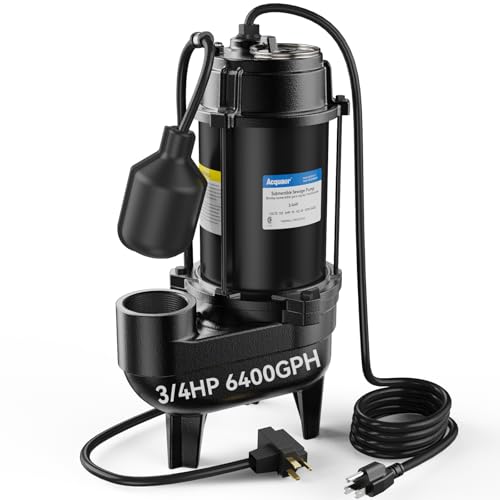
Acquaer 3/4 HP Sewage Pump Review Summary
The Acquaer 3/4 HP sewage pump makes sense for buyers who need a heavy-duty submersible pump for sump basins, basements, below-grade installations, or residential sewage and dewatering tasks.
Its main appeal is straightforward: high flow, an automatic tethered float switch, rugged cast iron construction, and a clog-resistant design that is meant for demanding environments.
This is not a general-purpose clean-water pump.
The listing positions it for sewage, wastewater drainage, sewer-related transfer, and basement flooding, and it explicitly says it is prohibited for septic tanks.
That matters because the right buyer here is someone who needs an aggressive utility pump for the stated use case, not someone looking for a broad “all water” solution.
Review Scorecard
| Category | Score | Buyer-focused rationale |
|---|---|---|
| Pumping Capacity | 9/10 | The listed 6400 GPH output and 29 ft lift target serious residential transfer jobs. |
| Automation | 8/10 | The tethered float switch and piggy-back plug support hands-off operation. |
| Durability | 8/10 | Cast iron casing and thermal overload protection are strong signs of practical robustness. |
| Clog Resistance | 8/10 | The vortex impeller and 2-inch solids handling are useful for sewage-type applications. |
| Installation Fit | 7/10 | The 2-inch NPT discharge and 10-foot cord are practical, but this is still a substantial pump. |
| Buyer Safety | 7/10 | Clear limits help, especially the explicit warning against septic tank use and dry-running issues. |
Bottom line: this is a purpose-built sewage and effluent pump for buyers who value automatic operation and heavy-duty construction over convenience features.
Key Features and Specifications of Acquaer 3/4 HP Sewage Pump
The core specification set is focused on residential sewage, basement drainage, and wastewater removal:
| Feature | Listing detail |
|---|---|
| Motor | 3/4 HP oil-filled split capacitor motor |
| Maximum flow | Up to 6400 GPH |
| Maximum lift | Up to 29 ft vertically |
| Switch | Adjustable mechanical tethered float switch |
| Power cord | 10 ft with piggy-back plug |
| Discharge | 2-inch NPT |
| Solids handling | Passes 2-inch diameter solids |
| Construction | Rugged cast iron casing |
| Safety | Automatic thermal overload protection |
| Warranty | 2-year warranty |
Those specifications tell a clear story.
This pump is designed to move a lot of water, tolerate harsh conditions, and reduce the need for constant supervision.
The float switch handles on/off cycling automatically when water levels rise and fall in a sump basin or septic pit, while the piggy-back plug is there to support that automatic operation.
The cast iron body and non-clogging vortex impeller matter just as much as the horsepower rating.
In real buyer terms, those features usually indicate a pump intended for difficult dirty-water service rather than an occasional household drain-out job.
The overload protection is another important detail because sewage pumps can be exposed to stress, dry-running risk, or blocked flow more often than a standard utility pump.
Pros and Cons of Acquaer 3/4 HP Sewage Pump
Pros
- Strong stated pumping performance for residential sewage and dewatering tasks.
- Automatic tethered float switch reduces manual monitoring.
- Cast iron casing suggests better toughness than lightweight plastic housing.
- Vortex impeller and 2-inch solids passage are useful for dirty water.
- Thermal overload protection adds a layer of motor safety.
- 2-year warranty is reassuring for a pump in this class.
Cons
- It is specialized, not a general-purpose pump for all water jobs.
- The listing explicitly says it is not for septic tanks.
- The 10-foot cord may be limiting depending on installation layout.
- Buyers who want a compact or lightweight pump may find this one overbuilt.
- It is only a good choice if the discharge size and solids-handling match the system.
The biggest advantage is that the feature set is consistent.
Nothing in the listing looks decorative or off-target.
The biggest drawback is also a strength in a different context: it is intentionally specialized, which means the wrong buyer could easily overbuy the pump for a simpler application.
Who Should Buy Acquaer 3/4 HP Sewage Pump?
This is a good match for homeowners or property managers who need reliable sewage or effluent transfer in a basement, sump basin, below-grade installation, or residential dewatering setup.
It is also sensible for buyers who want an automatic system that can react to rising water without constant attention.
It is especially relevant if the installation will involve dirty water, possible solids, or recurring flood risk.
The cast iron build, float automation, and overload protection all support that use case.
You should probably skip it if you need:
- A pump for septic tanks, since the listing says not to use it there.
- A lightweight pump for occasional clean-water drainage.
- A solution where a smaller discharge or different plumbing layout is required.
- A product for delicate or low-volume indoor water transfer jobs.
In short, buy this only if your job truly looks like sewage, effluent, or basement flood control.
If not, the extra capacity and mass are more liability than benefit.
Performance and Installation Considerations for Acquaer 3/4 HP Sewage Pump
Capacity Versus Real-World Use
The listed 6400 GPH figure is the main reason to consider this model.
For buyers, that suggests a pump aimed at moving water quickly when the basin fills or when rapid drainage matters.
The 29-foot lift spec also matters because flow and vertical lift are linked; this gives the pump a usable range for more demanding residential setups.
Float Switch and Automation
The adjustable mechanical float switch is a practical feature rather than a luxury one.
In a sewage or sump environment, automatic on/off control can be more valuable than a fancy control panel because it keeps the system responsive without user intervention.
The piggy-back plug reinforces that automation-first approach.
Build, Solids Handling, and Protection
Cast iron construction and a non-clogging vortex impeller are the kind of details buyers should look for when the water is not clean.
The ability to pass 2-inch solids is especially relevant in sewage-type applications, and the thermal overload shutdown is useful because pumps in hard service need protection from dry-running and overheating.
Fit for Basement and Below-Grade Systems
The listing repeatedly points to basement flooding, below-grade installations, and residential sewage systems.
That makes this pump a more natural fit for fixed installations than for casual portable use.
If you are replacing an existing sewage pump, the 2-inch NPT discharge and overall duty profile are the first compatibility checks to make.
Alternatives to Acquaer 3/4 HP Sewage Pump
If you are still comparing options, these Amazon search pages are credible starting points for similar sewage and effluent pumps:
Liberty Pumps and Zoeller are worth checking if you want a more established sewage-pump lineup.
Wayne and Simer are useful comparison points if you are looking for category alternatives with different housing, control, or installation formats.
Is Acquaer 3/4 HP Sewage Pump Worth It?
Yes, if you need a serious sewage or effluent pump and the system matches the listing. The Acquaer 3/4 HP pump is worth considering for buyers who want automatic float control, heavy-duty cast iron construction, solid solids-handling capability, and a design aimed at basement or residential wastewater work.
It is not worth it if you need a septic tank pump, a general-purpose utility pump, or a lightweight solution for occasional use.
For the right installation, though, this is a practical, no-nonsense option with the right priorities for the job.