Reliable drinking water can be difficult to find at a campsite, RV park, or remote cabin. The best reverse osmosis systems for camping turn questionable tap or stored water into cleaner drinking water without requiring a permanent installation.
This roundup compares portable RO purifiers, countertop models, and survival-oriented pump systems by portability, filtration features, power needs, waste-water handling, and everyday convenience.
Best 10 Reverse Osmosis Systems for Camping Picks for 2026
Best Lightweight Pump

- Chemical-free RO filtration
- Up to 8,000-liter capacity
- Up to 300 mL/min flow rate
Best For: Backpacking, hiking, and emergency kits
Best Battery-Powered Option
Purewell Electric RO System with UV
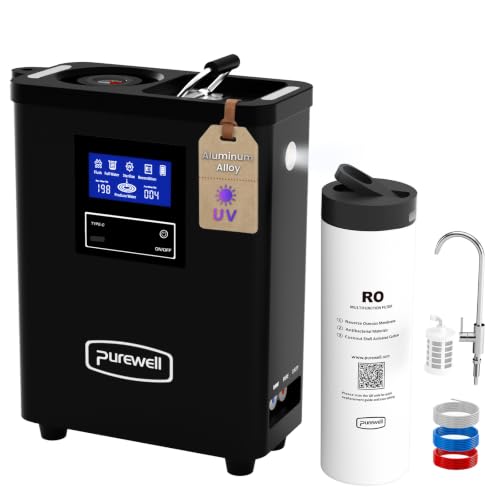
- 0.0001-micron RO membrane and dual UV
- Up to 6.5 hours of battery use
- TDS display and emergency lighting
Best For: Camping groups, RV trips, and emergency prep
Best High-Capacity Backup
Portable 3-Stage RO Survival Pump

- Three-stage purification
- 0.0001-micron RO membrane
- Listed 10,000-liter capacity
Best For: Emergency supplies and outdoor backup use
Best Plug-In Countertop Option

- No plumbing or installation
- Five-stage filtration with remineralization
- Glass carafe and filter-life monitor
Best For: Powered campsites, RVs, and countertop use
Best Heavy-Duty Travel Design

- Stainless steel travel kettle
- True 100°C boiling function
- Integrated filtration and heating
Best For: RV travel, overlanding, and off-grid road trips
Best High-Output Faucet-Connected System

- Approximately 3 gallons per hour
- RO plus DI filtration near 0 PPM
- Connects to a faucet without a plumber
Best For: RV and travel use with a compatible faucet
Efficient Countertop Pick

- 7-in-1 RO filtration with TDS monitoring
- Installation-free, self-cleaning countertop design
- 3-liter capacity and 3:1 pure-to-drain ratio
Best For: Powered campsites and RV kitchens needing compact RO filtration
Hot-and-Cold Camping Option
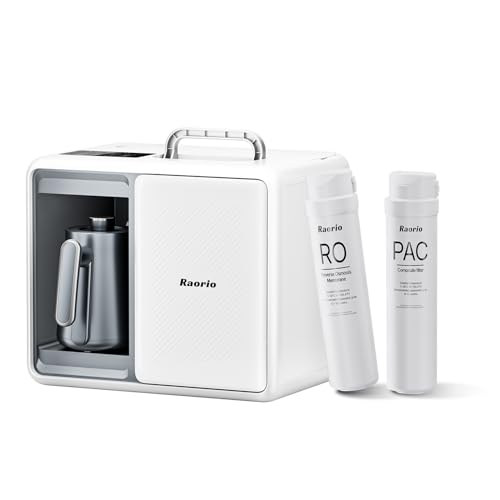
- Five-stage RO filtration with a 0.0001 μm membrane
- Nine temperature settings with hot-water dispensing
- No plumbing and quick filter replacement
Best For: RV and travel-trailer campers wanting hot filtered water
Best Lightweight Pump – Portable RO Water Filter Pump
For campers who need a compact purification option away from utilities, this portable pump is a straightforward choice among reverse osmosis systems for camping. Its RO membrane is designed to improve water from creeks and streams, with a listed capacity of up to 8,000 liters.
Best For: Backpackers, hikers, and emergency kits that need a compact, manually operated water purifier.
Pros:
- Portable freestanding design for outdoor use.
- Reverse osmosis filtration helps reduce small particles and impurities.
- Rated for up to 8,000 liters with a flow rate of up to 300 milliliters per minute.
- Uses chemical-free filtration.
Cons:
- Supports source water up to a listed 300 PPM TDS level.
- Flow rate is modest compared with powered systems.
- Only the water filter pump is listed among the included components.
This is the most compact and basic option in the group. It makes sense when portability and independence from an outlet matter more than high-volume dispensing or electronic monitoring.
Best Battery-Powered Option – Purewell Electric RO System with UV
This Purewell model is built for campers and RV travelers who want powered purification with extra monitoring. It combines a 0.0001-micron RO membrane, dual UV lamps, a TDS display, and a rechargeable battery in a portable aluminum-alloy unit.
Best For: Camping groups, RV trips, and emergency preparedness where battery operation, high-TDS reduction, and water-quality feedback are priorities.
Pros:
- 0.0001-micron RO membrane with dual UV treatment.
- TDS monitoring helps indicate water-quality status and filter replacement needs.
- Battery runs for up to 6.5 hours and can fill a 2.1-liter bottle in about three minutes.
- Includes a carry bag, emergency lighting, and a 54W charger.
Cons:
- Requires charging and has a larger footprint than a simple pump.
- Designed for fresh or brackish water, not ocean seawater.
- Filter life varies with source-water quality, despite the listed 12-month cycle.
With its battery, display, UV stage, and lighting, this is the most feature-rich choice here for off-grid use. It is a stronger fit for longer trips and groups, provided you can keep the battery charged.
Best Plug-and-Play Countertop Unit – Bluevua RO100ROPOT-Travel
The Bluevua RO100ROPOT-Travel is a countertop-style option for powered campsites, road trips, and travel setups with an outlet. It uses six-stage filtration with UV, needs no plumbing installation, and includes a reusable glass bottle for on-demand dispensing.
Best For: Car campers, RV users, and travelers who want a compact electric purifier with simple controls and a reusable bottle.
Pros:
- Six-stage filtration combines RO and UV treatment.
- Plug-and-play countertop design requires no plumbing.
- Includes a borosilicate glass bottle and dispenses 18 ounces at a time.
- Self-cleaning function, filter-life alert, and 3:1 filtered-to-waste ratio.
Cons:
- Corded electric operation requires access to an outlet.
- Glass construction may be less convenient for rugged backcountry travel.
- Its listed capacity is 2,000 liters rather than the higher capacities of some pump models.
This unit offers the easiest setup for campsite or RV use when electricity is available. Its compact dimensions and maintenance alerts are convenient, but the cord and glass bottle make it less suited to minimalist backpacking.
Best High-Capacity Backup – Portable 3-Stage RO Survival Pump
This portable three-stage survival pump is designed for outdoor and emergency water purification, with a 0.0001-micron RO membrane and a listed 10,000-liter capacity. It is a simple candidate for campers comparing reverse osmosis systems for camping without needing a countertop installation.
Best For: Emergency supplies, hiking, camping, and outdoor users seeking a high-capacity freestanding purifier.
Pros:
- Three-stage purification includes a 0.0001-micron RO membrane.
- Freestanding portable design suits outdoor use.
- Listed capacity of up to 10,000 liters.
Cons:
- The supplied notes do not specify flow rate or supported TDS level.
- No battery, charging system, or electronic monitoring is listed.
- Only one unit is listed in the package.
The large stated capacity makes this an interesting backup-oriented option. Because fewer operating details are provided, shoppers should confirm the flow rate, source-water limits, and included accessories before relying on it for a particular trip.
Best Plug-In Countertop Option – Bluevua RO100ROPOT
For campers who want a straightforward countertop setup, the Bluevua RO100ROPOT is one of the more convenient reverse osmosis systems for camping when access to a power source is available. It requires no plumbing, uses a borosilicate glass carafe, and combines five-stage filtration with remineralization.
Best For: Campers and RV users who want a portable, no-installation RO unit for powered campsites or indoor RV use.
Pros:
- No plumbing or installation is required; simply plug it into a power source.
- Five-stage filtration includes a remineralization filter and is designed to reduce 99.9% of possible contaminants.
- Glass carafe, filter-life monitor, standby mode, and a stated 2:1 pure-to-drain ratio add convenience.
Cons:
- Its corded-electric design requires access to compatible power.
- The glass carafe may be less suitable for rough travel than a shatter-resistant container.
- With a 0.26-liter-per-minute maximum flow rate, filling larger containers can take time.
The Bluevua is a strong fit when portability means easy countertop transport rather than completely off-grid operation. Its 12-liter capacity and long stated filter life are useful for extended stays, while the glass construction and remineralization feature may appeal to users focused on taste and materials.
Best Heavy-Duty Travel Design – Ranein Portable RO Purifier
The Ranein combines reverse osmosis filtration with a built-in hot-water kettle, making it a specialized choice among reverse osmosis systems for camping. Its stainless steel kettle is designed for road travel, and the unit can pair with portable power stations, RV generators, or suitable vehicle inverters.
Best For: RV travelers, campers, truck drivers, and overlanders who want filtered water plus true boiling in one compact countertop unit.
Pros:
- Food-grade stainless steel kettle is intended to resist drops, vibration, and rough road conditions better than glass.
- Heats water to a stated 100°C (212°F) for physical thermal sterilization.
- Integrated filtration and heating reduce loose components and save countertop space.
- Adjustable temperature controls support use with compatible portable power equipment.
Cons:
- The rated wattage must be compatible with the chosen power station, generator, or inverter.
- The supplied notes do not specify a filter life, capacity, flow rate, or contaminant-removal percentage.
- Its heating function may demand more power than a filtration-only camping setup.
Choose the Ranein if ruggedness and hot water are priorities rather than maximum specification detail. It is particularly practical for road-based camping, where a stainless steel container and all-in-one design can be more useful than a delicate countertop dispenser.
Best High-Output Faucet-Connected System – Universal 5-Stage RO
Campers who need higher output and a compact form may prefer this faucet-connected unit. It attaches without a plumber, works for RVs and travel, and uses a five-stage RO and DI setup designed to produce water close to 0 PPM after the deionizing postfilter.
Best For: RV owners, travelers, and campers who have a compatible faucet and want approximately three gallons of purified water per hour.
Pros:
- Portable countertop design attaches to a kitchen faucet without professional plumbing.
- Five-stage RO filtration with DI postfiltration is designed for water close to 0 PPM.
- 75 GPD capacity and approximately three gallons of pure water per hour support larger water needs.
- Made in the USA and supplied with a 75 GPD RO membrane.
Cons:
- It needs a compatible faucet connection, unlike plug-in tank-style countertop systems.
- The listed maximum source-water TDS level is 50 PPM, which limits suitability for higher-TDS sources.
- The supplied notes do not identify a storage tank or provide filter-replacement intervals.
This system makes sense when output matters and your campsite, RV, or travel location provides a usable faucet. Its DI stage is a notable feature for users seeking very low-TDS water, although the low stated maximum input TDS means checking your source water first is important.
Efficient Countertop Pick – DREO RO Water Filter 112
For shoppers comparing reverse osmosis systems for camping, the DREO RO Water Filter 112 is a compact, installation-free countertop option. Its 3-liter capacity, autofill pitcher, built-in TDS meter, and self-cleaning design suit campers who have access to a power source and want a simple water-purification setup.
Best For: Campers seeking a compact countertop RO unit with TDS monitoring and an autofill pitcher.
Pros:
- 7-in-1 RO filtration is described as reducing 99.9% of possible contaminants, including PFOA, PFOS, chlorine, and fluoride.
- Installation-free countertop design with a self-cleaning function.
- Displays TDS levels and filter-life information.
- Uses a 3:1 pure-to-drain ratio and supports source water up to 1,200 ppm TDS.
Cons:
- The 3-liter capacity may require frequent refilling for groups.
- At 9.5 pounds, it is less convenient for lightweight, mobile camping.
- Its listed six-month filter cycle adds an ongoing maintenance requirement.
The DREO stands out for straightforward countertop operation and useful monitoring features. It is a practical choice for powered campsites or RV kitchens, but its size and weight are worth considering if portability is your priority.
Hot-and-Cold Camping Option – Portable 5-Stage RO Purifier
This portable countertop system is a versatile choice among reverse osmosis systems for camping, especially for RVs and travel trailers. It combines five-stage RO filtration with instant hot and cold dispensing, nine temperature settings, and a no-plumbing setup.
Best For: RV campers who want filtered water plus convenient hot-water settings for drinks or baby formula.
Pros:
- Five-stage filtration with a 0.0001 μm membrane is designed to reduce TDS, PFAS, PFOA, fluoride, arsenic, lead, and other contaminants.
- Offers nine temperature settings, including hot water up to 212°F.
- Portable, installation-free countertop design works in RV and off-grid environments.
- Quick five-second filter replacement and a listed six- to 12-month filter lifespan simplify maintenance.
Cons:
- At 16.5 pounds, it is relatively heavy for frequent campsite transport.
- The 15-by-10-by-12-inch footprint may be large for small camping counters.
- It has an 8.5-pound listed capacity, so the product details do not specify a large water reservoir.
With hot-water dispensing and broad filtration claims, this model is more than a basic drinking-water filter. It makes the most sense for campers who value beverage convenience and have enough counter space for a heavier appliance.
Certified Feature-Rich Pick – BLACK+DECKER RO+UV System
The BLACK+DECKER RO+UV system is a strong contender among reverse osmosis systems for camping when monitoring, hot-water access, and certification are important. Its portable, no-installation design fits an RV or campsite with power, while the UV-equipped five-stage system adds another treatment stage.
Best For: Campers wanting certified RO filtration, UV treatment, hot water, and detailed digital monitoring.
Pros:
- Five-stage RO filtration with UV light is designed to reduce PFOS, PFOA, PFAS, chlorine, fluoride, arsenic, lead, and more.
- Provides five temperatures from 68°F to 212°F and three selectable dispensing volumes.
- Includes real-time TDS monitoring, filter alerts, automatic dispensing, and a child lock for hot water.
- NSF/ANSI 58 and IAPMO R&T Platinum Seal certifications are listed, along with a 2:1 pure-to-drain ratio.
Cons:
- The supplied notes do not provide the unit’s dimensions, weight, or reservoir capacity.
- Hot-water operation and UV treatment require access to electricity, limiting use away from powered sites.
- Filter replacement is still required, although the listed filter life is up to 12 months.
This BLACK+DECKER model offers the most comprehensive feature set of the three, combining RO, UV, temperature control, and certification information. It is best suited to powered camping setups where convenience and monitoring matter more than ultralight portability.
How We Picked the Best Reverse Osmosis Systems for Camping
We focused on portability, filtration design, setup requirements, and practical campsite usability. The lineup includes compact travel RO units, electric countertop systems, multi-stage purifiers, and models with extras such as UV treatment, remineralization, hot-water dispensing, or TDS monitoring.
We also considered how easily each system can fit into an RV, tent base camp, cabin, or emergency kit. Because camping conditions vary, no single model is ideal for every trip: power availability, source-water quality, daily volume, and tolerance for wastewater all matter.
Quick Comparison
- Best for travel: Compact countertop or dedicated travel units with simple reservoirs and low setup demands.
- Best for RV use: Electric countertop RO systems that provide higher daily capacity and convenient dispensing.
- Best for emergencies: Pump-style systems that can operate away from standard household plumbing, provided their output and effort requirements suit your group.
- Best for monitoring: Models with TDS displays, filter-life indicators, or automatic filling features.
- Best for extra treatment: Systems adding UV purification or additional stages for specific concerns such as PFAS.
Key Buying Factors for Reverse Osmosis Systems for Camping
Power and Setup
Check whether the purifier needs wall power, a vehicle outlet, batteries, or manual pumping. Electric units are convenient at powered campsites but may be unsuitable for remote use unless you have a compatible inverter or power station.
Water Capacity and Speed
Compare the clean-water reservoir, raw-water capacity, and dispensing rate with your group’s needs. A small tank may be adequate for one or two people, while larger groups benefit from faster production and fewer refills.
Waste-Water Ratio
RO filtration typically creates reject water. Look for the stated pure-to-drain ratio and plan how to collect or reuse wastewater when camping. A less efficient unit can consume more source water than expected.
Filtration and Maintenance
Confirm the included stages, membrane rating, and replacement-filter availability. UV can add another treatment step, while TDS monitoring helps track performance but does not identify every contaminant. Follow the manufacturer’s sanitizing and storage instructions between trips.
Portability and Durability
Measure the unit and account for its weight, reservoirs, cords, and accessories. A compact design is valuable in a tent or small RV kitchen, but rugged construction and protected controls matter more for frequent outdoor transport.
Who Should Buy Which Reverse Osmosis Systems for Camping?
Choose a compact travel model if you need cleaner water for short trips, hotel stays, or small RV kitchens. Choose a countertop system with monitoring and automatic functions if convenience and repeat daily use are priorities at a powered campsite or cabin. Choose a UV-equipped or enhanced multi-stage model when you want additional treatment features for treated source water. Choose a manual pump purifier for emergency kits and off-grid situations, but verify its real-world flow rate and the effort required before relying on it for a group. Always check source-water advisories and use only systems rated for the water conditions you expect to encounter.
