Well water can contain sediment, hardness minerals, metals, microbes, and other contaminants that affect taste, odor, and household water quality. The right reverse osmosis system can provide a more reliable source of filtered drinking water when paired with appropriate pretreatment.
These 10 picks cover under-sink, tankless, alkaline, UV, high-capacity, and whole-house configurations. Use the guide below to match flow rate, filtration stages, maintenance needs, and well-water compatibility to your home.
Best 10 Reverse Osmosis Systems for Well Water Picks for 2026
Whole-Home Softening Pick
Aquasure 64,000-Grain Bundle with 75 GPD RO

- 64,000-grain whole-house softener
- 75 GPD reverse osmosis drinking system
- Up to 5-year warranty and lifetime support
Best For: Larger homes needing softened water and RO drinking water
Alkaline Under-Sink Pick
- Six-stage under-sink filtration
- Adds calcium for alkaline water
- 75 GPD rating and up to 2,000 ppm TDS
Best For: Point-of-use drinking water with added alkalinity
High-Purity DIY Pick
Express Water RODI10D RO/DI System

- Six-stage RO and deionization
- Up to 99.99% listed contaminant reduction
- Leak detector and customizable fittings
Best For: DIY users needing high-purity under-sink water
Pre-Filter and Softener Bundle
Aquasure 72,000-Grain Whole-House System

- Whole-house softener and pre-filter bundle
- 75 GPD RO drinking-water stage
- Programmable automatic regeneration and backwash
Best For: Homes needing hardness, sediment, and drinking-water treatment
Best Certified Tankless Pick
iSpring RO500AK Alkaline RO System

- NSF/ANSI 58 complete-system certification
- 500 GPD tankless design with 2:1 drain ratio
- Alkaline remineralization and auto-flush
Best For: Certified, space-saving filtration with improved taste
Best High-Capacity Smart System

- 600 GPD capacity with 2:1 low drain ratio
- Smart faucet displays TDS and filter life
- NSF/ANSI 58 and 372 certified
Best For: High-volume use with built-in water monitoring
Best Traditional Alkaline Value

- NSF/ANSI 58 certified for multiple reductions
- Six-stage filtration with alkaline remineralization
- Includes a modern black RO faucet
Best For: Traditional under-sink filtration with mineralized taste
High-Capacity Pick
Waterdrop G5P700A Alkaline Mineral RO

- 700 GPD tankless output with a 2:1 pure-to-drain ratio
- 8-stage filtration with RO and alkaline mineralization
- Compact design supports refrigerator and ice-maker connections
Best For: Busy households wanting fast, compact filtration with remineralized water
UV Protection Pick
iSpring RO5004F-AK UV Alkaline RO
- Tankless 500 GPD system with built-in pump
- Adds UV protection and alkaline remineralization
- Filter-life monitoring supports scheduled maintenance
Best For: Well-water users wanting UV treatment and pump-assisted flow
Boost-Pump Value

- 100 GPD seven-stage system with booster pump
- Includes UV filtration and alkaline remineralization
- Supports feedwater up to 750 ppm TDS
Best For: Moderate-use households needing pump-assisted filtration
Whole-Home Softening Pick – Aquasure 64,000-Grain Bundle with 75 GPD RO
For households comparing reverse osmosis systems for well water, this Aquasure bundle combines whole-house softening with a 75 GPD reverse osmosis drinking-water system. Its 64,000-grain capacity and support for water TDS levels up to 2,000 ppm make it suited to larger homes seeking both softened water and filtered drinking water.
Best For: Homes with four to five bathrooms and up to six residents that want whole-house water softening plus drinking-water RO filtration.
Pros:
- Designed for homes with 4 to 6+ bathrooms and up to six family members.
- 64,000-grain softening capacity helps address hard minerals such as iron and magnesium.
- Automatic metered control and a 75 GPD RO membrane support efficient operation and lower maintenance.
- Includes up to a five-year manufacturer warranty and lifetime technical support.
Cons:
- Its whole-house design requires more installation space than an under-sink RO system.
- The listed maximum flow rate is 1.33 gpm, so it is not intended as a high-flow whole-home supply solution.
This is a practical choice when well-water concerns include both hardness and drinking-water quality. Buyers should confirm available installation space and water-pressure compatibility before choosing it.
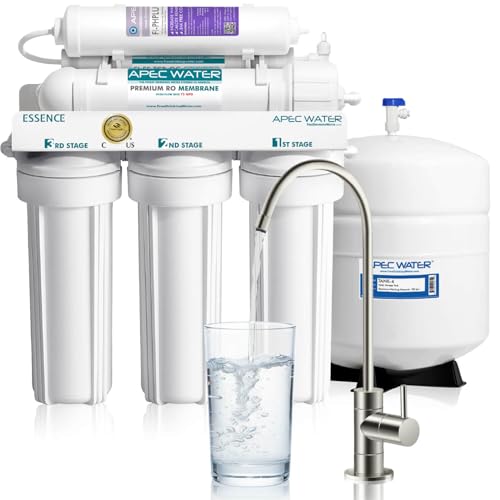
Alkaline Under-Sink Pick – APEC ROES-PH75 6-Stage RO
The APEC ROES-PH75 is a compact under-sink option for shoppers evaluating reverse osmosis systems for well water. Its six-stage design is rated for up to 99% reduction of numerous impurities, while the calcium-based stage adds minerals for improved alkalinity and taste.
Best For: Households that want an under-sink drinking-water system with alkaline enhancement and a 75 GPD production rating.
Pros:
- Six-stage filtration is designed to reduce chlorine, fluoride, arsenic, lead, heavy metals, VOCs, and other impurities.
- Calcium-based filter media adds minerals and supports improved alkalinity.
- Supports feed-water pressure from 40 to 85 psi and TDS levels up to 2,000 ppm.
- Includes a tank, faucet, tubing, adapter, drain saddle, and filter-changing wrenches.
Cons:
- Under-sink installation treats drinking water rather than water throughout the home.
- The listed maximum flow rate is 0.05 gpm, so filling containers may take time.
With WQA certification details and premium replacement cartridges, this system is a strong fit for point-of-use filtration. Verify that your well-water pressure falls within its 40–85 psi operating range.
High-Purity DIY Pick – Express Water RODI10D RO/DI System
For buyers seeking reverse osmosis systems for well water and other demanding filtration needs, the Express Water RODI10D pairs reverse osmosis with deionization. The six-stage under-sink system is designed to reduce up to 99.99% of listed contaminants and includes a leak detector that can stop water flow when it senses moisture.
Best For: DIY-minded users who want very high-purity water for drinking, cooking, cleaning, plants, or aquariums.
Pros:
- Combines RO filtration with ion-exchange deionization for additional impurity removal.
- Designed to reduce lead, chlorine, fluoride, nitrates, calcium, arsenic, and other contaminants.
- Quick-connect fittings support installation and future customization with optional filtration attachments.
- Includes an emergency leak-stop detector and a four-gallon storage tank.
Cons:
- The system is rated for maximum feed-water TDS of 1,000 ppm, lower than some competing options.
- Its under-sink format does not provide whole-house filtration.
- Deionized water may not be the preferred choice for every household drinking-water setup.
The RODI10D stands out when low-mineral water and expandability matter more than whole-home coverage. Check the incoming TDS level and plan for enough cabinet space for the tank and filtration assembly.
Pre-Filter and Softener Bundle – Aquasure 72,000-Grain Whole-House System
This Aquasure bundle is built for shoppers considering reverse osmosis systems for well water alongside broader whole-house treatment. It combines a water softener, dual-purpose sediment/GAC pre-filter, and 75 GPD RO system to address hardness, sediment, odors, chlorine, and selected contaminants before drinking-water filtration.
Best For: Homes with one to six bathrooms that need whole-house softening and pre-filtration plus a dedicated RO drinking-water stage.
Pros:
- Designed to provide filtered and softened water throughout the home.
- Pre-filters target sediment, sand, silt, rust, chlorine, VOCs, odors, and taste.
- Programmable digital controls can automate regeneration, backwash, and auto-flush intervals.
- Includes a five-year extended warranty after online activation and lifetime U.S.-based technical support.
Cons:
- The supplied specifications list a maximum TDS level of 500 ppm, which may limit suitability for some well sources.
- Replacement filters are recommended every 6–12 months, adding ongoing maintenance.
- The listed installation type is under sink despite the bundle’s whole-house components, so installation planning is important.
This bundle is appealing when a well-water setup needs more than RO alone, particularly sediment and hardness management. Confirm the source-water TDS and clarify the installation layout before purchasing.
Best Certified Tankless Pick – iSpring RO500AK Alkaline RO System
For shoppers comparing reverse osmosis systems for well water, the iSpring RO500AK-BN combines NSF/ANSI 58 complete-system certification with alkaline remineralization and a compact tankless design. Its 500 GPD capacity, auto-flush feature, and 2:1 pure-to-waste ratio make it a practical under-sink option, provided you have an electrical outlet and water pressure within its 15–70 psi operating range.
Best For: Households wanting a certified, space-saving RO system with alkaline water and strong water-efficiency features.
Pros:
- NSF/ANSI 58 certified as a complete system for TDS reduction.
- Produces up to 500 GPD at up to 0.4 GPM and fills an 8-ounce cup in about 10 seconds.
- Alkaline filter adds minerals back and is designed to improve taste.
- Tankless construction, auto-flush, and filter-change alerts simplify everyday use.
Cons:
- Requires under-sink electricity.
- Maximum supported TDS is listed as 1,000 ppm, so testing well water first is important.
- Includes a one-year warranty rather than a longer coverage period.
The RO500AK-BN stands out when certification, compact sizing, and mineralized taste matter more than avoiding electrical installation. Its documented contaminant-reduction claims and low drain ratio make it a well-rounded choice for many treated well-water setups.
Best High-Capacity Smart System – Waterdrop G3P600 Tankless RO
The Waterdrop G3P600 is a high-capacity option among reverse osmosis systems for well water, delivering up to 600 gallons per day in a tankless under-sink format. NSF/ANSI 58 certification for TDS reduction, a smart display faucet, and an 8-stage filtration design provide useful monitoring and filtration features, but the system requires electricity and an 87 psi operating pressure.
Best For: Larger households that want fast flow, high daily capacity, and faucet-based TDS and filter-life monitoring.
Pros:
- NSF/ANSI 58 certified for TDS reduction and NSF/ANSI 372 certified for lead-free materials.
- 600 GPD capacity, approximately 0.42 GPM flow, and an 8-ounce fill time of about eight seconds.
- Smart display faucet shows filtered-water TDS and filter-life status.
- 2:1 low drain ratio and tool-free filter changes help reduce maintenance.
Cons:
- Requires under-sink electricity.
- Its listed 87 psi operating pressure may require careful well-system compatibility checks.
- At 18.12 by 5.67 by 17.72 inches, it needs a sufficiently large cabinet.
With the highest rated capacity of these three systems, the G3P600 is appealing for frequent water use and households that value live feedback. Confirm cabinet dimensions, available power, and well-water pressure before choosing it.
Best Traditional Alkaline Value – iSpring RCC7AK-BLK 6-Stage RO
The iSpring RCC7AK-BLK offers a conventional six-stage under-sink setup for shoppers evaluating reverse osmosis systems for well water. It pairs NSF/ANSI 58 certification with an alkaline remineralization stage and a stylish black faucet, making it a strong fit for users who want mineralized taste and broad contaminant-reduction testing without moving to a tankless configuration.
Best For: Homes seeking a certified six-stage RO system with alkaline remineralization and a coordinated black faucet.
Pros:
- NSF/ANSI 58 certified for reductions including TDS, lead, fluoride, arsenic, PFAS, and other listed contaminants.
- Six-stage filtration includes three pre-filters, a 0.0001-micron RO membrane, polishing GAC, and an alkaline filter.
- Alkaline stage restores minerals and is designed to improve taste.
- Includes installation parts, quick-fitting connectors, instructional resources, and lifetime technical support.
Cons:
- Its listed capacity is 75 gallons, substantially lower than the tankless systems in this roundup.
- Under-sink space should be checked before purchase; the listed dimensions are 15.5 by 16 by 18 inches.
- Well-water quality should be tested first because the supplied specifications list a maximum TDS of 97 ppm.
The RCC7AK-BLK is the straightforward choice for buyers who prefer a traditional six-stage system and want the visual upgrade of a black faucet. Its certification and alkaline finishing stage are compelling, though its listed capacity and TDS specification deserve attention when matching it to well water.
High-Capacity Pick – Waterdrop G5P700A Alkaline Mineral RO
For households comparing reverse osmosis systems for well water, the Waterdrop G5P700A stands out for its 700 GPD output, compact tankless design, and alkaline mineral stage. Its 8-stage filtration is designed to reduce contaminants including PFAS, lead, fluoride, heavy metals, chlorine, and unpleasant tastes and odors. The system is rated for feedwater up to 500 ppm TDS.
Best For: Busy households wanting fast, compact filtration with remineralized water.
Pros:
- 700 GPD capacity can fill a 6-ounce cup in about 6 seconds.
- 8-stage filtration includes a 0.0001-micron RO membrane and alkaline mineralization.
- Tankless design saves under-sink space and provides a 2:1 pure-to-drain ratio.
- Can connect to an ice maker, refrigerator, or other water-using appliance with Waterdrop XT.
Cons:
- Feedwater TDS is limited to 500 ppm.
- Electric operation requires a nearby power connection.
- Faucet installation requires drilling a countertop hole.
The G5P700A is a strong fit when speed and space efficiency matter. Before buying for well water, verify that your source falls within the stated pressure, temperature, and TDS ranges.
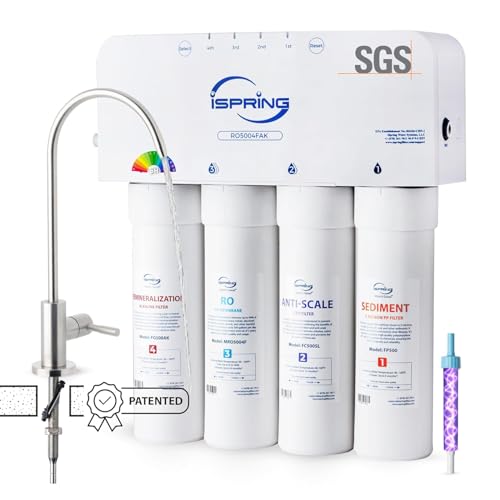
UV Protection Pick – iSpring RO5004F-AK UV Alkaline RO
The iSpring RO5004F-AK is one of the more feature-rich reverse osmosis systems for well water, combining tankless filtration with UV protection, alkaline remineralization, and a built-in pump. SGS testing supports its PFAS and TDS reduction claims, while the pump is intended to improve performance in lower-pressure environments.
Best For: Well-water users who want UV treatment, pump-assisted flow, and filter-life monitoring.
Pros:
- Seven-stage-style treatment includes RO, UV, and an alkaline mineral stage.
- Built-in pump supports RO performance in low water pressure conditions.
- 500 GPD output can fill a cup in about 10 seconds.
- Filter monitoring and quick-twist replacement simplify maintenance.
Cons:
- UV operation and the pump require electrical power.
- Its 500 GPD rating is lower than the 700 GPD Waterdrop option.
- Replacement filters are an ongoing ownership expense.
With UV protection, a pump, and maintenance reminders, this model is well suited to users who want additional treatment features in a tankless format. Check your installation space and water conditions before choosing it.
Boost-Pump Value – iSpring RCC1UP-AK 7-Stage RO
The iSpring RCC1UP-AK combines seven-stage filtration with a booster pump, UV treatment, and alkaline remineralization. For shoppers evaluating reverse osmosis systems for well water, its pump can help maintain membrane performance while reducing wastewater compared with pumpless models. It supports feedwater up to 750 ppm TDS, though its 100 GPD output is intended for a more moderate-use setup.
Best For: Households needing pump-assisted, multi-stage filtration with a higher stated TDS limit.
Pros:
- Reduces up to 99% of more than 1,000 listed contaminants, according to the supplied product information.
- Booster pump helps pressurize water through the RO membrane.
- Includes UV filtration and an alkaline filter for remineralization.
- Supports feedwater up to 750 ppm TDS and includes a transparent first-stage housing.
Cons:
- 100 GPD capacity is substantially slower than the tankless systems in this roundup.
- The under-sink assembly is larger, measuring 15.35 by 9.06 by 18.11 inches.
- Its 0.07 gpm maximum flow rate may feel slow for high-demand households.
The RCC1UP-AK makes sense when pump assistance, UV treatment, and a 750 ppm TDS limit are priorities. Its lower capacity and larger footprint make it better suited to moderate water use with adequate cabinet space.
How We Picked These Reverse Osmosis Systems for Well Water
We selected systems across several common well-water setups rather than focusing on one design. The lineup includes compact under-sink units, high-output tankless models, alkaline remineralization systems, UV-equipped options, and whole-house bundles that combine softening or sediment filtration with drinking-water RO.
Our comparison emphasizes practical specifications: daily production capacity, filtration stages, certification or testing claims, included pretreatment, installation format, replacement-filter availability, and whether the system is designed for point-of-use or broader household treatment. Because well-water chemistry varies widely, no RO system should be treated as a universal fix without testing the incoming water first.
Quick Comparison
| Best For | Look For | Why It Matters |
|---|---|---|
| Most drinking-water setups | Under-sink RO with remineralization | Balances filtration, footprint, and taste |
| High daily water demand | 500–700 GPD tankless output | Faster filling and less storage space |
| Hard or sediment-heavy well water | Softener and sediment/GAC pretreatment | Protects RO membranes from fouling |
| Microbial concerns | UV stage or whole-house disinfection | Adds another treatment barrier, but does not replace testing |
| Low incoming pressure | Booster pump | Helps maintain production and rejection performance |
Key Buying Factors for Reverse Osmosis Systems for Well Water
Test the Water First
Start with a laboratory water test covering hardness, iron, manganese, nitrate, arsenic, sulfur, pH, TDS, bacteria, and other locally relevant contaminants. RO is effective against many dissolved impurities, but high sediment, iron, hardness, or microbial contamination may require upstream treatment.
Choose the Right System Type
Point-of-use systems filter water at one faucet and are usually the simplest choice for drinking and cooking. Whole-house bundles treat incoming water more broadly, but they require more space, plumbing work, and ongoing media maintenance. A whole-house softener or prefilter may be especially useful before a separate under-sink RO unit.
Compare Capacity and Pressure Requirements
GPD ratings indicate nominal production under specified conditions, not guaranteed real-world output. Well systems with low pressure may benefit from a booster pump. Tankless systems save cabinet space, while tank models provide stored water during short periods of high demand.
Consider Maintenance and Wastewater
Plan for sediment and carbon filter changes, membrane replacement, sanitization, and filter availability. Check the system’s product-water-to-drain-water ratio and confirm that your plumbing can accommodate the drain connection.
Who Should Buy Which Reverse Osmosis Systems for Well Water?
Choose a whole-house bundle if your well water is hard, visibly sediment-laden, or affecting multiple fixtures. Choose a tankless high-output model if you want fast dispensing, a smaller footprint, and frequent daily use. Choose an alkaline system if you prefer remineralized water and a less acidic taste after RO filtration. Choose a UV-equipped system when testing or professional assessment indicates a microbial-treatment need. Choose a booster-pump model when well pressure is inconsistent or below the manufacturer’s recommended range.
Before installation, verify connection sizes, cabinet clearance, electricity requirements, replacement-filter costs, and local water-treatment guidance. The best system is the one that matches your tested water chemistry and can be maintained consistently.
