The right water can make a noticeable difference in coffee flavor, espresso consistency, and equipment maintenance. A reverse osmosis system can reduce unwanted minerals and contaminants, but the best setup depends on how much coffee you make and how you want to remineralize the water.
We compare 10 options for homes, offices, cafés, and light commercial use, covering countertop purifiers, high-capacity tankless systems, and certified under-sink filters.
Best 10 Reverse Osmosis System for Coffee Picks for 2026
Commercial Coffee Specialist

- Purpose-built for coffee, tea, and espresso
- Includes two RO membranes and a post filter
- Heavy-duty, U.S.-made polypropylene system
Best For: Dedicated beverage-service installations
High-Output Commercial Pick

- Produces up to 1,000 gallons per day
- Tankless, on-demand design with pressure gauges
- Connects to espresso machines and other appliances
Best For: High-volume cafés and small businesses
Portable Countertop Option

- No plumbing or installation required
- Five-stage RO filtration with remineralization
- Glass carafe and filter-life monitor included
Best For: Home coffee stations and renters
Space-Saving Alkaline Pick

- Eight-stage filtration with alkaline minerals
- Tankless 500 GPD under-sink design
- 2:1 pure-to-drain ratio and appliance connections
Best For: Compact home coffee and kitchen setups
Best Countertop Hot-and-Cold Pick

- Instant hot and chilled water
- Seven-stage filtration with mineralization
- Large tank with no plumbing required
Best For: Families and coffee drinkers wanting convenient countertop dispensing
Best Under-Sink Performance Pick
Waterdrop T3-T Remineralization RO

- 220 GPD high-flow production
- Seven-stage filtration with remineralization
- Compact design with quick filter changes
Best For: Frequent coffee makers wanting fast, space-saving under-sink filtration
Best Glass-Carafe Pick
AquaTru Alkaline Countertop RO Purifier

- Four-stage filtration certified to NSF standards
- Glass carafe with alkaline mineral boost
- No plumbing or drilling required
Best For: Countertop coffee stations prioritizing glass storage and simple setup
Best Certified Value
iSpring RCC7-BN 75 GPD RO System

- NSF/ANSI 58 certified filtration
- Reduces TDS and scale-forming minerals
- 75 GPD, no power required
Best For: Traditional under-sink coffee-water filtration
Best Space-Saving Upgrade
Waterdrop WD-T4-A Alkaline Tankless RO
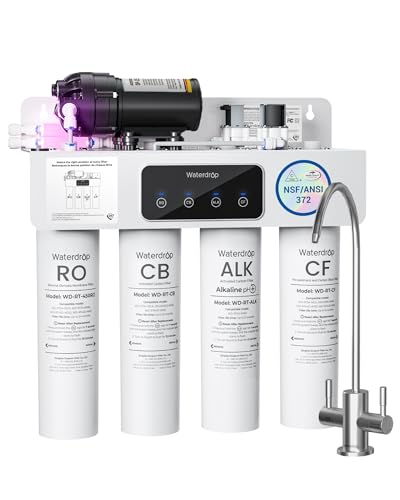
- Dual standard and alkaline water streams
- 450 GPD tankless output
- 2:1 pure-to-drain ratio
Best For: Compact, high-volume kitchen filtration
Best Remineralizing Option
iSpring RCC7AK-BLK Alkaline RO System

- Six-stage alkaline remineralization
- NSF/ANSI 58 certified
- Includes a stylish black faucet
Best For: Coffee users who prefer mineral-restored RO water
Commercial Coffee Specialist – 3M TFS450 Series
The 3M TFS450 Series is a purpose-built reverse osmosis system for coffee, hot tea, and espresso applications. Its heavy-duty polypropylene construction, included RO membranes, and 300-gallon capacity make it a focused option for beverage-service setups.
Best For: Coffee shops, espresso stations, and beverage applications needing a dedicated 3M RO system.
Pros:
- Designed specifically for coffee, hot tea, and espresso.
- Includes two RO membranes and a post filter.
- Heavy-duty polypropylene construction.
- Made in the United States.
Cons:
- Its 300-gallon capacity is lower than the higher-output commercial systems in this roundup.
- The 20-by-7-by-30-inch form factor may require dedicated installation space.
Choose this model when beverage preparation is the priority and you want a system built around coffee and espresso service rather than general household filtration.
High-Output Commercial Pick – iSpring CRO1000
The iSpring CRO1000 is a high-capacity reverse osmosis system for coffee shops and other busy settings. Its tankless design produces up to 1,000 gallons per day at a stated 0.7 GPM flow rate, and it can connect to espresso machines, ice makers, refrigerators, and faucets.
Best For: Coffee shops, restaurants, offices, and small businesses needing high-volume purified water.
Pros:
- High 1,000 GPD output for demanding applications.
- Tankless design supplies water on demand.
- Commercial-size four-stage filtration with a stainless-steel RO membrane housing.
- Freestanding wheeled frame includes locking brakes and pressure gauges.
Cons:
- Its 23.5-by-10.5-by-38.25-inch frame requires substantial floor space.
- A booster pump is recommended when inlet pressure is below 80 psi.
- Filter replacement intervals vary with water quality.
With its commercial output and appliance connections, the CRO1000 is the strongest fit here for operations that need a reverse osmosis system for coffee alongside other high-demand water uses.
Portable Countertop Option – Bluevua RO100ROPOT
The Bluevua RO100ROPOT is a plug-in countertop reverse osmosis system for coffee drinkers who want purified water without plumbing changes. Its five-stage filtration includes remineralization, while the borosilicate glass carafe and portable design make it convenient for home beverage preparation.
Best For: Home coffee stations, renters, and users who want countertop filtration without installation.
Pros:
- Requires no plumbing or installation.
- Five-stage filtration includes a remineralization filter.
- Includes a borosilicate glass carafe.
- Offers a stated 2:1 pure-to-drain ratio and filter-life monitoring.
Cons:
- Its 0.26-liter-per-minute flow rate is suited to countertop use rather than commercial volume.
- It requires a corded electrical connection.
- The 12-liter capacity may require refilling for larger brewing routines.
This is a practical choice when convenience and portability matter more than rapid throughput, especially for a home reverse osmosis system for coffee.
Space-Saving Alkaline Pick – Waterdrop G5P500A
The Waterdrop G5P500A combines an under-sink tankless design with eight-stage filtration and alkaline mineralization. Its 500 GPD capacity, 2:1 pure-to-drain ratio, and appliance-connectivity options make it a versatile reverse osmosis system for coffee in a modern kitchen.
Best For: Households wanting compact under-sink filtration with mineralized water and a steady supply for coffee and other appliances.
Pros:
- Eight-stage filtration includes alkaline mineralization.
- Tankless design frees under-sink space.
- 500 GPD capacity fills a stated 6-ounce cup in about 8 seconds.
- Can connect to ice makers, refrigerators, and other water-using devices.
Cons:
- Faucet installation requires drilling a countertop hole.
- It requires a corded electrical connection.
- Its maximum supported TDS level is 500 ppm.
The G5P500A is a balanced home option for coffee preparation when you want compact installation, fast access to purified water, and added minerals rather than a large storage tank.
Best Countertop Hot-and-Cold Pick – G1Pro Countertop RO System
For coffee drinkers who want purified water without plumbing, the G1Pro is a convenient reverse osmosis system for coffee. Its countertop design provides instant hot water with multiple temperature settings, while the remineralization stage is intended to improve taste.
Best For: Families and coffee drinkers who want countertop convenience, hot and chilled dispensing, and a larger water capacity.
Pros:
- Instant hot water with multiple temperature settings for coffee and tea.
- Seven-stage filtration includes UV treatment and strontium mineralization.
- Large 1.32-gallon tank and detachable pitcher suit households of four to six.
- No plumbing or installation required; includes TDS and filter-life monitoring.
Cons:
- Its 19.1-inch height and countertop footprint may require substantial space.
- Hot-and-cold dispensing adds features and complexity compared with a basic RO unit.
The G1Pro stands out when coffee convenience matters as much as filtration. Choose it if you want ready-to-use hot water at the counter; its monitoring, mineralization, and portability make it a feature-rich option for kitchens, offices, or RVs.
Best Under-Sink Performance Pick – Waterdrop T3-T Remineralization RO
The Waterdrop T3-T is a strong reverse osmosis system for coffee when you want a fast, under-sink source of purified water. Its 220 GPD production rate and remineralization stage are designed to reduce waiting and provide water with a fresher taste for coffee and cooking.
Best For: Households seeking a compact, high-flow under-sink system with remineralization and simplified filter replacement.
Pros:
- Produces up to 220 gallons per day and can fill five 16.9-ounce bottles in about one minute.
- Seven-stage filtration is SGS tested to NSF/ANSI 58 standards for a broad range of contaminant reductions.
- Remineralizes water with potassium, calcium, sodium, and magnesium for coffee and tea.
- Compact tankless design, 2:1 pure-to-drain ratio, and quick twist-in filter replacement.
Cons:
- Faucet installation requires drilling holes in the countertop.
- It requires under-sink installation, unlike the plug-and-play countertop models in this roundup.
The T3-T is the practical choice for users who prioritize speed, space savings, and ongoing convenience. Its installation is less casual than a countertop unit, but the high flow rate and remineralization are well matched to frequent coffee preparation.
Best Glass-Carafe Pick – AquaTru Alkaline Countertop RO Purifier
The AquaTru Glass Carafe is a polished reverse osmosis system for coffee for shoppers who prefer a countertop appliance and glass storage. Its four-stage filtration reduces 84 listed contaminants, while the alkaline mineral boost is designed to support a cleaner-tasting cup.
Best For: Coffee and tea drinkers who want countertop RO filtration, a removable glass carafe, and no drilling or plumbing.
Pros:
- Four-stage RO filtration is IAPMO tested and certified to NSF standards.
- Reduces 84 contaminants, including microplastics, arsenic, and PFOA/PFOS.
- Alkaline mineral boost filter is designed to improve taste for coffee, tea, and cooking.
- Plug-in countertop operation includes a removable borosilicate glass carafe with lid.
Cons:
- Maximum supported feed-water TDS is 600 ppm.
- Its listed maximum flow rate is 0.5 GPM, so it may be less suited to high-volume filling.
- Filter replacement schedules vary from six months to one year depending on the filter.
The AquaTru is a good fit for buyers who value simple setup and a glass carafe over maximum throughput. It offers a clean countertop format and mineral enhancement, making it especially appealing for individual coffee stations or smaller households.
Best Certified Value – iSpring RCC7-BN 75 GPD RO System
If you want a dependable reverse osmosis system for coffee, the iSpring RCC7-BN combines five-stage filtration with a 75 GPD capacity and NSF/ANSI 58 certification. Its filtration reduces TDS, hard-water minerals, and a broad range of listed contaminants, while the final carbon stage helps polish water for brewing.
Best For: Coffee drinkers who want a certified, traditional tank-style under-sink system without an electrical connection.
Pros:
- NSF/ANSI 58 certified and designed to reduce up to 99% of more than 1,000 listed contaminants.
- Reduces TDS by 80–90% and lowers hard-water minerals that can contribute to scale buildup.
- 75 GPD capacity, lead-free faucet, and food-grade tubing support regular kitchen and coffee use.
- Transparent first-stage housing, leak-prevention check valve, and included 1-year limited warranty after registration.
Cons:
- The tank-style design requires more under-sink space than a tankless system.
- Its 23.62-by-15.75-by-11.81-inch dimensions should be checked against available cabinet space.
The RCC7-BN is a practical pick when certification, mineral reduction, and a no-power installation matter more than compact tankless design. It is especially suited to brewers seeking consistently filtered water for coffee and other kitchen uses.
Best Space-Saving Upgrade – Waterdrop WD-T4-A Alkaline Tankless RO
The Waterdrop WD-T4-A is a flexible reverse osmosis system for coffee that offers both standard RO water and a mineral-enhanced alkaline stream. Its tankless design, 450 GPD output, and 2:1 pure-to-drain ratio make it a strong option for households that want fast, on-demand filtration while preserving under-sink space.
Best For: Busy kitchens that want compact tankless filtration, fast output, and a choice between standard and alkaline water.
Pros:
- Dual water flow provides standard RO-purified and mineral-enhanced alkaline options.
- 450 GPD capacity supports quick, on-demand water delivery.
- 2:1 pure-to-drain ratio is designed to reduce wastewater compared with traditional RO systems.
- Tankless construction frees reported under-sink space, while filter reminders help track replacements.
Cons:
- Requires an electrical connection for operation.
- Faucet installation requires drilling a countertop hole.
- Replacement schedules vary by component, including six months for the CF filter and 24 months for the RO membrane.
Choose the WD-T4-A if convenience and flexibility are priorities. Its dual-flow setup lets you select the water profile you prefer for coffee and drinking, though installation requirements and powered operation make it less suitable for a simple no-electricity setup.
Best Remineralizing Option – iSpring RCC7AK-BLK Alkaline RO System
For coffee drinkers who prefer RO water with minerals restored, the iSpring RCC7AK-BLK adds an alkaline remineralization stage to six-stage filtration. It is NSF/ANSI 58 certified, reduces TDS and numerous listed contaminants, and includes a stylish black faucet for a coordinated under-sink installation.
Best For: Users who want certified RO filtration with restored alkalinity and a modern black faucet.
Pros:
- Six-stage filtration includes an alkaline filter that restores minerals and alkalinity.
- NSF/ANSI 58 certified for reduction of TDS and several listed contaminants.
- Transparent first-stage housing makes filter inspection easier.
- DIY-oriented installation includes quick-fitting connectors, instructional support, and lifetime technical support.
Cons:
- Under-sink dimensions measure approximately 15.5 by 16 by 18 inches, so cabinet clearance should be verified.
- The system uses an AC power source according to the supplied specifications.
- Its 75-gallon capacity is lower than the Waterdrop model’s listed 450 GPD capacity.
The RCC7AK-BLK is a good match for brewers who do not want the mineral profile of standard RO water. Its remineralization stage and certification add appeal, while the included black faucet makes it a polished choice for a visible kitchen setup.
How We Picked the Best Reverse Osmosis System for Coffee
We focused on systems suited to brewing rather than treating drinking water alone. Our comparison considers filtration stages, stated production capacity, countertop or under-sink installation, included tanks or carafes, remineralization options, certifications, and features that affect daily coffee preparation.
Capacity claims are typically measured under specific water-pressure and temperature conditions, so real-world output may vary. We also looked for practical differences between compact home systems and higher-volume models intended for restaurants, offices, or small businesses.
Quick Comparison
| Best For | Recommended Type | What to Prioritize |
|---|---|---|
| Small kitchens and renters | Countertop RO | No plumbing, compact footprint, simple dispensing |
| Daily home coffee and espresso | Under-sink RO | Consistent supply, faucet quality, remineralization |
| High-volume brewing | Tankless or commercial RO | Fast flow, high daily capacity, durable cartridges |
| Balanced coffee flavor | RO with remineralization | Adjustable mineral profile and controlled output |
Key Buying Factors for a Reverse Osmosis System for Coffee
Water Profile and Remineralization
RO water is highly filtered and may taste flat when used by itself. Coffee brewers often benefit from a controlled amount of minerals, so consider an alkaline or remineralization stage if the system provides one. Avoid assuming that a higher pH automatically means better coffee; consistency matters more than marketing claims.
Flow Rate and Capacity
A compact countertop unit may be adequate for a few cups each day, while an espresso bar or busy office needs faster production and more storage. Compare gallons per day, dispensing speed, tank capacity, and recovery rate rather than relying on stage count alone.
Installation and Space
Countertop systems are usually easiest for renters and occasional users. Under-sink models save counter space but require plumbing access, a compatible faucet opening, and room for filters or a storage tank. Tankless systems can offer more usable cabinet space but may need power and adequate water pressure.
Certification and Maintenance
Look for relevant NSF/ANSI certifications and verify what each certification covers. Filter replacement schedules, cartridge cost, wastewater ratio, leak protection, and service access can have a larger long-term impact than the initial purchase price.
Who Should Buy Which Reverse Osmosis System for Coffee?
Choose a countertop system if you rent, lack plumbing access, or want a dedicated brewing station. These models are generally the simplest to install and move, though their reservoirs can require frequent refilling.
Choose an under-sink system for regular household coffee, tea, and drinking water. It keeps equipment off the counter and can provide a steadier supply for multiple users.
Choose a tankless high-capacity model if cabinet space, speed, and frequent brewing are priorities. Confirm electrical requirements, water pressure, drain connections, and replacement-filter availability before buying.
Choose a commercial-oriented RO system for a café, restaurant, or small business where demand is high and dependable output matters. Pair the system with a water recipe appropriate for the coffee equipment and local water conditions, and have installation completed according to the manufacturer’s requirements.