Portable reverse osmosis systems make it easier to produce cleaner-tasting drinking water without installing a permanently plumbed filtration system. Countertop models vary widely in capacity, filtration stages, wastewater ratios, automation, and maintenance requirements.
We compared 10 leading options to help you find the right balance of filtration performance, convenience, footprint, and long-term operating cost for your kitchen, office, apartment, or RV.
Best 10 Portable Reverse Osmosis Systems Picks for 2026
Best Glass-Carafe Pick

- Install-free countertop design
- Borosilicate glass carafe
- Five-stage RO with remineralization
Best For: Everyday home or office use
Best Outdoor-Ready Pick

- Battery-powered for off-grid use
- RO plus dual UV purification
- Emergency light and carry bag included
Best For: Camping, RV travel, and emergency prep
Best Pitcher-Convenience Pick

- Includes two autofill pitchers
- Built-in TDS and filter indicators
- Seven-stage countertop filtration
Best For: Pitcher-style household convenience
Best Compact Pick
Bluevua RO100ROPOT-Lite Countertop Reverse Osmosis Filter

- Plug-and-play countertop design
- Seven-stage filtration with UV and remineralization
- 3:1 pure-to-drain ratio with yearly filter changes
Best For: Small households wanting a compact, low-maintenance countertop RO system
Best High-Capacity Pick
Waterdrop G3P600 Tankless Reverse Osmosis System

- 600 GPD output with fast dispensing
- Eight-stage filtration and multiple certifications
- Tankless under-sink design with smart display faucet
Best For: Households needing high-volume RO water and an under-sink installation
Best Large-Carafe Pick
Bluevua RO100ROPOT Countertop RO System
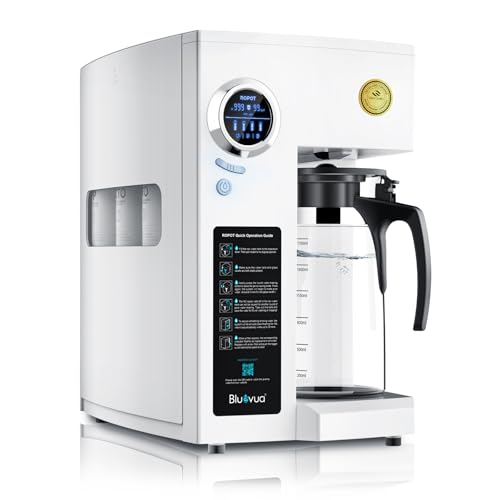
- No-install countertop operation
- Six-stage filtration with UV and remineralization
- 1,700 ml borosilicate glass carafe
Best For: Users wanting a convenient countertop RO system with a larger glass reservoir
Best Mineral-Tasting Option

- Mineral filter adds calcium, magnesium, potassium, and sodium
- Automatic 40-ounce glass pitcher refill
- 3:1 pure-to-drain ratio with up to 12-month filter life
Best For: One or two people who want mineral-enhanced water
Best Smart Controls

- Built-in TDS meter and filter-change indicator
- SGS-tested seven-in-one RO filtration
- Includes an autofill pitcher and requires no installation
Best For: Users who want visible filtration monitoring
Best Glass-Carafe Pick – Bluevua RO100ROPOT
The Bluevua RO100ROPOT is a practical choice among portable reverse osmosis systems when you want countertop operation without plumbing. Its five-stage filtration, remineralization filter, glass carafe, and filter-life monitor make it well suited to everyday home use.
Best For: Apartment kitchens, offices, and households seeking an install-free countertop RO system with a glass container.
Pros:
- No plumbing or installation required
- Borosilicate glass carafe helps reduce reliance on plastic
- Five-stage filtration includes remineralization
- Displays filter service life and water quality
Cons:
- Requires a corded electrical outlet
- Dispenses at a listed maximum flow of 0.26 liters per minute
- Its 12-liter capacity and countertop footprint may require dedicated space
Choose this model if a premium carafe and straightforward maintenance tracking matter more than battery portability. The 2:1 pure-to-drain ratio and automatic standby mode also support more efficient daily use.
Best Outdoor-Ready Pick – Purewell K8680/P01
The Purewell K8680/P01 stands out among portable reverse osmosis systems for camping, RV travel, and emergency preparation. Its battery power, dual UV lamps, aluminum-alloy body, carry bag, and emergency lighting provide useful features away from a conventional outlet.
Best For: Outdoor teams, RV trips, camping, and power-outage preparedness using fresh or brackish water.
Pros:
- Battery-powered design runs for up to 6.5 hours
- Uses 0.0001-micron RO filtration with dual UV purification
- Can fill a 2.1-liter bottle in about three minutes
- Includes emergency lighting and a carry bag
Cons:
- Not designed for ocean seawater
- Requires replacement filters as water quality and usage dictate
- More specialized than a simple countertop home dispenser
This is the strongest fit when portability and backup capability are priorities. Its Type-C port can reverse-charge devices, while the 2:1 purified-to-wastewater ratio helps conserve water during travel.
Best High-Flow Countertop Pick – SimPure Y7P-BW
The SimPure Y7P-BW is one of the more convenient portable reverse osmosis systems for countertop dispensing. It combines four-stage 0.0001-micron RO filtration with UV purification, quick-change cartridges, and a listed 4:1 pure-to-drain ratio.
Best For: Homes, offices, apartments, and RVs that need fast room-temperature purified water without installation.
Pros:
- Install-free countertop setup
- UV purification works alongside RO filtration
- 418 GPD flow rate can dispense a cup in approximately 15 seconds
- Quick-change filters provide up to 528 gallons of purified water
Cons:
- Only rated for source water with TDS below 500 ppm
- Dispenses room-temperature water only
- Filter life is listed at approximately six months
Consider this model if speed and water efficiency are more important than hot or cold dispensing. Its compact countertop format and twist-in filters simplify setup, while the UV stage adds another purification step.
Best Pitcher-Convenience Pick – DREO RO Water Filter
The DREO RO Water Filter 113 offers a convenient countertop approach to portable reverse osmosis systems, pairing seven-stage filtration with two autofill pitchers. Built-in TDS and filter-life indicators make it easier to monitor performance without plumbing or a complicated installation.
Best For: Households that want install-free RO filtration with refillable pitchers and straightforward touch controls.
Pros:
- Includes two autofill water pitchers
- Built-in TDS meter and filter-change indicator
- Touch controls support simple countertop operation
- Designed to filter 99.9% of possible contaminants, according to the supplied testing claim
Cons:
- Its 5-liter capacity may require frequent refilling for larger households
- No battery or power-source details are provided in the supplied notes
- Uses an ABS body rather than a glass container
This model makes the most sense when pitcher convenience and monitoring features are central to your buying decision. Its 15.7-by-6.7-by-13.4-inch footprint is relatively narrow, but you should still allow room for the two included pitchers.
Best Compact Pick – Bluevua RO100ROPOT-Lite Countertop Reverse Osmosis Filter
If you want portable reverse osmosis systems for a small kitchen, apartment, or office, the Bluevua RO100ROPOT-Lite offers plug-and-play filtration without plumbing. Its compact countertop design combines seven-stage filtration, UV treatment, remineralization, and a glass carafe.
Best For: One or two people who want a compact countertop RO system with smart controls and minimal annual maintenance.
Pros:
- No installation or plumbing required.
- Seven-stage filtration includes UV light and remineralization.
- Glass carafe, built-in TDS monitoring, and a 3:1 pure-to-drain ratio.
- Filter replacement is designed for once-a-year maintenance.
Cons:
- Its 1,200 ml capacity and 0.26-liter-per-minute flow rate are better suited to light household use.
- It requires a power connection and accepts water with a maximum TDS of 500 ppm.
The RO100ROPOT-Lite is a practical choice when portability and simple setup matter more than high-volume output. The included infuser and automatic volume selection add convenience for everyday drinking.
Best High-Capacity Pick – Waterdrop G3P600 Tankless Reverse Osmosis System
Among portable reverse osmosis systems, the Waterdrop G3P600 is designed for buyers who need substantially higher output in an under-sink format. Its tankless system delivers up to 600 gallons per day, uses eight-stage filtration, and includes a smart display faucet.
Best For: Households needing fast, high-volume filtered water and willing to install an under-sink system with electricity.
Pros:
- 600 GPD capacity and a flow rate of up to 0.42 gpm.
- Eight-stage filtration is certified or tested for reduction of multiple contaminants, including TDS, chlorine, fluoride, arsenic, and PFAS.
- Tankless design saves under-sink space compared with a conventional storage tank.
- Smart faucet displays TDS and filter-life information.
Cons:
- Requires under-sink electricity and installation.
- Cabinet dimensions must accommodate its 18.12-by-5.67-by-17.72-inch footprint.
- Its 2:1 pure-to-drain ratio produces more wastewater than the Bluevua countertop options listed here.
The G3P600 is the strongest fit for performance-focused shoppers who want fast dispensing at a sink. It is less portable in day-to-day use than a countertop unit, but its capacity and smart faucet make it more suitable for busy households.
Best Large-Carafe Pick – Bluevua RO100ROPOT Countertop RO System
The Bluevua RO100ROPOT is a convenient option for shoppers comparing portable reverse osmosis systems that do not require plumbing. It uses a six-stage process with UV and remineralization, then stores treated water in a 1,700 ml borosilicate glass carafe.
Best For: Users who want countertop convenience, a larger glass carafe, and filter-life and water-quality monitoring.
Pros:
- Countertop setup requires no plumbing or installation.
- Six-stage filtration includes a 0.0001 μm RO membrane, UV light, and remineralization.
- 2:1 pure-to-drain ratio and automatic standby mode help limit water and energy use.
- Large 1,700 ml glass carafe and built-in TDS meter.
Cons:
- The 0.26-liter-per-minute flow rate is intended for countertop dispensing rather than continuous high-volume use.
- It requires a power connection and supports source water up to 500 ppm TDS.
- The listed 12-month filter cycle may require more frequent replacement than the Lite model’s stated annual schedule depending on use.
Choose the RO100ROPOT when a no-installation setup and larger carafe are priorities. Its monitoring features and glass construction make it especially appealing for routine home hydration, while the compact countertop format keeps the system accessible.
Best Mineral-Tasting Option – Waterdrop C2SL Countertop RO
The Waterdrop C2SL is a practical choice among portable reverse osmosis systems for households that want installation-free filtration with a more balanced taste. Its countertop design, mineral filter, and automatic glass pitcher refill make it well suited to everyday drinking and cooking.
Best For: One or two people who want mineral-enhanced water and a refrigerator-ready pitcher.
Pros:
- Seven-stage RO filtration uses a 0.0001 μm membrane and is tested to reduce several listed contaminants.
- Mineral filtration adds calcium, magnesium, potassium, and sodium for a smoother taste.
- No plumbing or drilling is required, and the 40-ounce glass pitcher refills automatically.
- A 3:1 pure-to-drain ratio and 12-month filter life can reduce routine maintenance.
Cons:
- The system is designed for one to two people and has a 40-ounce pitcher.
- It requires a power outlet and accepts feed water with a maximum listed TDS of 500 ppm.
- It dispenses filtered water at room temperature rather than chilled or heated.
Choose the C2SL if taste, a glass pitcher, and simple countertop operation matter as much as contaminant reduction. Its compact footprint and voice-guided setup make it especially approachable for smaller kitchens.
Best Smart Controls – DREO 7-in-1 Countertop RO
The DREO 7-in-1 is one of the more feature-focused portable reverse osmosis systems, combining countertop convenience with touch controls, TDS monitoring, and an autofill pitcher. It is a good fit for shoppers who want filtration information visible during daily use.
Best For: Users who prioritize a built-in TDS meter, filter-life tracking, and touch control.
Pros:
- Seven-in-one RO filtration is tested by SGS against NSF/ANSI 58 and is listed to reduce 99.9% of possible contaminants.
- Built-in TDS monitoring and a filter-change indicator make system status easier to track.
- The countertop format requires no plumbing installation and includes an autofill water pitcher.
- Its listed maximum feed-water TDS of 1,200 ppm offers more tolerance than the other supplied models.
Cons:
- The supplied filter-life rating is six months, shorter than some competing options.
- The included capacity is three liters, so frequent users may need to refill it regularly.
- The notes do not specify a pure-to-drain ratio or mineral-reminalization feature.
The DREO stands out for its monitoring and touch-interface features rather than a mineral-enhancing design. Consider it when clear operating feedback and broad listed TDS support are more important than a longer stated filter cycle.
Best for Water Efficiency – SimPure Y7T-A Mineral RO
The SimPure Y7T-A combines countertop portability with five-stage RO filtration and alkaline remineralization. Among portable reverse osmosis systems, its stated 4:1 pure-to-drain ratio makes it appealing to shoppers who want to limit wastewater while using a glass pitcher.
Best For: Homes, offices, RVs, or camping setups needing installation-free filtration with mineral-enhanced water.
Pros:
- SGS-tested against NSF/ANSI 58 and listed to remove 99.99% of more than 1,000 contaminants under stated conditions.
- The alkaline filter adds calcium, magnesium, and potassium to the filtered water.
- A borosilicate glass pitcher helps avoid relying on a traditional plastic container.
- The 4:1 pure-to-drain ratio is designed for higher water utilization.
Cons:
- The system is limited to tap or well water with a stated TDS below 500 ppm.
- It dispenses room-temperature water only and does not provide hot or cold water.
- Its lid needs at least 22 inches of vertical clearance when fully open.
The Y7T-A is a strong match for buyers focused on water efficiency and mineral balance. Check the available vertical space before purchase, especially if the unit will sit beneath kitchen cabinets.
How We Picked the Best Portable Reverse Osmosis Systems
We focused on countertop and compact reverse osmosis units that can be used without complex plumbing or professional installation. Our comparison considered filtration design, stated contaminant-reduction capabilities, water production speed, clean-water and wastewater capacity, controls, dispensing convenience, and filter replacement requirements.
We also looked for practical differences that matter in daily use, including TDS displays, filter-life indicators, UV treatment, mineral-remineralization stages, automatic filling, pitcher compatibility, and overall countertop footprint. Because household water quality and usage vary, no single system is ideal for everyone.
Quick Comparison
| Feature | Why It Matters |
|---|---|
| Filtration stages | More stages can add treatment options, but may increase replacement costs and complexity. |
| Tank or tankless design | Tanks offer immediate dispensing; tankless models can save space but often require a water connection. |
| Pure-to-drain ratio | A higher ratio generally means less water wasted during filtration. |
| Mineral or UV features | Mineral stages can improve taste, while UV treatment adds another microbial-control step. |
| Capacity and speed | Choose based on how much filtered water your household needs each day. |
Key Buying Factors for Portable Reverse Osmosis Systems
Water Quality and Filtration
Check which contaminants the system is designed to reduce and review the manufacturer’s performance claims. Reverse osmosis commonly targets dissolved solids and many common impurities, but results depend on source-water quality, pressure, temperature, and proper maintenance.
Countertop Space and Setup
Measure the available area before buying. Most portable units need room for the appliance, a filling reservoir, ventilation, and access to the dispenser. A self-contained tank is convenient, while tankless designs may be better for users who prefer a smaller storage footprint.
Wastewater and Daily Capacity
Compare the stated pure-to-drain ratio and production rate, especially if water conservation is important. Consider whether the clean-water tank is large enough for your routine or whether frequent refilling would become inconvenient.
Maintenance Costs
Look beyond the purchase price. Confirm how often each filter must be replaced, whether replacement cartridges are readily available, and whether the system provides filter-life alerts. A lower-cost unit can become expensive if its consumables are costly or difficult to source.
Convenience Features
Displays for TDS, filter status, and water volume can simplify monitoring. Automatic dispensing, refillable pitchers, UV treatment, and mineral stages may be worthwhile if they match your priorities, but added features can increase price and maintenance needs.
Who Should Buy Which Portable Reverse Osmosis Systems?
Choose a compact countertop model if you live in an apartment, rent your home, or want filtration without altering existing plumbing. A larger reservoir is better for families and frequent water use, while a smaller unit suits individuals or occasional use.
Prioritize UV treatment if you want an additional purification step, and consider a mineral-added model if you prefer a less neutral taste after reverse osmosis. Look for a high-efficiency ratio if wastewater matters, and choose a tankless system when counter space is limited and a compatible water connection is available.
Before ordering, verify dimensions, power requirements, source-water limits, filter availability, warranty coverage, and whether the unit is intended for your local water conditions. These details will have more impact on long-term satisfaction than headline features alone.