A tankless water heater can cut standby heat loss, but the right choice depends on more than its maximum flow rating. Fuel type, incoming water temperature, and the number of fixtures running at once all affect the hot water you actually get.
These five models span natural gas and propane, indoor and outdoor installations, and different capacity needs. Use the guide below to narrow your options before checking current efficiency certification and installation requirements.
Best 5 Energy Star Tankless Water Heaters Picks for 2026
Most Flexible High-Flow Pick

- Up to 11.1 GPM; 0.98 UEF
- Natural gas or propane
- Indoor or outdoor installation
Best For: Larger households wanting high flow and flexible placement
Certified Outdoor Pick

- ENERGY STAR certified; 0.94 UEF
- Up to 10 GPM on natural gas
- Includes temperature remote
Best For: Outdoor natural-gas installations needing high output
Flexible Mid-Flow Pick

- Up to 9 GPM; 0.97 UEF
- Natural gas or propane
- Indoor or outdoor installation
Best For: Households wanting flexible fuel and placement at 9 GPM
Best for Multi-Bathroom Homes
Rheem RTGH 6.8 GPM Propane Tankless Water Heater
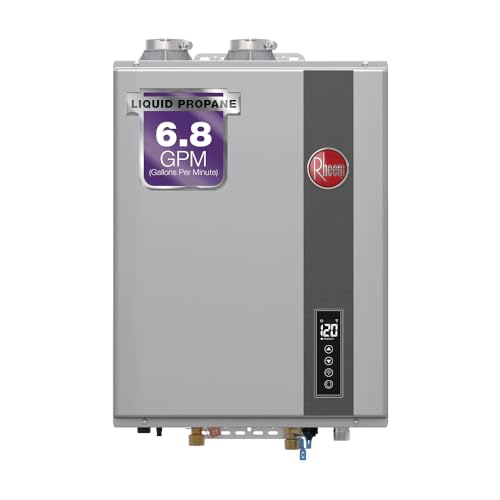
- 6.8 GPM at a 35°F rise
- 0.93 UEF condensing design
- Indoor direct-vent installation
Best For: Propane households with multiple bathrooms
Best for Flexible Venting
Rinnai RUCS75iP Propane Tankless Water Heater
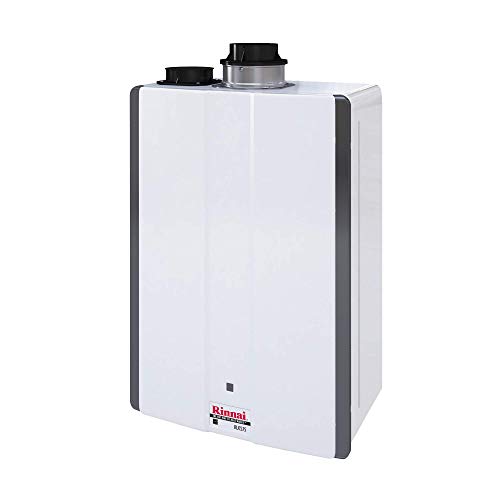
- Listed as ENERGY STAR qualified
- Up to 7.5 GPM stated flow
- Multiple venting options
Best For: Indoor propane installations needing venting flexibility
Most Flexible High-Flow Pick – Rinnai RX199iN
Among energy star tankless water heaters, the Rinnai RX199iN is worth considering if you need high flow and flexible installation. This condensing model runs on natural gas or propane and delivers up to 11.1 GPM, though actual flow depends on incoming water temperature and demand.
Best For: Larger households that want a high-flow gas heater with indoor or outdoor installation options.
Pros:
- Up to 11.1 GPM and 199,000 BTU/hr.
- Smart Sense supports natural gas or propane; Versa Vent supports indoor or outdoor installation.
- 0.98 UEF and a Quick Flush feature for simpler maintenance.
Cons:
- Outdoor installation requires a separate RX-OVC vent cap.
- Wi-Fi control requires a Controlr module that is not included.
The RX199iN offers the highest stated flow of these three models. Budget for professional installation, and check local groundwater temperatures when deciding whether its output fits your household.
Certified Outdoor Pick – A. O. Smith ProLine XE 540H
If you are comparing energy star tankless water heaters for an outdoor natural-gas installation, the ENERGY STAR-certified A. O. Smith ProLine XE 540H is a focused option. Its condensing design delivers up to 10 GPM with a 0.94 UEF.
Best For: Homes with natural gas that need a high-output outdoor heater and a wall-mounted temperature controller.
Pros:
- ENERGY STAR certified, with a 0.94 UEF.
- Up to 10 GPM and 199,000 BTU/hr.
- Includes a wall-mounted temperature remote controller and advanced diagnostics.
Cons:
- This model runs on natural gas, not propane.
- Professional installation is recommended.
The 540H pairs substantial stated flow with safety controls and a 15-year limited residential heat-exchanger warranty. Its natural-gas requirement makes fuel availability the first thing to check.
Flexible Mid-Flow Pick – Rinnai RX160iN
For shoppers considering energy star tankless water heaters but needing less stated flow than the RX199iN, the condensing Rinnai RX160iN offers up to 9 GPM and a 0.97 UEF. Smart Sense supports natural gas or propane, while Versa Vent allows indoor or outdoor installation.
Best For: Households seeking a 9 GPM gas heater with flexible fuel and placement options.
Pros:
- Up to 9 GPM with a 0.97 UEF.
- Supports natural gas or propane and indoor or outdoor installation.
- Quick Flush feature simplifies flushing.
Cons:
- Outdoor installation requires a separate RX-OVC vent cap.
- Wi-Fi control requires an optional Controlr module.
The RX160iN retains the fuel and placement flexibility of the larger Rinnai model at a lower stated flow rate. Have a professional size it against your fixtures and incoming water temperature before installation.
Best for Multi-Bathroom Homes – Rheem RTGH 6.8 GPM Propane Tankless Water Heater
Among energy star tankless water heaters, this Rheem is worth considering if you need an indoor propane model for several bathrooms. Its 6.8 GPM rating is specified at a 35°F temperature rise, so compare that condition with your household’s needs rather than treating the figure as a fixed output.
Best For: Households seeking an indoor, direct-vent propane heater for two or three simultaneous showers under the stated flow conditions.
Pros:
- Condensing design has a stated 0.93 Uniform Energy Factor.
- Digital LED control adjusts temperature with stated ±1°F precision.
- Includes freeze protection and a 15-year heat exchanger warranty.
Cons:
- Requires liquid propane and indoor direct-vent installation; professional installation is recommended.
- The 6.8 GPM rating applies at a 35°F temperature rise, not every inlet-water condition.
This is a strong fit when propane, venting, and household demand line up. The supplied notes do not confirm ENERGY STAR qualification for this model, so verify certification if that is a requirement.
Best for Flexible Venting – Rinnai RUCS75iP Propane Tankless Water Heater
If you’re comparing energy star tankless water heaters for indoor propane use, the Rinnai RUCS75iP is listed as ENERGY STAR qualified. It offers a stated flow rate of up to 7.5 GPM and multiple venting options, making installation requirements an important part of the buying decision.
Best For: Propane households that want an indoor heater with flexible venting choices and a stated flow rate of up to 7.5 GPM.
Pros:
- Listed as ENERGY STAR qualified and heats water only when needed.
- Rated for up to 7.5 GPM and described as serving up to six appliances at once.
- Offers multiple venting options, including PVC/CPVC with the specified adaptor.
Cons:
- Professional installation is recommended.
- PVC/CPVC venting requires the Ubbink Concentric to Twin Pipe adaptor.
The RUCS75iP pairs an explicitly stated ENERGY STAR qualification with useful venting choices. Confirm the vent configuration and your household’s hot-water demand with an installer before choosing it.
How We Picked the Best Energy Star Tankless Water Heaters
We focused on practical differences among the five selected models: fuel type, stated flow or input capacity, indoor versus outdoor placement, and suitability for different hot-water demands. A model name or a “high efficiency” claim does not, by itself, confirm current ENERGY STAR certification. Before buying, check the exact model and fuel configuration in the current ENERGY STAR product listing and confirm its specifications with the manufacturer.
Quick Comparison
The Rinnai RX199iN and A. O. Smith ATO-540H-N are natural-gas options to consider when comparing higher-output installations; the A. O. Smith is specifically listed here as an outdoor, 199,000-BTU, 10-GPM model. The Rinnai RX160iN offers another natural-gas capacity choice. For propane, compare the indoor Rheem RTGH 6.8-GPM, 120,000-BTU model with the Rinnai RUCS75iP. Published GPM figures are not directly interchangeable: the stated flow depends on the temperature rise used for testing.
Key Buying Factors for Energy Star Tankless Water Heaters
Size for Simultaneous Use
Add up the flow needed when showers, sinks, or appliances might run together. Then account for your local incoming-water temperature and desired outlet temperature. A larger temperature rise reduces the flow a heater can deliver, so a headline GPM figure may overstate performance in colder climates.
Match Fuel and Installation Location
Choose the model configured for your available natural-gas or propane supply; these fuels are not interchangeable without manufacturer-approved provisions. Check whether your site suits an indoor or outdoor unit, including venting, combustion air, weather exposure, freeze protection, and applicable clearances. A licensed installer should verify gas-line capacity and local code requirements before you commit.
Check Total Cost, Not Just the Unit Price
Ask for an installed quote that covers venting or outdoor mounting, gas piping, condensate drainage where required, electrical needs, and any water-treatment recommendations. Compare the exact model’s certified efficiency, warranty terms, and maintenance requirements. Hard water can make periodic descaling especially important.
Who Should Buy Which Energy Star Tankless Water Heaters?
Start with the RX199iN or outdoor ATO-540H-N if you need to investigate higher-output natural-gas options; choose between them based on verified sizing and where the heater can be installed. Consider the RX160iN if your calculated demand points to a different natural-gas capacity. Propane households should compare the indoor Rheem RTGH and Rinnai RUCS75iP against their required temperature rise, available space, and installer’s recommendations. For any of these Energy Star Tankless Water Heaters, verify certification for the exact model before treating an efficiency label as a deciding factor.