The right tankless water heater depends on more than its advertised gallons per minute. Your fuel supply, incoming water temperature, peak hot-water demand, and installation location all affect which model makes sense.
These 10 Rheem options span natural gas and propane, indoor and outdoor installation, and several rated flow capacities. Use the comparisons below to narrow the field before confirming specifications with a qualified installer.
Best 10 High Efficiency Tankless Water Heaters Picks for 2026
Best for High-Demand Natural Gas Homes
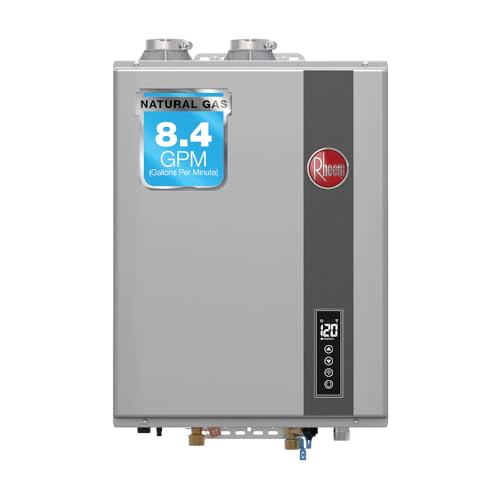
- 8.4 GPM at a 35°F rise
- 0.93 UEF condensing design
- Indoor natural gas; direct vent
Best For: Natural gas homes with several simultaneous hot-water demands
Best Outdoor Propane Option

- 7.0 GPM at a 35°F rise
- Outdoor propane installation
- 0.82 UEF; non-condensing
Best For: Propane homes that need outdoor mounting and moderate whole-home demand
Best Lower-Output Condensing Pick

- 6.8 GPM at a 35°F rise
- 0.93 UEF condensing design
- 120,000 BTU/hr natural gas
Best For: Natural gas homes with moderate simultaneous hot-water demand
Best High-Flow Indoor Propane Pick

- 8.4 GPM at a 35°F rise
- Indoor propane; direct vent
- 0.82 UEF; non-condensing
Best For: Propane homes with high simultaneous demand and indoor mounting
Best for High-Demand Propane Homes
Rheem RTGH 9.5 GPM Indoor Condensing

- 9.5 GPM at a 35°F rise
- 0.93 UEF condensing design
- Indoor direct-vent propane model
Best For: Multi-bathroom propane households with high simultaneous demand
Best Outdoor Natural Gas Pick
Rheem RTG 8.4 GPM Non-Condensing
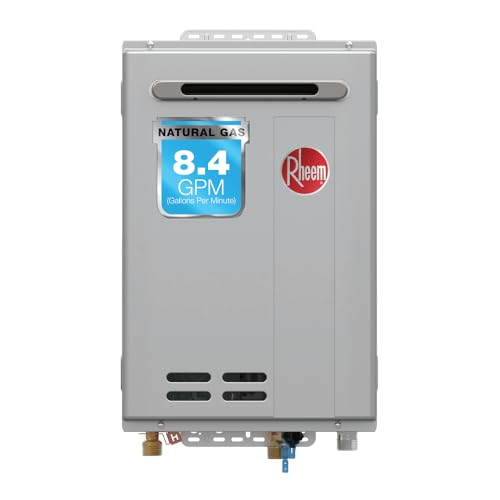
- 8.4 GPM at a 35°F rise
- 0.82 UEF; natural gas
- Outdoor mounting avoids indoor venting
Best For: Natural-gas homes with an appropriate outdoor mounting spot
Best for Moderate Propane Demand

- 7.0 GPM at a 35°F rise
- 0.82 UEF; liquid propane
- Indoor direct-vent wall mount
Best For: Propane homes with moderate simultaneous hot-water demand
Best for Higher-Demand Homes
Rheem RTG 9.5 GPM Indoor Natural Gas

- 9.5 GPM at a 35°F rise
- 199,900 BTU/hr; 0.82 UEF
- Indoor, direct-vent installation
Best For: Multi-bathroom homes with higher simultaneous hot-water demand
Best Outdoor Installation
Rheem RTG 7.0 GPM Outdoor Natural Gas
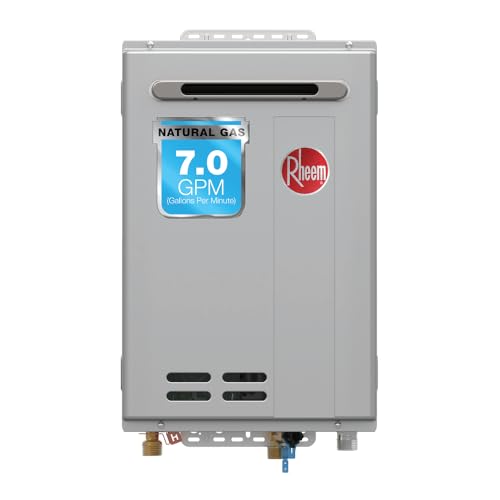
- 7.0 GPM at a 35°F rise
- Outdoor mounting avoids indoor venting
- 160,000 BTU/hr; 0.82 UEF
Best For: Natural-gas homes seeking an outdoor-mounted heater
Best Indoor Leak Protection
Rheem RTG 7.0 GPM Indoor Natural Gas

- Listed LeakGuard internal leak protection
- 7.0 GPM at a 35°F rise
- Indoor direct-vent design; 0.82 UEF
Best For: Moderate-demand homes wanting an indoor unit with listed leak protection
Best for High-Demand Natural Gas Homes – Rheem RTGH 8.4 GPM Indoor
Among high efficiency tankless water heaters, this indoor natural gas model stands out for its combination of 8.4 GPM at a 35°F temperature rise and a 0.93 Uniform Energy Factor (UEF). Its condensing design is suited to households that need hot water at several fixtures at once.
Best For: Homes with natural gas and roughly three to four simultaneous showers or comparable hot-water demand.
Pros:
- 0.93 UEF condensing design and 157,000 BTU/hr rating.
- 8.4 GPM at a 35°F rise, with digital temperature control adjustable to ±1°F.
- Built-in freeze protection and a 15-year heat exchanger warranty.
Cons:
- Indoor installation requires direct venting and professional installation is recommended.
- The quoted 8.4 GPM applies at a 35°F temperature rise; flow can differ with water conditions.
Choose this model if higher simultaneous demand justifies its output and your installation can accommodate an indoor, direct-vent natural gas unit.
Best Outdoor Propane Option – Rheem RTG 7.0 GPM Outdoor
If you need an outdoor propane entry among high efficiency tankless water heaters, this Rheem RTG avoids indoor vent routing. Its non-condensing design is rated at 0.82 UEF and delivers a listed 7.0 GPM at a 35°F temperature rise.
Best For: Propane-fueled homes seeking outdoor installation and hot water for roughly two to three simultaneous showers.
Pros:
- Outdoor placement eliminates the need for indoor venting.
- 7.0 GPM rating at a 35°F rise, with digital temperature adjustment to ±1°F.
- Built-in freeze and flame-failure protection; 15-year heat exchanger warranty.
Cons:
- Its 0.82 UEF is lower than the 0.93 UEF of the condensing RTGH models in this roundup.
- Professional installation is required.
This is the practical pick when outdoor mounting and propane compatibility matter more than the higher UEF of a condensing unit. Confirm the heating rating with the installer: the supplied title and bullets say 160,000 BTU/hr, while the details list 180,000 BTU/hr.
Best Lower-Output Condensing Pick – Rheem RTGH 6.8 GPM Indoor
For buyers comparing high efficiency tankless water heaters for a somewhat smaller hot-water load, this indoor natural gas RTGH keeps the 0.93 UEF condensing design while offering 6.8 GPM at a 35°F temperature rise. Its 120,000 BTU/hr rating is below that of the 8.4 GPM RTGH model.
Best For: Natural gas households whose expected peak demand is around two to three simultaneous showers.
Pros:
- 0.93 UEF condensing operation with ultra-low NOx emissions.
- 6.8 GPM at a 35°F rise and digital temperature control adjustable to ±1°F.
- Built-in freeze protection and a 15-year heat exchanger warranty.
Cons:
- Lower listed flow than the 8.4 GPM models in this roundup.
- Indoor placement requires direct venting; professional installation is recommended.
It is a sensible alternative to the larger RTGH when its listed flow meets your household’s peak needs and you want a condensing natural gas unit.
Best High-Flow Indoor Propane Pick – Rheem RTG 8.4 GPM Indoor
For propane users considering high efficiency tankless water heaters, this indoor RTG offers a listed 8.4 GPM at a 35°F temperature rise and 180,000 BTU/hr. It is a non-condensing model rated at 0.82 UEF, with a wall-mount design that saves floor space.
Best For: Propane homes needing an indoor unit for roughly three to four simultaneous showers or other high peak demand.
Pros:
- 8.4 GPM at a 35°F rise for multiple concurrent hot-water uses.
- Digital temperature adjustment to ±1°F, plus built-in freeze and flame-failure protection.
- Wall-mounted design and a 15-year heat exchanger warranty.
Cons:
- 0.82 UEF is lower than the 0.93 UEF of the condensing models listed here.
- Indoor installation calls for direct venting and professional installation.
Pick this one when indoor propane compatibility and the higher listed flow take priority; check that your venting plan and expected temperature rise match the installation.
Best for High-Demand Propane Homes – Rheem RTGH 9.5 GPM Indoor Condensing
Among high efficiency tankless water heaters, this indoor liquid-propane model stands out for its 0.93 UEF condensing design and rated 9.5 GPM flow at a 35°F temperature rise. Its 199,900 BTU/hr input suits households with substantial simultaneous hot-water demand.
Best For: Multi-bathroom homes using propane that need an indoor, direct-vent heater for several showers at once.
Pros:
- 0.93 UEF condensing technology.
- Rated 9.5 GPM at a 35°F rise; advertised for three to four simultaneous showers.
- Digital temperature control, built-in freeze protection, and a 15-year heat-exchanger warranty.
Cons:
- Requires liquid propane and an indoor direct-vent installation.
- Professional installation is recommended.
Choose this model when higher flow and condensing efficiency matter more than a simpler non-condensing setup. Actual flow at your desired temperature depends on incoming water temperature.
Best Outdoor Natural Gas Pick – Rheem RTG 8.4 GPM Non-Condensing
For shoppers comparing high efficiency tankless water heaters that mount outdoors, this natural-gas Rheem offers an 0.82 UEF and a rated 8.4 GPM at a 35°F temperature rise. Outdoor placement avoids an indoor vent run.
Best For: Natural-gas homes with multiple bathrooms and a suitable outdoor installation location.
Pros:
- Rated 8.4 GPM at a 35°F rise with 180,000 BTU/hr input.
- Outdoor installation eliminates indoor venting.
- Digital temperature control, built-in freeze protection, and a 15-year heat-exchanger warranty.
Cons:
- Non-condensing design has a lower listed UEF than the condensing propane model in this roundup.
- Requires an outdoor location and professional installation.
This is a practical fit if your home uses natural gas and outdoor mounting works for the site. Size it against your local incoming-water temperature, since the stated flow assumes a 35°F rise.
Best for Moderate Propane Demand – Rheem RTG 7.0 GPM Indoor
This indoor propane option rounds out a shortlist of high efficiency tankless water heaters for households that need less flow than the larger models. It is rated for 7.0 GPM at a 35°F temperature rise, with 160,000 BTU/hr input and an 0.82 UEF.
Best For: Propane households seeking an indoor, wall-mounted heater for roughly two to three simultaneous showers under the stated rating conditions.
Pros:
- Rated 7.0 GPM at a 35°F rise.
- Wall-mounted indoor design saves floor space.
- Digital temperature control, built-in freeze protection, and a 15-year heat-exchanger warranty.
Cons:
- Lower rated flow than the other two models in this roundup.
- Requires liquid propane, direct venting, and professional installation.
Pick this model when its stated flow matches your expected overlap in hot-water use. For colder incoming water or heavier simultaneous demand, account for the greater temperature rise before choosing a size.
Best for Higher-Demand Homes – Rheem RTG 9.5 GPM Indoor Natural Gas
Among high efficiency tankless water heaters, this indoor Rheem RTG is the higher-flow option here: it delivers up to 9.5 GPM at a 35°F temperature rise, with a 199,900 BTU/hr rating and a 0.82 UEF.
Best For: Homes with natural gas and multiple bathrooms that need hot water at several fixtures at once.
Pros:
- Rated for 3–4 simultaneous showers at the stated temperature rise.
- Wall-mounted design saves floor space compared with a tank heater.
- Digital temperature control and built-in freeze and flame-failure protection.
Cons:
- Requires professional indoor installation and direct venting.
- Its 0.82 UEF is lower than that of many condensing models.
Choose this model when the extra flow capacity matters more than maximizing efficiency; actual hot-water flow will depend on the required temperature rise.
Best Outdoor Installation – Rheem RTG 7.0 GPM Outdoor Natural Gas
If you want to keep the unit outside, this Rheem RTG is an outdoor choice among high efficiency tankless water heaters. It provides up to 7.0 GPM at a 35°F temperature rise, with a 160,000 BTU/hr rating and a 0.82 UEF.
Best For: Natural-gas homes needing an outdoor-mounted unit for roughly 2–3 simultaneous showers at the stated temperature rise.
Pros:
- Outdoor placement eliminates indoor venting.
- Wall-mount cabinet measures 13.5 inches wide by 20.75 inches high.
- Digital display, self-diagnostics, and built-in freeze protection.
Cons:
- Lower rated flow than the 9.5 GPM indoor model.
- Requires an appropriate outdoor mounting location and qualified installation.
This is the practical pick when outdoor placement is the priority. Check your incoming water temperature and peak fixture demand before relying on the stated shower count.
Best Indoor Leak Protection – Rheem RTG 7.0 GPM Indoor Natural Gas
This 7.0 GPM indoor Rheem RTG stands out among high efficiency tankless water heaters for its listed LeakGuard leak detection and prevention feature. Its 160,000 BTU/hr output and 0.82 UEF suit moderate whole-home demand.
Best For: Natural-gas households seeking an indoor, wall-mounted heater for 2–3 simultaneous water points at the stated 35°F temperature rise.
Pros:
- LeakGuard is listed for detecting internal leaks, large or small.
- 7.0 GPM rating at a 35°F temperature rise.
- Digital temperature control, hot-start programming, and built-in freeze protection.
Cons:
- Indoor installation requires direct venting.
- Offers less rated flow than the 9.5 GPM indoor option.
Consider this model if indoor placement and the listed leak-protection feature matter more than maximum flow. Size it against your local inlet-water temperature and expected simultaneous use.
How We Picked the Best High Efficiency Tankless Water Heaters
We organized the 10 selected Rheem models around the decisions that matter most before purchase: natural gas versus liquid propane, indoor versus outdoor installation, and the listed flow and BTU ratings. The group includes RTG high-efficiency models and RTGH super-high-efficiency models. Those labels are not a substitute for a model’s published Uniform Energy Factor (UEF); check the exact model number and efficiency documentation before estimating energy costs.
We did not treat a higher advertised GPM as a guarantee of better performance in every home. Actual hot-water flow depends on the required temperature rise, while installation cost can vary substantially with venting, gas-line capacity, condensate handling, and local code.
Quick Comparison: Which Configuration Fits?
- Fuel: Choose a natural-gas model for an existing natural-gas supply or a propane model for a suitable LP system. These fuels are not interchangeable unless the manufacturer specifically permits a conversion.
- Location: Indoor models need the specified venting and combustion-air arrangements. Outdoor models must be approved for local weather and installed with adequate freeze protection where needed.
- Listed flow: The selection ranges from 6.8 to 9.5 GPM. Use the manufacturer’s flow-versus-temperature-rise chart, not the headline GPM alone, to compare usable output.
Key Buying Factors for High-Efficiency Tankless Water Heaters
Size for Simultaneous Demand
Add the flow rates of fixtures likely to run at the same time, then account for your incoming cold-water temperature and desired hot-water temperature. Colder inlet water demands a larger temperature rise and generally reduces available GPM. A plumber can verify whether one unit covers your busiest period.
Check Efficiency and Installed Cost
Compare the exact models’ UEF ratings and estimated annual operating costs using your local fuel prices. Also request an installed quote: a replacement may require gas-piping upgrades, a dedicated electrical connection, compatible vent materials, condensate drainage for condensing equipment, or changes to the mounting location. A less expensive heater can cost more overall if installation is complicated.
Plan for Water Quality and Maintenance
Hard water can cause scale buildup that reduces performance. Check the manufacturer’s water-quality limits and maintenance instructions, and ask whether isolation valves, periodic descaling, or water treatment are appropriate for your supply. Review warranty terms alongside service access and local technician availability.
Who Should Buy Which High Efficiency Tankless Water Heaters?
For modest simultaneous use, start by checking the 6.8 or 7.0 GPM listings against your local temperature rise. For greater concurrent demand, compare the 8.4 and 9.5 GPM options using their full performance charts. Choose indoor or outdoor placement based on a code-compliant installation plan, then select the model built for your actual fuel supply. If efficiency is your deciding factor, compare published UEF figures for the RTG and RTGH models rather than relying on series names alone.
