The best power inverters turn a vehicle’s 12-volt battery system into usable AC power for laptops, chargers, small appliances, and emergency equipment. The right model depends on the wattage you need, the devices you plan to run, and how long you need to operate them.
This roundup compares compact car plug-in units with higher-output pure sine wave inverters for RVs, work vehicles, and backup applications. Use the guide below to match capacity, waveform, connections, and safety features to your setup.
Best 10 Power Inverters Picks for 2026
Best Compact Car Pick
BESTEK 300W Car Power Inverter
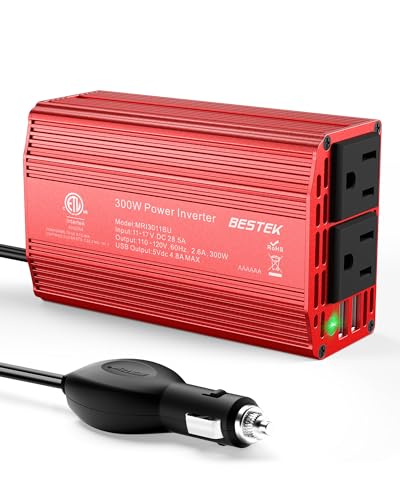
- 300W continuous, 700W peak output
- Two AC outlets and dual USB ports
- Compact aluminum design for vehicle use
Best For: Road trips and charging personal electronics
Best Heavy-Duty RV Pick
LANDERPOW 3000W Pure Sine Wave Inverter

- 3,000W continuous and 6,000W surge output
- Pure sine wave power for sensitive loads
- 15-foot remote and heavy-gauge battery cables
Best For: RV, off-grid, emergency, and job-site power
Best Budget Travel Pick
YSOLX 300W Portable Car Inverter

- Two AC outlets plus four USB-A/C ports
- Lightweight 9-ounce portable design
- Vehicle cigarette-lighter connection
Best For: Travelers charging small electronics on the road
Best Midrange Pure Sine Pick
BELTTT 2000W Pure Sine Wave Inverter

- 2,000W continuous and 4,000W surge output
- LCD monitoring and 23-foot remote
- Dual AC, 20A, USB, and hardwire connections
Best For: RV and off-grid users needing clean moderate-high power
Best Budget Car Inverter
TWING 1000W Car Power Inverter

- 750W continuous and 1,000W peak output
- Two AC outlets plus QC 3.0 and 30W USB-C
- Cigarette-lighter or direct-battery connection
Best For: Road trips, camping, and vehicle emergency charging
Best High-Output Option
Cantonape 3000W Power Inverter

- 3,000W continuous and 6,000W surge output
- Four AC outlets and four USB ports
- LCD monitoring, remote control, and six protections
Best For: RV, truck, boat, camping, and emergency power setups
Best Compact Pick
Pro Chaser 400W Car Power Inverter
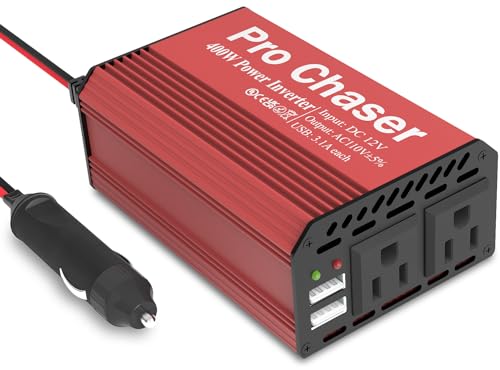
- 400W continuous and 800W peak output
- Dual AC outlets and two 3.1A USB ports
- Compact body with a 30-inch power cord
Best For: Road trips and everyday vehicle charging
Compact Multi-Port Pick
PiSFAU 200W Car Power Inverter

- Two AC outlets plus four USB charging ports
- Compact 5-inch design weighs about 8.8 ounces
- Built-in protection for common charging risks
Best For: Portable vehicle charging for phones, tablets, laptops, and small electronics
Lightweight Road-Trip Value
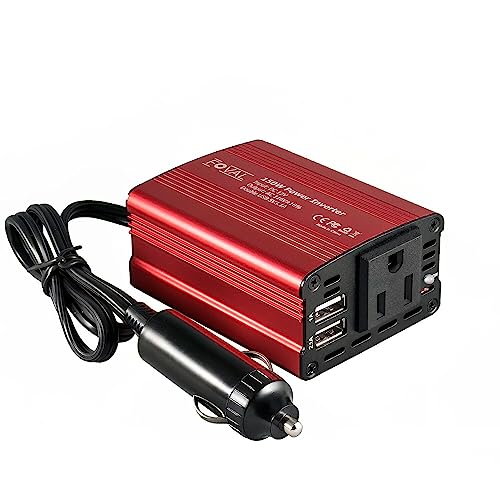
- 150W continuous and 300W peak output
- One AC outlet and two USB ports
- Credit-card-size aluminum housing
Best For: Light-duty charging during commutes, travel, and road trips
High-Output Vehicle Option
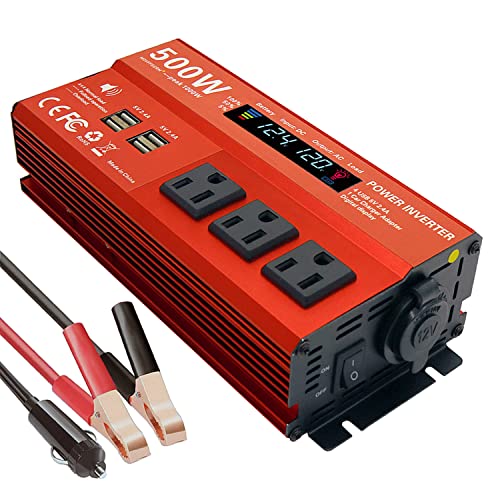
- 500W continuous and 1000W peak output
- Three AC outlets and four USB ports
- Includes car plug and 12V battery clips
Best For: Higher-demand vehicle electronics and multi-device setups
Best Compact Car Pick – BESTEK 300W Car Power Inverter
The BESTEK 300W is a practical choice among power inverters for road trips, work travel, and everyday vehicle charging. Its compact design provides two AC outlets and two USB ports from a compatible 11–17V vehicle system.
Best For: Drivers who need lightweight charging for laptops, tablets, phones, cameras, and other smaller electronics.
Pros:
- Supplies 300W continuous power with up to 700W peak output.
- Offers two AC outlets and dual 4.8A USB charging ports.
- Compact, iPhone-sized aluminum housing with a 32-inch vehicle plug cable.
- Includes protections against overheating, voltage issues, short circuits, and overloads.
Cons:
- Modified sine wave output may not suit every sensitive or motor-driven device.
- Not intended for high-demand appliances requiring more than 300W.
Choose this BESTEK model when portability and convenient device charging matter more than heavy-duty output. Its 300W capacity is well suited to personal electronics, while the built-in protections and quiet cooling fan add everyday practicality.
Best Heavy-Duty RV Pick – LANDERPOW 3000W Pure Sine Wave Inverter
The LANDERPOW 3000W is one of the more capable power inverters for RVs, emergency backup, solar setups, and job sites. Its pure sine wave output is designed for sensitive electronics and demanding appliances, with 3,000W continuous power and 6,000W surge capacity.
Best For: RV owners and off-grid users powering appliances, tools, CPAPs, microwaves, refrigerators, and other higher-demand equipment.
Pros:
- Provides 3,000W continuous and 6,000W peak pure sine wave power.
- Includes three AC outlets, a hardwired terminal, USB charging, and a 30W PD port.
- Comes with thick 1 AWG copper battery cables and a 15-foot wired remote.
- Offers real-time monitoring plus protection from overload, overheating, voltage issues, short circuits, and reverse connection.
Cons:
- Its high output requires substantial battery capacity and careful installation.
- Larger, heavier-duty systems are less convenient for casual vehicle charging.
This LANDERPOW inverter stands out when clean AC power and substantial starting capacity are priorities. The remote display, rugged metal housing, and included cables make it especially useful for stationary RV, truck, emergency, or off-grid applications.
Best Budget Travel Pick – YSOLX 300W Portable Car Inverter
The YSOLX 300W is a compact option among power inverters for keeping personal electronics charged in a car. It connects through a vehicle cigarette lighter and combines two AC outlets with four USB-A/C charging ports in a lightweight package.
Best For: Travelers, campers, and mobile workers charging phones, cameras, laptops, small accessories, and similar low-power devices.
Pros:
- Provides up to 300W of vehicle-based AC power.
- Includes six total output ports: two AC outlets and four 24W USB-A/C ports.
- Small 5.4-by-2.75-by-1.4-inch design weighs about 9 ounces.
- Uses an upgraded intelligent cooling fan intended for quieter, steadier operation.
Cons:
- Modified sine wave output may be unsuitable for some sensitive devices.
- It is not designed for high-power appliances such as hair dryers or electric heaters.
- The supplied details list 200W output and 200W peak specifications, so buyers should verify the exact rating before demanding use.
This YSOLX model makes sense for basic travel charging where size and multiple ports are more important than high wattage. Keep connected loads modest and follow the vehicle-only usage guidance for reliable operation.
Best Midrange Pure Sine Pick – BELTTT 2000W Pure Sine Wave Inverter
The BELTTT 2000W is a versatile choice among power inverters for RVs, trucks, outdoor use, solar systems, and off-grid applications. It delivers pure sine wave AC power, 2,000W continuous output, and up to 4,000W surge capacity for compatible equipment.
Best For: Users who need clean power for sensitive electronics and moderate-to-high-demand equipment without stepping up to a 3,000W unit.
Pros:
- Offers 2,000W continuous and 4,000W peak pure sine wave output.
- Features an LCD showing input and output voltage, battery status, load, and operating conditions.
- Includes dual AC sockets, a 20A outlet, USB port, hardwire terminal, and 23-foot remote.
- Provides greater than 93% stated conversion efficiency and multiple safety protections.
Cons:
- The 12V system can draw substantial battery current at higher loads.
- At 7.7 pounds, it is less portable than compact car-plug inverters.
- The supplied warranty is one year.
For buyers seeking a balance between capacity and manageable installation, the BELTTT combines clean output with useful monitoring and remote control. Its outlet mix and included battery cables make it a flexible fit for RV and off-grid setups.
Best Budget Car Inverter – TWING 1000W Car Power Inverter
If you need versatile power inverters for road trips, emergencies, or camping, the TWING 1000W model offers a practical mix of AC and USB charging. It provides 750 watts of continuous power and 1,000 watts of peak power from a 12V vehicle battery, with both cigarette-lighter and direct-battery connection options.
Best For: Drivers and campers who need multiple charging ports for laptops, cameras, lights, and other moderate-power electronics.
Pros:
- Includes two AC outlets, QC 3.0 USB, and 30W PD Type-C charging.
- Digital display shows operating information, while built-in protections help guard against overload, overheating, short circuits, and voltage issues.
- Can connect through a cigarette lighter or included battery cables for more flexible use.
Cons:
- Uses a modified sine wave, which may not suit every sensitive electronic device.
- The cigarette-lighter connection is intended for lower loads than the inverter’s full rated output.
- Requires use in a dry, well-ventilated area.
The TWING is a well-equipped choice among compact power inverters, especially if USB-C charging and flexible vehicle connections matter. Keep total connected wattage within the inverter’s limits and verify device compatibility with its modified sine-wave output.
Best High-Output Option – Cantonape 3000W Power Inverter
For demanding vehicle, RV, camping, or backup-power setups, the Cantonape is one of the higher-output power inverters in this roundup. It converts 12V battery power into 3,000 watts of continuous modified sine-wave AC power, with 6,000 watts available for surge demands.
Best For: Users who need several AC and USB ports for appliances and electronics in an RV, truck, boat, home, or outdoor setup.
Pros:
- Offers four AC outlets, four USB ports, 3,000 watts of continuous power, and 6,000 watts of surge power.
- LCD display reports input and output voltage, battery capacity, load capacity, frequency, and fault codes.
- Includes a remote control, temperature-controlled fan, aluminum housing, and multiple protection systems.
- Comes with battery cables, an instruction manual, and a 12-month warranty.
Cons:
- Its modified sine-wave output may not be appropriate for every sensitive or waveform-dependent appliance.
- A 12V battery system must support the substantial current demands of 3,000 watts.
- The remote control requires a separate 12V 23A battery.
The Cantonape stands out when output capacity and outlet count are priorities. Its display and fault reporting make monitoring easier, but installation should account for battery capacity, cable requirements, ventilation, and the limitations of modified sine-wave power.
Best Compact Pick – Pro Chaser 400W Car Power Inverter
The Pro Chaser is a small, travel-friendly option for shoppers comparing power inverters for everyday vehicle charging. It delivers 400 watts continuously and up to 800 watts at peak, with dual AC sockets and two 3.1A USB ports in a cellphone-sized design.
Best For: Road trips and daily driving when you need to charge phones, tablets, cameras, laptops, or other moderate-power devices.
Pros:
- Compact 14.08-ounce design is easy to carry and store.
- Provides two AC outlets and dual USB ports with a combined 4.8A USB charging capacity.
- Includes a 30-inch cord for flexible placement in a vehicle.
- Built-in protections and a temperature-activated cooling fan support safer operation.
Cons:
- Its 400W continuous rating is intended for smaller loads, not high-demand appliances.
- Modified sine-wave output may limit compatibility with some sensitive electronics.
- It is designed for 12V vehicle use rather than higher-capacity battery-bank applications.
The Pro Chaser is a sensible pick when portability and convenient charging matter more than maximum output. Its 400W rating suits common travel electronics, while the safety features and 12-month warranty add reassurance for regular vehicle use.
Compact Multi-Port Pick – PiSFAU 200W Car Power Inverter
If you need versatile power in a vehicle, the PiSFAU 200W is a compact option with two AC outlets and four USB charging ports. Its 12V DC to 110V AC output suits everyday electronics such as laptops, tablets, phones, and small lighting devices.
Best For: Road trips, camping, and drivers who want several charging options in a small package.
Pros:
- Provides two AC outlets and four USB ports, including USB-A/C charging.
- Compact 5 x 2.7 x 1.4-inch design weighs about 8.8 ounces.
- Includes protection against overheating, voltage problems, overloads, and short circuits.
- Uses a high-efficiency design intended to reduce heat and fan noise.
Cons:
- Its 200W output is intended for smaller electronics rather than high-demand appliances.
- Uses a modified sine wave output.
The PiSFAU stands out among compact power inverters for its unusually generous port selection. It is a practical fit when convenience and portability matter more than running larger equipment.
Lightweight Road-Trip Value – FOVAL 150W Car Power Inverter
The FOVAL 150W is one of the more compact power inverters for basic in-car charging. It converts 12V DC to 110V AC, adds one AC outlet and two USB ports, and is sized for laptops, phones, tablets, and other modest electronic loads.
Best For: Everyday commuting, road trips, and travelers who prioritize a small, lightweight adapter.
Pros:
- Delivers 150W of continuous AC output with a 300W peak rating.
- Dual USB ports provide up to 3.1A total output for phones and tablets.
- Credit-card-size design measures 3.2 x 2.5 x 1.5 inches and weighs about 8 ounces.
- Includes a cooling fan and protection against overheating, voltage issues, overloads, and short circuits.
Cons:
- Only one AC outlet is available.
- 150W continuous output limits it to relatively small devices.
- Uses a modified sine wave output.
FOVAL’s main advantage is portability: it takes up little space while still providing an AC outlet and two USB connections. Choose it for light-duty vehicle charging rather than for powering multiple larger devices.
High-Output Vehicle Option – MOVFFGGRM 500W Power Inverter
For shoppers who need more capacity from vehicle power inverters, the MOVFFGGRM supplies 500W of continuous power with a 1000W peak rating. It offers three AC outlets, four USB ports, and a cigarette-lighter port, with both a car-plug connection and battery clips included.
Best For: Vehicle-based setups that need multiple outlets or more power than a standard cigarette-lighter inverter can provide.
Pros:
- Provides 500W continuous output and 1000W peak output.
- Offers three AC outlets, four 2.4A USB ports, and an additional cigarette-lighter port.
- Can connect through a vehicle socket or directly to a 12V battery using the included clips.
- Aluminum body and a quiet fan support heat dissipation, with efficiency listed above 90%.
Cons:
- Loads above 150W should use the battery clips instead of the vehicle cigarette-lighter socket.
- At 2.2 pounds and 8.27 inches long, it is less portable than smaller car adapters.
- Uses a modified sine wave output.
This model is the strongest choice of the three for higher-output vehicle use, but its connection method matters. The battery clips are essential for loads beyond the typical cigarette-lighter fuse limit, so it is best suited to users comfortable with a larger, battery-connected setup.
How We Picked These Power Inverters
We selected models across the most useful power ranges, from compact 150W and 200W car adapters to larger 2,000W and 3,000W units. Our comparison focuses on rated continuous output, peak or surge capacity, waveform type, outlet and USB options, installation style, and practical vehicle compatibility.
Because inverter performance depends on the vehicle battery, wiring, and connected load, advertised peak wattage is not treated as the main measure of capability. Continuous output is more important for equipment that runs for more than a few seconds.
Quick Comparison
| Power class | Best suited for | Typical connection |
|---|---|---|
| 150W–400W | Phones, tablets, laptops, cameras, and small electronics | 12V accessory socket |
| 500W–1,000W | Multiple chargers, small tools, monitors, and moderate vehicle loads | Accessory socket or direct battery connection |
| 2,000W–3,000W+ | RV appliances, tools, medical equipment, and heavier backup loads | Direct battery connection with appropriately sized cables |
Key Buying Factors for Power Inverters
Continuous and Surge Wattage
Add the running wattage of every device you expect to use at the same time. Motors, compressors, printers, and some appliances can require substantially more power when starting, so check the inverter’s surge rating as well. Avoid choosing a model based only on its maximum or peak number.
Pure Sine Wave Versus Modified Sine Wave
Pure sine wave power is the safer choice for sensitive electronics, audio equipment, medical devices, variable-speed motors, and many modern appliances. Less demanding loads such as basic chargers or incandescent lights may work with modified sine wave output, but compatibility can vary.
Battery, Wiring, and Installation
High-output inverters draw significant current. A 12V inverter delivering 1,000W can draw roughly 80–100 amps before losses, while larger models require much heavier cables, proper fusing, ventilation, and a suitable battery bank. Do not rely on a standard cigarette-lighter socket for loads beyond its rated capacity.
Ports and Protection
Consider the number of AC outlets, USB-A or USB-C charging ports, cable length, display information, cooling fans, and mounting options. Low-voltage shutdown, overload protection, over-temperature protection, short-circuit protection, and input overvoltage protection are valuable safeguards.
Who Should Buy Which Power Inverters?
Choose a compact 150W–400W inverter for everyday car travel, laptop charging, phones, cameras, and small accessories. A 500W–1,000W model is better for road crews, truck owners, and users who need several devices or moderate loads at once.
For RVs, workshops, emergency backup, or equipment with demanding startup loads, consider a 2,000W–3,000W pure sine wave model—but only with a battery system and wiring designed for that current. If you are unsure of your device’s startup requirements or installation needs, select a lower load, consult the manufacturer’s specifications, or have a qualified installer review the setup.
