Safe drinking water can become difficult to access after storms, power outages, evacuations, or other emergencies. The right purifier helps reduce your dependence on bottled water while keeping treatment practical in the field.
This roundup compares 10 emergency water purification options, including chemical tablets, packet treatments, personal filter straws, and higher-capacity gravity systems. Use the guide below to match treatment speed, capacity, portability, and contaminant protection to your situation.
Best 10 Water Purifiers for Emergencies Picks for 2026
Best Tablet Backup
Potable Aqua Water Purification Tablets

- 100 tablets across two bottles
- Effective against Giardia when used as directed
- Lightweight with a four-year shelf life
Best For: Portable emergency and travel kits
Best Personal Filter Straw
Membrane Solutions S1 Water Filter Straw
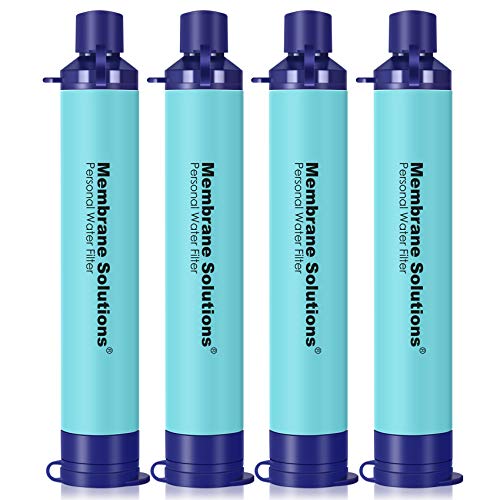
- Five-stage reusable filtration system
- Removes up to 99.9999% of total coliforms
- Compact, 2-ounce design rated for 1,320 gallons
Best For: Individual emergency and outdoor use
Best Family Gravity Purifier
LifeStraw Family 12 L Water Purifier

- Removes viruses, bacteria, and protozoan cysts
- 18,000-liter stated purification capacity
- Non-electric gravity operation for family use
Best For: Household emergency water treatment
Best Taste-Neutralizing Tablet Set
Potable Aqua Tablets with PA Plus

- Includes 50 purifier and 50 neutralizer tablets
- Helps reduce iodine taste and color
- Designed for bacteria and Giardia treatment
Best For: Compact kits prioritizing better-tasting treated water
Compact Emergency Essential
LifeStraw Personal Water Filter
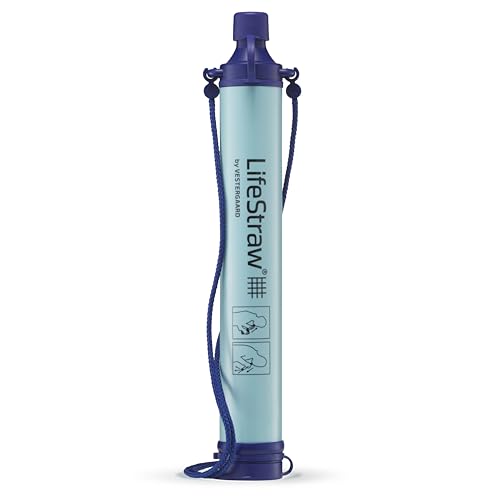
- Removes bacteria, parasites, and microplastics
- Filters up to 1,000 gallons
- Lightweight personal straw design
Best For: Solo emergency kits, hiking, and travel
Group-Ready Gravity Kit
Practical Survival Gravity Water Filtration System

- Includes two 6-liter water bags
- Filters up to 1,800 gallons
- No pumping required
Best For: Families, groups, and basecamp emergencies
Family Water Treatment Packets

- Treats 2.5 gallons per packet
- Removes bacteria and viruses
- Compact 12-packet supply
Best For: Family kits, travel, and batch water treatment
Best Gravity Straw
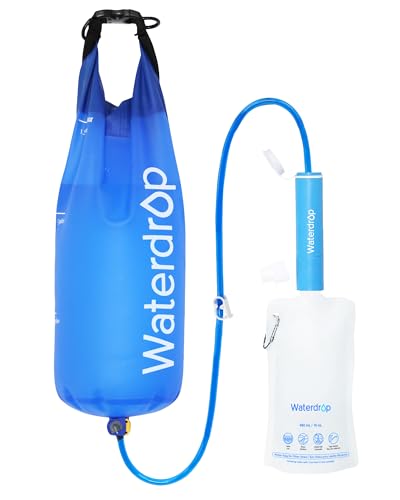
- Gravity-fed 1.5-gallon bag
- 0.1-micron, five-stage filtration
- Up to 1,400-gallon filter life
Best For: Portable emergency kits and small-group hydration
Best High-Volume Pump
Trailgo Pro Emergency Water Filter

- 1.5 liters-per-minute hand pump
- Three-stage ultrafiltration system
- Rated for up to 3,000 liters
Best For: Families, groups, and off-grid emergency water use
Best Shelf-Stable Gravity System
Uzima UZ-2 Portable Water Filter

- Electricity-free gravity operation
- 99.999% bacterial protection claim
- 10-year stated shelf life
Best For: Emergency kits, camping, and simple backup filtration
Best Tablet Backup – Potable Aqua Water Purification Tablets
For compact water purifiers for emergencies, these Potable Aqua tablets provide a lightweight, manual treatment option. The twin pack contains 100 tablets total and is designed for camping, travel, hiking, and disaster preparedness.
Best For: Travelers, hikers, and emergency kits that need a portable tablet-based treatment option.
Pros:
- Includes two 50-tablet bottles.
- Suitable for emergency situations, camping, hiking, and international travel.
- Effective against Giardia lamblia when used as directed.
- Lightweight, with a listed four-year shelf life.
Cons:
- Requires treating water tablet by tablet rather than filtering it immediately.
- The supplied information does not specify removal of viruses, chemicals, or sediment.
This is a practical space-saving choice for backup hydration supplies. Its long shelf life and two-bottle format make it easy to divide between a home emergency kit and a go-bag.
Best Personal Filter Straw – Membrane Solutions S1 Water Filter Straw
The Membrane Solutions S1 is a reusable personal filter for shoppers comparing water purifiers for emergencies. Its five-stage system uses hollow-fiber ultrafiltration, activated carbon, and other filter layers, with a compact design for bottles, cups, and soft water pouches.
Best For: Individual emergency kits, hiking packs, and travelers who prefer a reusable, non-chemical filter.
Pros:
- Independently certified to NSF/ANSI 42, 372, and 401 according to the supplied notes.
- Rated to remove up to 99.9999% of total coliforms, including E. coli and representative organisms.
- Compact 7.1-inch design weighs about 2 ounces.
- Rated for up to 1,320 gallons and supports multiple use modes.
Cons:
- Does not lower TDS, so dissolved minerals remain in the water.
- Designed primarily for personal or small-group use rather than high-volume household storage.
- The supplied information does not claim virus removal.
With its small size, backflush capability, and long stated service life, the S1 is a flexible option for on-the-go filtration. Choose it when portability and repeated use matter more than treating large batches at once.
Best Family Gravity Purifier – LifeStraw Family 12 L Water Purifier
For households preparing for extended disruptions, the LifeStraw Family is a higher-capacity choice among water purifiers for emergencies. Its 12-liter gravity-fed design requires no electricity or treatment chemicals and produces up to 9–12 liters per hour.
Best For: Families needing a chemical-free, high-capacity purifier for emergency preparedness or camping.
Pros:
- Removes 99.99% of viruses, 99.9999% of bacteria, and 99.9% of protozoan cysts to 0.02 microns.
- Purifies up to 18,000 liters without iodine, chlorine, or other chemicals.
- Gravity operation works without electricity.
- Sealed storage bag is useful for emergency readiness.
Cons:
- Less compact than a personal straw or tablet kit.
- Requires time for gravity filtration, with a listed flow rate of 9–12 liters per hour.
- Its listed three-year filter life requires replacement planning.
This is the strongest fit here for shared household use and sustained water treatment. Its virus-removal claim, large capacity, and non-electric operation make it well suited to a family emergency reserve.
Best Taste-Neutralizing Tablet Set – Potable Aqua Tablets with PA Plus
This Potable Aqua set combines one bottle of purification tablets with one bottle of PA Plus neutralizing tablets, making it a useful chemical option for water purifiers for emergencies. The treatment is intended for questionable water during travel, hiking, camping, and natural disasters.
Best For: Emergency kits where reducing iodine taste and color is a priority.
Pros:
- Includes 50 purification tablets and 50 PA Plus neutralizing tablets.
- Designed to make questionable water bacteriologically suitable to drink when used correctly.
- PA Plus helps leave no iodine taste or color when used correctly.
- Effective against bacteria and Giardia lamblia according to the supplied notes.
Cons:
- Requires two treatment steps using separate tablet bottles.
- Not described as a filter for sediment or dissolved contaminants.
- Tablet quantities are limited to one 50-count bottle of each type.
The included neutralizing tablets distinguish this set from basic chemical treatments, especially for users sensitive to iodine taste or color. It is a compact backup, but follow the directions carefully and plan supplies around the 50-treatment count.
Compact Emergency Essential – LifeStraw Personal Water Filter
The LifeStraw Personal Water Filter is a straightforward choice when you need water purifiers for emergencies that pack small and work without batteries or chemicals. It is designed for personal drinking and can filter up to 1,000 gallons over its service life.
Best For: Solo hikers, bug-out bags, travel kits, and emergency preparedness supplies.
Pros:
- Removes 99.999999% of waterborne bacteria and 99.999% of waterborne parasites, including E. coli, Salmonella, Giardia, and Cryptosporidium.
- Reduces microplastics down to 1 micron and turbidity down to 0.2 microns.
- Lightweight at approximately 0.04 kg and rated for up to 4,000 liters (1,000 gallons).
- Uses BPA-free materials and has claims verified through laboratory testing.
Cons:
- Its personal straw format is less suited to treating water for a group or filling containers in advance.
- The supplied notes do not indicate virus removal.
Choose this LifeStraw when portability and simple personal use matter most. Its long rated lifespan makes it a practical addition to a compact emergency kit, but group users may prefer a higher-volume system.
Group-Ready Gravity Kit – Practical Survival Gravity Water Filtration System
This gravity filtration kit is a strong option among water purifiers for emergencies when several people need treated water without pumping. It includes separate dirty- and clean-water bags, a high-capacity filter, and a carry bag for basecamp or emergency use.
Best For: Families, groups, basecamps, and preparedness kits that need larger-volume water filtration.
Pros:
- Filters over 99.99% of waterborne bacteria and parasites and filters microplastics down to 0.1 micron.
- Includes two 6-liter hanging bags, filter, connectors, cleaning plunger, and carry bag.
- Sets up in about 60 seconds and works by gravity without pumping or complex assembly.
- Its filter is rated for up to 1,800 gallons and is compatible with standard soda or water bottle threads.
Cons:
- At approximately 1.5 pounds, it is less minimal than a personal straw filter.
- Gravity filtration requires a place to hang the dirty-water bag and time for water to flow.
For shared emergency water needs, this system offers more capacity and convenience than a personal filter. The two-bag layout and 1,800-gallon rating make it especially practical for camp, household, or group preparedness.
Family Water Treatment Packets – P&G Purifier of Water Packets
P&G Purifier of Water packets provide a compact chemical treatment option for water purifiers for emergencies. Each packet treats 2.5 gallons, or 10 liters, and the 12-pack is easy to store in camping, travel, or preparedness supplies.
Best For: Families, travelers, and emergency kits that need lightweight treatment packets for larger batches of water.
Pros:
- Removes 99.9999% of bacteria and 99.99% of viruses, according to the supplied product notes.
- One packet treats up to 2.5 gallons or 10 liters of water.
- Small, lightweight packets fit easily into travel and survival kits.
- Registered as a disinfectant by the EPA and designed to work in about 30 minutes.
Cons:
- Requires a 30-minute treatment period before the water is ready.
- It is a powdered treatment rather than a reusable mechanical filter.
- Supplied product information lists an expiration date of April 2028, so rotation is important.
These packets are useful when storage space is limited and virus treatment is a priority. They work best for treating water in batches, provided you can wait the stated treatment time and keep track of the expiration date.
Best Gravity Straw – Waterdrop 0.1-Micron Filter
For emergency water purifiers, the Waterdrop Gravity Water Filter Straw offers a compact, non-electric way to process water from a bag or compatible bottle. Its 1.5-gallon gravity-fed bag supports larger batches than a typical straw, while the 0.1-micron hollow-fiber membrane and five-stage filtration target sediment, particulates, chlorine, bad taste, and odor.
Best For: Emergency kits, hiking, backpacking, and situations where you want a lightweight gravity-fed setup for personal or small-group hydration.
Pros:
- Includes a 1.5-gallon water bag and a 16-ounce pouch.
- Non-electric design with a maximum flow rate of up to 700 ml per minute.
- Rated for up to 1,400 gallons and supports backwashing to help maintain flow.
- Connects with the included bag or compatible threaded water bottles.
Cons:
- Its 700 ml-per-minute flow is slower than a hand-pump system.
- The included filter warranty is limited to 30 days.
- Designed around a 1.5-gallon capacity rather than large household storage.
This is a practical pick when portability and simple gravity operation matter most. The included bag makes it more immediately useful for emergency preparedness than a standalone straw, though households needing faster or higher-volume output may prefer a pump-style purifier.
Best High-Volume Pump – Trailgo Pro Emergency Water Filter
Among water purifiers for emergencies, the Trailgo Pro stands out for its hand-operated, higher-volume design. It pumps up to 1.5 liters per minute through a three-stage system with a 5-micron pre-filter, PP cotton, and ultrafiltration, making it suited to preparing water for several people without batteries or electricity.
Best For: Families, groups of hikers, base camps, off-grid locations, power-outage kits, and emergency preparedness supplies that need faster manual filtration.
Pros:
- Produces up to 1.5 liters per minute for groups of four to six.
- Three-stage filtration targets bacteria, protozoa, cysts, microplastics, sediment, and cloudiness.
- Includes the filter body, reusable pre-filter, tubes, clamps, carry bag, and instructions.
- Rated for up to 3,000 liters, with replacement cartridges available.
Cons:
- At 4 pounds, it is heavier than compact gravity straws.
- Manual pumping requires more effort than a gravity-fed system.
- Its stated maximum supported TDS level is 100 ppm.
The Trailgo Pro is the most practical choice here when output speed and group use take priority. Its complete kit and long rated capacity make it a strong backup-water option, but its weight and hand-pump operation are less convenient for ultralight packing.
Best Shelf-Stable Gravity System – Uzima UZ-2 Portable Water Filter
The Uzima UZ-2 is a straightforward gravity-fed option for emergency water purifiers, with no batteries or electricity required. Its hollow-fiber filter is designed to protect against 99.999% of bacteria, and the compact jug-style system is intended for camping, travel, hunting, and disaster-preparedness kits.
Best For: Shelf-stable emergency kits, camping, car travel, and users who want a simple manual purifier with a long stated product shelf life.
Pros:
- Gravity-fed operation requires no electricity or batteries.
- Protects against 99.999% of bacteria according to the supplied product information.
- Offers a flow rate of up to 1 liter per minute.
- Includes a filter, water tap, and filter cleaner, with a stated 10-year shelf life.
Cons:
- The 1-liter capacity is smaller than the Waterdrop’s included water bag.
- Its gravity-fed flow is slower than the Trailgo Pro’s pump output.
- The supplied notes do not specify the filter’s rated total treatment capacity.
The UZ-2 makes sense as a low-maintenance backup for emergency storage and occasional outdoor use. Its long shelf life and simple operation are appealing, while the small capacity may require repeated fills for families or extended disruptions.
How We Picked These Water Purifiers for Emergencies
We selected products across the main emergency-treatment categories: purification tablets, powdered packets, personal filters, gravity-fed systems, and portable filtration kits. The comparison emphasizes portability, stated filtration or purification capabilities, treatment capacity, ease of use, and suitability for camping, evacuation kits, travel, or home emergency storage.
Because product performance depends on the specific model and conditions, check the manufacturer’s instructions and certifications before relying on any purifier. Filtration and purification are not always interchangeable: some filters reduce particles and certain microorganisms, while chemical treatments or specialized systems may address a broader range of biological contaminants.
Quick Comparison
- Most compact: Personal filter straws and tablet bottles fit easily in go bags, pockets, and vehicle kits.
- Best for groups: Gravity systems can process larger quantities without electricity, pumps, or constant squeezing.
- Best for stored emergency supplies: Tablets and water-purification packets are lightweight, stackable, and simple to distribute.
- Best for flexible field use: Portable gravity and inline filtration systems can work with bottles, reservoirs, or containers, depending on the design.
Key Buying Factors for Water Purifiers for Emergencies
Contaminant Coverage
Start by identifying what you need to remove. Sediment, bacteria, protozoa, and viruses require different treatment capabilities. A fine-pore filter may handle many particles and microorganisms but not necessarily viruses or dissolved chemicals. If water may be affected by sewage, prioritize a product that explicitly states virus protection or pair filtration with an approved disinfection method when appropriate.
Capacity and Treatment Speed
A personal straw is convenient for one person drinking directly from a source, while tablets and packets treat a measured volume over a specified wait time. Gravity systems are more practical when several people need water for drinking and cooking. Compare daily output with your household size rather than relying only on the advertised maximum capacity.
Portability and Storage
For evacuation bags, weight and pack size matter most. For a home kit, capacity, shelf life, replacement parts, and storage stability may matter more. Keep treatment supplies protected from heat and moisture, and store backup containers so treated water can be held safely.
Ease of Use and Maintenance
Choose a system everyone in the household can operate under stress. Check whether it requires batteries, pumping, priming, replacement cartridges, chemical mixing, or a waiting period. Filters also need cleaning and eventual replacement; untreated water should never be confused with water that has already passed through the system.
Who Should Buy Which Water Purifiers for Emergencies?
Solo hikers, commuters, and evacuation-kit users should consider a personal filter straw or compact tablet supply. Families and small groups will generally benefit from a gravity purifier with a larger reservoir and hands-free operation. People preparing for extended outages should combine high-capacity filtration with chemical backup treatment and enough containers for storage. Campers and travelers may prefer a portable filter that works with multiple water sources, provided its stated protection matches the risks in the area.
Whichever option you choose, read the instructions before an emergency, test the setup, and keep a backup treatment method available. The best emergency purifier is one you can use correctly, maintain, and carry or store when clean water is not readily available.
