Choosing among the best water purifiers for families means balancing filtration performance, daily capacity, installation, maintenance, and cost. The right system should reliably match your household’s drinking and cooking needs without creating unnecessary upkeep.
We’ve selected 10 options spanning reverse osmosis, gravity filtration, countertop convenience, and stainless-steel designs. Use the guide below to compare key features and narrow the list to the system that fits your water source, space, and budget.
Best 10 Water Purifiers for Families Picks for 2026
Best Overall Mineral-Boosted RO

- NSF/ANSI 58-certified six-stage RO system
- Alkaline remineralization stage
- 75 GPD under-sink capacity
Best For: Families wanting certified RO filtration with mineral remineralization
Best Countertop Simplicity

- Stainless steel countertop design
- Reduces 200-plus common contaminants
- 5000-gallon listed capacity
Best For: Families wanting portable countertop filtration without under-sink installation
Best Value Under-Sink RO

- Five-stage, 50 GPD RO filtration
- NSF Certified 372 and 58
- DIY-friendly kit with tank and faucet
Best For: Families wanting a conventional under-sink RO system
Best No-Plumbing Option

- Gravity-fed countertop operation
- No electricity or plumbing required
- Two filters rated up to 6000 gallons per pair
Best For: Small families needing flexible, no-plumbing countertop filtration
Best Space-Saving RO
Alkaline 500 GPD Tankless System

- Eight-stage RO filtration with alkaline mineralization
- Compact tankless design saves under-sink space
- 500 GPD capacity with a 2:1 pure-to-drain ratio
Best For: Families wanting fast, mineralized drinking water in a compact under-sink setup
Best No-Electricity Option
Crown Berkey 6-Gallon Gravity System

- Gravity-fed design needs no electricity or plumbing
- Includes Black Berkey and PF-2 filter elements
- Six-gallon stainless-steel countertop capacity
Best For: Families seeking countertop, camping, RV, or emergency water filtration
Best High-Capacity Smart RO
Waterdrop G3P600 600 GPD System

- 600 GPD output with a 2:1 low-drain ratio
- Smart faucet monitors TDS and filter life
- Eight-stage RO filtration with listed certifications
Best For: Busy families wanting fast, monitored under-sink RO filtration
Best Gravity Option
Purewell 3-Stage Ultra-Filtration System

- Non-electric gravity-fed design
- 2.25-gallon stainless-steel countertop build
- 0.01-micron UF membrane and replaceable filters
Best For: Families wanting power-free countertop filtration
Best Glass-Carafe RO
Bluevua RO100ROPOT Countertop System
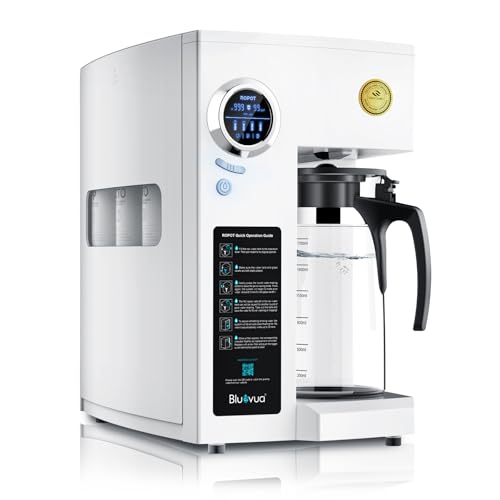
- Six-stage RO filtration with UV and remineralization
- Glass carafe and no-installation countertop setup
- Built-in TDS meter and filter-life monitoring
Best For: Families wanting portable RO filtration with a glass carafe
Best for High-Volume Convenience
DREO Countertop RO Water Filter

- 5-liter countertop RO dispenser
- Two autofill pitchers for convenient serving
- TDS, filter-life, touch-control, and self-cleaning features
Best For: Families wanting convenient install-free RO filtration
Best Overall Mineral-Boosted RO – iSpring RCC7AK-BN
For families seeking thorough under-sink filtration, the iSpring RCC7AK-BN combines six-stage reverse osmosis with an alkaline remineralization stage. Its 75 GPD capacity, NSF/ANSI 58 certification, transparent first-stage housing, and included storage tank make it a strong water purifier for families who want filtered water available at the kitchen tap.
Best For: Families wanting certified reverse osmosis filtration with mineral remineralization.
Pros:
- NSF/ANSI 58 certified for the complete RO system.
- Reduces TDS and numerous listed contaminants, including PFAS, lead, fluoride, and chlorine.
- Alkaline mineral stage adds minerals and supports a balanced pH.
- Top-mounted faucet design and DIY-oriented installation materials can simplify setup.
Cons:
- Under-sink installation requires space for the system and storage tank.
- Several filter sets require replacement on schedules ranging from six months to three years.
- Operation is specified for water pressure around 70 psi and TDS up to 750 ppm.
The RCC7AK-BN is a feature-rich choice when certification, broad contaminant reduction, and remineralized taste matter. Its under-sink format is less convenient than a countertop model, but it keeps filtered water integrated with the kitchen faucet.
Best Countertop Simplicity – Alexapure Pro
The Alexapure Pro is a stainless steel countertop option for households that want to pour in water and collect filtered water without permanent plumbing. It uses activated carbon and carbon-block filtration and is described as reducing more than 200 common contaminants, making it a practical water purifier for families who prefer a portable setup.
Best For: Families seeking a countertop system with no under-sink installation.
Pros:
- Countertop stainless steel construction offers a durable, compact format.
- Reduces 200-plus common contaminants, including lead, viruses, cysts, chlorine, and fluoride.
- Simple fill-and-filter operation avoids permanent plumbing.
Cons:
- Its 5000-gallon capacity is listed for the system, but the notes do not specify a filter replacement schedule.
- Countertop placement occupies workspace and requires manually adding water.
- The supplied details list electricity as the power source, unlike gravity-fed alternatives.
This model suits families who value portability and straightforward countertop use over a built-in faucet. Its stainless steel body and broad stated contaminant reduction make it a convenient everyday option, provided there is room on the counter.
Best Value Under-Sink RO – APEC ROES-50
The APEC ROES-50 provides five-stage reverse osmosis filtration at a 50 GPD rate, with a tank, faucet, installation kit, and filter set included. For families comparing water purifiers for families, it offers a practical under-sink setup designed to reduce up to 99.99% of impurities, including lead, fluoride, arsenic, chlorine, and other listed contaminants.
Best For: Families wanting a conventional, DIY-friendly under-sink RO system.
Pros:
- Five-stage filtration is designed to reduce 1000-plus impurities.
- Listed NSF Certified 372 and 58, with up to 99.99% impurity reduction claimed in the notes.
- Includes a brushed nickel faucet, storage tank, filter set, and installation materials.
- Colored tubing and quick connections support DIY installation and maintenance.
Cons:
- Its 50 GPD rating is lower than the 75 GPD iSpring system.
- Filters may need replacement every six to 24 months depending on incoming water quality.
- Under-sink installation requires cabinet space and access to plumbing.
The ROES-50 is a balanced pick for households that want comprehensive RO filtration without adding a separate countertop appliance. Its included components and service-friendly design make ownership more approachable, while the lower output may matter for especially high-demand families.
Best No-Plumbing Option – Big Berkey 2.25 Gal
The Big Berkey is a gravity-fed countertop purifier designed for everyday household use without electricity, plumbing, tools, or water pressure. Its 2.25-gallon capacity and two included Black Berkey elements make it suitable for families, apartments, offices, and RVs that need accessible filtered water for drinking, cooking, and filling bottles.
Best For: Small families wanting long-lasting, no-plumbing countertop filtration.
Pros:
- Gravity-fed operation works without electricity, plumbing, or water pressure.
- Includes two Black Berkey filter elements and a durable stainless steel chamber design.
- 2.25-gallon capacity is designed for approximately one to four people.
- Each pair of filters is specified for up to 6000 gallons before replacement is recommended.
Cons:
- Countertop design is taller than many compact water dispensers.
- Filtration is gravity-fed at a listed maximum flow rate of 0.03 gpm.
- Replacement elements are sold separately, and actual filter life varies with water quality, use, and maintenance.
The Big Berkey stands out for flexible placement and independence from household plumbing. It is particularly useful where installation is impractical, though families with high daily demand may prefer a plumbed RO system with a faster dedicated faucet.
Best Space-Saving RO – Alkaline 500 GPD Tankless System
For families comparing water purifiers for families, the Waterdrop G5P500A is a compact under-sink reverse osmosis system designed for fast, everyday access to purified water. Its eight-stage filtration, alkaline mineralization, 500 GPD capacity, and 2:1 pure-to-drain ratio suit busy kitchens while preserving under-sink space.
Best For: Families wanting a high-capacity, space-saving RO system with alkaline mineralization for drinking and cooking water.
Pros:
- Eight-stage filtration with a 0.0001 μm RO membrane helps reduce contaminants including lead, fluoride, PFAS, chlorine, and heavy metals.
- Alkaline mineralization adds minerals such as calcium, magnesium, sodium, and potassium.
- Tankless design frees up to 70% of under-sink space, with 500 GPD capacity and a 2:1 pure-to-drain ratio.
- Can connect to appliances such as ice makers and refrigerators using Waterdrop XT.
Cons:
- Requires under-sink electricity and countertop drilling for the included faucet installation.
- The faucet and system require careful cabinet and countertop measurement before installation.
The G5P500A is a practical family option when cabinet space, quick flow, and mineralized RO water matter. Its certified filtration and efficient drain ratio add useful everyday value, though installation planning is important.
Best No-Electricity Option – Crown Berkey 6-Gallon Gravity System
The Crown Berkey is a countertop gravity-fed system for households seeking water purifiers for families without plumbing or electricity. Its six-gallon stainless-steel configuration includes Black Berkey elements plus PF-2 elements intended to reduce fluoride and arsenic.
Best For: Families, RV users, campers, and emergency-preparedness households that need a large-capacity, electricity-free filtration system.
Pros:
- Gravity-fed operation requires no electricity, tools, or plumbing.
- Black Berkey elements are reported to address more than 200 typical tap-water contaminants.
- Includes PF-2 elements designed to reduce fluoride, arsenic, and certain residual heavy-metal ions.
- Six-gallon capacity and stainless-steel construction suit countertop, off-grid, and emergency use.
Cons:
- The 25.75-inch height may require substantial vertical countertop clearance.
- Black Berkey elements and PF-2 elements have different recommended replacement intervals.
This Berkey system stands out for flexible placement and off-grid readiness rather than rapid, plumbed-in dispensing. It can be a useful family backup or countertop solution, provided there is room for its tall design and ongoing filter replacement.
Best High-Capacity Smart RO – Waterdrop G3P600 600 GPD System
For families needing a high-output under-sink purifier, the Waterdrop G3P600 combines eight-stage reverse osmosis filtration with a smart display faucet. It produces up to 600 gallons per day, fills an 8-ounce cup in about eight seconds, and uses a 2:1 pure-to-drain ratio.
Best For: Larger or busy households that want high-capacity RO filtration with built-in TDS monitoring and filter-life tracking.
Pros:
- NSF/ANSI 58 certification covers TDS reduction, while NSF/ANSI 372 covers lead-free materials; NSF 42 certification covers chlorine, taste, and odor reduction.
- Eight-stage filtration is tested to reduce a broad range of substances, including PFAS, fluoride, arsenic, chlorine, and particles.
- 600 GPD capacity, fast flow, and a 2:1 low-drain ratio support frequent family use.
- Smart faucet displays filtered-water TDS and tracks filter life; filters can be changed without tools.
Cons:
- Requires under-sink electricity and a cabinet larger than its 18.12-by-5.67-by-17.72-inch dimensions.
- Tankless installation may require more planning than a countertop gravity-fed system.
The G3P600 is a strong fit when output and monitoring are priorities. Its smart faucet makes maintenance easier, while the compact tankless format saves space, but families should confirm cabinet clearance and access to power before buying.
Best Gravity Option – Purewell 3-Stage Ultra-Filtration System
For families seeking water purifiers for families without electricity or plumbing, the Purewell 3-Stage system offers a countertop gravity-fed setup. Its 0.01-micron hollow-fiber UF membrane, silver-ion membrane, and activated carbon block are designed to reduce chlorine and intercept rust, sediment, organic matter, and some heavy metals.
Best For: Families wanting a non-electric countertop purifier for indoor or outdoor use.
Pros:
- Gravity operation requires no electricity or plumbing.
- 2.25-gallon capacity supports household drinking-water needs.
- Includes two filters, a stainless-steel spigot, and a non-slip stand.
- Filters are rated for up to 3,000 gallons each, depending on water quality.
Cons:
- Does not lower TDS levels.
- Requires careful filling because adding water when the lower chamber is full can cause leaking.
- Filters should be replaced about every six months for optimum performance.
The Purewell is a practical choice when low operating complexity and power-free filtration matter most. Its larger reservoir suits family use, though shoppers specifically concerned with TDS reduction should consider a reverse osmosis model instead.
Best Glass-Carafe RO – Bluevua RO100ROPOT Countertop System
The Bluevua RO100ROPOT is a strong option for families comparing water purifiers for families that reduce dissolved solids. Its six-stage reverse osmosis system adds UV treatment and remineralization, while the countertop design avoids plumbing installation.
Best For: Families wanting portable reverse osmosis filtration with TDS monitoring and a glass carafe.
Pros:
- Six-stage filtration includes a 0.0001-micron RO membrane, UV light, and remineralization.
- Designed to reduce TDS, PFOA, PFOS, chlorine, fluoride, arsenic, lead, and more.
- High-borosilicate glass carafe helps avoid a traditional plastic water container.
- Filter-life and water-quality monitoring simplify maintenance.
Cons:
- Requires a power source and has a slower maximum flow rate of 0.26 liters per minute.
- The 1,700-milliliter carafe may require frequent refilling for larger families.
- At 17.8 pounds, it is heavier than many basic countertop filters.
With a 2:1 pure-to-drain ratio, standby power saving, and filters designed to last 12–24 months, the Bluevua balances convenience with advanced purification. It is best suited to households that prioritize RO filtration and a premium glass serving container.
Best for High-Volume Convenience – DREO Countertop RO Water Filter
For families seeking water purifiers for families with convenient refilling, the DREO countertop RO system combines reverse osmosis filtration with two autofill pitchers. Its 5-liter capacity, touch controls, TDS display, and filter indicator are designed to make routine household use straightforward.
Best For: Families wanting an install-free RO dispenser with larger capacity and autofill pitchers.
Pros:
- Seven-in-one RO filtration is tested by SGS against NSF/ANSI 58 standards.
- Designed to filter out 99.9% of possible contaminants, including PFOA, PFOS, chlorine, and fluoride.
- Includes two autofill water pitchers for convenient serving and refilling.
- Offers TDS monitoring, filter-life tracking, touch control, and self-cleaning functionality.
Cons:
- Uses an electric countertop setup rather than a non-electric gravity design.
- The supplied details list one RO filter, so replacement planning may be important for ongoing use.
- Its 15.7-inch length may require substantial counter space.
The DREO stands out for families who value capacity and hands-off pitcher filling more than compact dimensions. Its monitoring features can make maintenance easier, while the RO process provides TDS reduction in an install-free format.
How We Picked the Best Water Purifiers for Families
We compared these systems by filtration approach, stated capacity, installation requirements, certifications or testing claims, maintenance needs, and practical family usability. Reverse osmosis models can provide broad contaminant reduction and are often suited to treated municipal water or well water requiring more intensive filtration. Gravity and ultrafiltration systems generally need no plumbing and can be easier to install, but their capabilities depend heavily on the included elements and the contaminants they are designed to address.
We also considered workflow: refill frequency, dispensing speed, countertop footprint, wastewater, replacement-filter availability, and whether the system provides useful indicators such as TDS or filter-life monitoring. Always confirm performance against your local water report and the manufacturer’s current specifications.
Quick Comparison
- Best for under-sink installation: iSpring RCC7AK-BN or APEC ROES-50.
- Best for high daily demand: Waterdrop G3P600 tankless RO system.
- Best for countertop RO convenience: Bluevua RO100ROPOT or DREO countertop RO.
- Best for gravity-fed filtration: Big Berkey, Crown Berkey, Alexapure Pro, or Purewell.
- Best for alkaline water features: iSpring RCC7AK-BN or Waterdrop G5P500A.
Key Buying Factors for Water Purifiers for Families
Filtration Method and Contaminant Goals
RO systems typically use multiple stages and a semipermeable membrane to reduce many dissolved solids, while gravity systems rely on filter elements and require no water connection. If you are concerned about a specific contaminant, look for independent certification or performance data that names it rather than relying only on the number of stages.
Capacity and Flow Rate
Estimate how much purified water your household uses for drinking, cooking, coffee, and appliances. A larger storage tank or higher rated gallons-per-day capacity can reduce waiting, but real-world output varies with water pressure, temperature, and feed-water quality. Gravity systems also need enough upper-chamber capacity to avoid frequent refilling.
Installation, Space, and Wastewater
Under-sink systems save counter space but may require a dedicated faucet, drain connection, and adequate cabinet room. Tankless RO units can be more compact, while countertop models are easier for renters. Ask whether an RO system has a drain ratio that suits your priorities and whether it needs a power outlet.
Maintenance and Total Cost
Check replacement-filter prices, replacement intervals, membrane availability, cleaning instructions, and the expected service life of the housing or tank. A lower purchase price may not remain economical if filters are expensive or difficult to source. Follow the manufacturer’s sanitation and replacement schedule to protect water quality.
Who Should Buy Which Water Purifiers for Families?
Choose an under-sink RO system if your family wants a permanent, high-use setup and has room for installation. Choose a tankless or countertop RO model if you want strong filtration with less cabinet work or need a renter-friendly solution. Choose a gravity-fed purifier if you lack a water connection, prefer manual operation, or want filtration during outages. Stainless-steel gravity systems can also appeal to buyers prioritizing durability and a large reservoir.
Before buying, test your water when possible, verify the exact certifications for your target contaminants, and measure the available installation area. For families, the best choice is the one that combines suitable filtration with enough capacity and a maintenance routine everyone can realistically follow.
