Reliable drinking water can be difficult to find when you are backpacking, traveling, camping, or preparing for an emergency. The best portable water purifiers make questionable sources more manageable without adding unnecessary weight or complexity.
This roundup compares 10 portable options, including filter straws, pump systems, gravity filters, purifier bottles, and electric units. Use the guide below to match capacity, filtration performance, portability, and power requirements to your plans.
Best 10 Portable Water Purifiers Picks for 2026
Best Ultralight Pick

- 2-ounce hollow-fiber filter
- Rated for up to 100,000 gallons
- Connects to pouch, bottles, and hydration packs
Best For: Ultralight hiking, travel, and emergency kits
Best All-Around Purifier
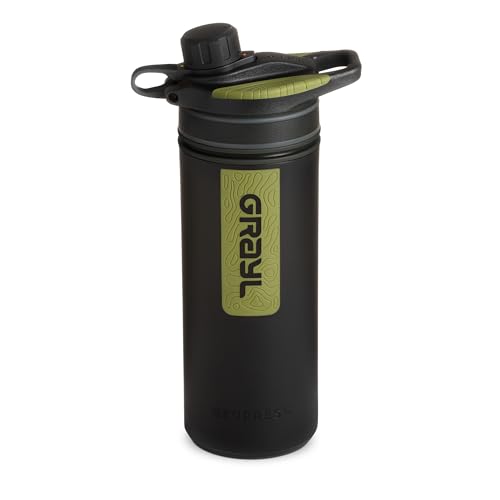
- Purifies 24 ounces in about 8 seconds
- Addresses listed viruses, bacteria, and protozoa
- Bottle-style design needs no batteries or hoses
Best For: Travel, camping, and emergency preparedness
Best Backup Straw

- Lightweight personal membrane filter
- Rated for up to 1,000 gallons
- Attaches to compatible bottles and gravity hoses
Best For: Ultralight hiking and emergency backup hydration
Best for Groups

- Pumps a stated 1.5 liters per minute
- Three-stage filtration for outdoor water sources
- Includes hoses, clamps, pre-filter, and carry bag
Best For: Group camping, base camps, and emergency water storage
Best Lightweight Pick
Membrane Solutions S1 Filter Straw
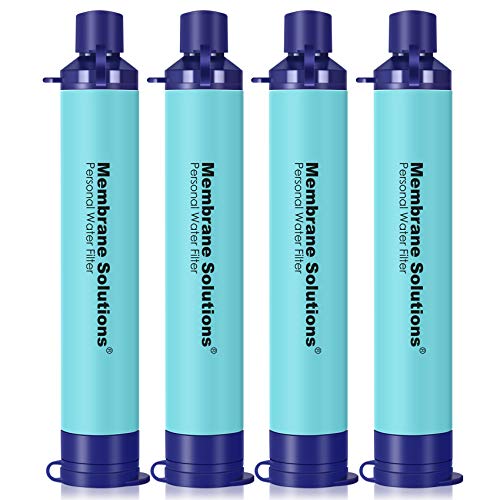
- 2-ounce personal straw filter
- Triple NSF-certified materials and reductions
- Up to 1,320-gallon capacity
Best For: Solo hiking, travel, and compact emergency kits
Best High-Flow Pump
Purewell Portable Water Purifier

- Hand pump reaches up to 1,400 ml/min
- Multi-stage hollow-fiber and carbon filtration
- Includes tubing, carry bag, and accessories
Best For: Small groups, base camps, and emergency water supply
Best Gravity System
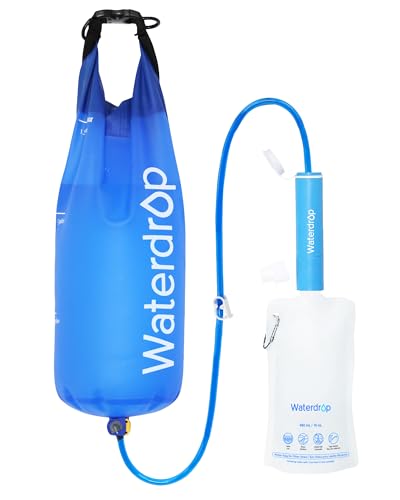
- Includes a 1.5-gallon gravity water bag
- Up to 700 ml/min flow and 1,400-gallon capacity
- Backwashable, five-stage filtration
Best For: Backpacking, group use, and emergency preparedness
Best Solar-Powered Pick

- 800 ml/min automatic flow
- USB-C, solar, and hand-crank charging
- 8-layer filtration with 5,000-liter capacity
Best For: Campers and emergency-preparedness users wanting flexible powered filtration
Best No-Power Option
Uzima UZ-2 Gravity Water Filter

- Electricity-free gravity operation
- 1-liter-per-minute flow rate
- 10-year shelf life
Best For: Off-grid camping and emergency kits that need manual filtration
Best Emergency Multi-Tool
ITEHIL Solar Electric Water Filter
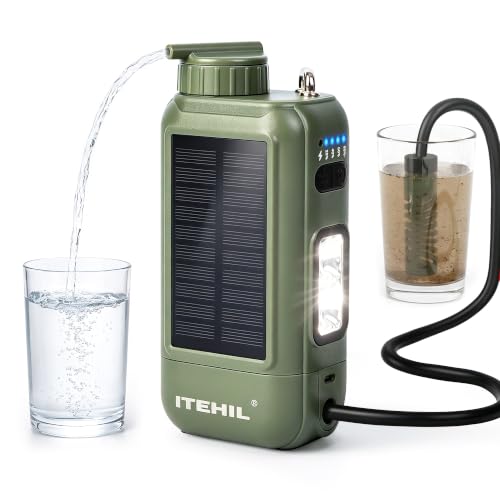
- 0.01-micron dual filtration
- 5,200mAh battery with solar and Type-C charging
- Includes emergency light and power-bank functions
Best For: Outdoor and emergency users seeking filtration with backup power features
Best Ultralight Pick – Sawyer MINI Water Filter
The Sawyer MINI is one of the lightest portable water purifiers for hiking, camping, travel, and emergency kits. Its 2-ounce hollow-fiber filter can connect to the included pouch, compatible 28 mm bottles, or a hydration pack, and it can also be used with the included straw.
Best For: Ultralight backpackers, travelers, scouts, and emergency-preparedness kits that prioritize low weight and long filter life.
Pros:
- Weighs just 2 ounces and fits in the palm of your hand.
- Removes listed bacteria, protozoa, and microplastics through a 0.1-micron absolute filter.
- Rated for up to 100,000 gallons and includes a cleaning plunger.
- Works with a pouch, compatible bottles, hydration packs, or direct drinking.
Cons:
- It is a filter rather than a purifier designed to address viruses.
- The included pouch holds only 16 ounces at a time.
The MINI stands out when pack weight and filter longevity matter most. Its flexible connection options make it practical for individual outdoor use, although users seeking virus protection or higher-volume group processing may prefer another design.
Best All-Around Purifier – GRAYL GeoPress 24 oz
The GRAYL GeoPress is a bottle-style option for shoppers who want portable water purifiers with broad treatment coverage. Fill the 24-ounce bottle, press the inner cartridge, and drink; the system is designed to address viruses, bacteria, protozoa, particulates, and several listed chemical contaminants.
Best For: Travelers, campers, and emergency-preparedness users who want fast, bottle-based purification with no batteries, hoses, or prolonged waiting.
Pros:
- Purifies 24 ounces in about 8 seconds using a fill-and-press design.
- Targets listed viruses, bacteria, protozoa, sediment, microplastics, VOCs, PFAS, and other contaminants.
- Works from sources ranging from hotel sinks to rivers, lakes, and wells.
- Replaceable cartridge is rated for 65 gallons and the bottle includes a 10-year warranty from authorized retailers.
Cons:
- At 15.9 ounces empty, it is heavier than a basic straw or inline filter.
- Its 24-ounce capacity may require frequent refills for groups.
- The cartridge has a shorter rated life than the Sawyer MINI.
The GeoPress is a strong choice when pathogen coverage and simple operation outweigh minimal pack weight. Its press mechanism is especially convenient for travel and short outdoor trips, while the replaceable cartridge keeps the bottle useful for repeated outings.
Best Backup Straw – LifeStraw Peak Series
The LifeStraw Peak Series is a compact choice among portable water purifiers for backup hydration. Its membrane microfilter is designed to remove listed bacteria, parasites, and microplastics, while the threaded design can connect to compatible bottles and standard gravity hoses.
Best For: Ultralight hikers and emergency-kit users who want a durable personal filter straw that can also support bottle or gravity-hose setups.
Pros:
- Lightweight, BPA-free construction is designed for drops, pressure, and rugged conditions.
- Removes listed bacteria, parasites, and microplastics.
- Provides a rated capacity of up to 1,000 gallons or 4,000 liters.
- Re-engineered membrane is intended to reduce clogging from sand and silt.
Cons:
- It is a personal filter straw, so it is less convenient for treating water for a whole group.
- The supplied notes describe filtration rather than virus removal.
- Published flow-rate figures vary between the product bullets and details.
The Peak Series makes sense as a lightweight backup or individual drinking solution. Its attachment options add flexibility beyond direct straw use, but shoppers needing virus treatment or larger-volume processing should consider a different format.
Best for Groups – Trailgo Pro Hand-Pump Filter
The Trailgo Pro is a high-volume option for portable water purifiers when several people need water. Its hand-operated, three-stage setup combines a 5-micron pre-filter, PP cotton stage, and ultrafiltration membrane, delivering a stated 1.5 liters per minute without batteries or electricity.
Best For: Base camps, family camping, hunting camps, off-grid use, and emergency kits that need more output than a personal straw or bottle.
Pros:
- Stated 1.5-liter-per-minute flow is intended to serve groups of four to six.
- Three-stage filtration addresses listed bacteria, protozoa, cysts, microplastics, sediment, and cloudiness.
- Hand operation works without batteries or electricity.
- Complete kit includes hoses, clamps, pre-filter, carry bag, and instructions.
Cons:
- At 4 pounds, it is substantially heavier than personal filters.
- The filter is rated for 3,000 liters, less than the Sawyer MINI’s stated capacity.
- The supplied notes describe filtration claims rather than virus removal.
The Trailgo Pro is best viewed as a portable group-filtration system rather than an ultralight personal purifier. Its pump and included accessories make it practical for camps and preparedness storage, while the four-pound weight is a trade-off for higher throughput.
Best Lightweight Pick – Membrane Solutions S1 Filter Straw
If pack space and weight matter most, this portable water purifier is a compact straw-style option for hiking, travel, camping, and emergency kits. It weighs 2 ounces, measures 7.1 inches long, and connects to 28mm threaded bottles, cups, or compatible water pouches.
Best For: Solo travelers, hikers, and emergency kits that need a lightweight personal filter.
Pros:
- Triple NSF certifications cover chlorine and taste improvement, lead-free materials, and microplastic and particulate reduction.
- Five-stage filtration uses a coarse screen, PP cotton, activated carbon, and hollow-fiber ultrafiltration.
- Rated for up to 1,320 gallons and supports flow of up to 500 ml per minute.
- Removable ends and a backflush inlet support cleaning and extended use.
Cons:
- It is designed for personal drinking rather than quickly filtering large quantities of water.
- It does not lower TDS, so dissolved minerals remain in the water.
The S1 is a strong choice when portability and independently documented filtration standards take priority. Its bottle compatibility and backflush design add flexibility, though larger groups may prefer a pump or gravity system.
Best High-Flow Pump – Purewell Portable Water Purifier
For groups or situations where speed matters, this portable water purifier uses a hand pump and multi-stage filtration system. Its claimed flow rate reaches up to 1,400 ml per minute, and the system works without electricity for camping, backpacking, and emergency preparedness.
Best For: Small groups and campers who want fast, manually pumped water filtration.
Pros:
- High-performance hollow-fiber ultrafiltration is paired with activated carbon and PP cotton stages.
- Up to 1,400 ml per minute of flow can serve several people more quickly than a personal straw.
- Reusable carbon filtration is rated for up to 793 gallons before replacement.
- Includes tubing, hose clip, carry bag, instruction manual, and a built-in drinking-cup lid.
Cons:
- At about 1 pound, it is heavier and bulkier than straw-style purifiers.
- Manual pumping requires more effort than gravity-fed filtration.
- Replacement timing depends on source-water quality.
The Purewell pump makes sense when throughput is more important than minimal pack weight. Its included accessories and non-electric operation suit base camps and emergency kits, while the heavier design is less ideal for ultralight trips.
Best Gravity System – Waterdrop Filter Straw Kit
This portable water purifier combines a 0.1-micron filter straw with a 1.5-gallon gravity-fed bag, making it useful when you want hands-free filtration and a larger water reserve. The kit also includes a 16-ounce pouch and supports connections to compatible bottles and water bags.
Best For: Backpackers and emergency users who prefer gravity filtration with a larger batch capacity.
Pros:
- The 1.5-gallon water bag can hold roughly 11 500-ml bottles of water.
- Five-stage filtration reduces chlorine, sediment, particulates, bad taste, and odors.
- Flow reaches up to 700 ml per minute, with a rated capacity of up to 1,400 gallons.
- Backwashing helps maintain the reusable straw when flow decreases.
Cons:
- The gravity bag and accessories take more room than a standalone personal straw.
- The supplied specifications list a maximum supported TDS level of 300 ppm.
- The filter warranty is limited to 30 days.
The Waterdrop kit is a practical middle ground between personal filtration and a larger group setup. Its gravity-fed bag reduces pumping effort and provides useful storage capacity, but the complete kit is less compact than a straw alone.
Best Solar-Powered Pick – 3-in-1 Electric Water Filter
For shoppers comparing portable water purifiers, this 3-in-1 electric model stands out for its automatic pumping and multiple charging options. It delivers up to 800 ml per minute, includes an attached 27-ounce pouch, and is designed for camping, hiking, and emergency supplies.
Best For: Campers and preparedness-minded users who want powered filtration with USB-C, solar, and hand-crank backup options.
Pros:
- Automatic 800 ml-per-minute flow fills a 1-liter bottle in about 75 seconds.
- Supports USB-C, solar, and hand-crank charging.
- 8-layer filtration includes activated carbon, PP cotton, and ultrafiltration membranes.
- Includes a storage pouch, LED light, and filter rated for up to 5,000 liters.
Cons:
- Requires charging or manual cranking for powered operation.
- More feature-heavy than a simple gravity-fed filter.
Its combination of high capacity, fast flow, and power flexibility makes it a strong choice when convenience matters. The built-in light and compact 360-gram design also add practical value for low-light or emergency use.
Best No-Power Option – Uzima UZ-2 Gravity Water Filter
Among portable water purifiers, the Uzima UZ-2 is a straightforward gravity-fed system for users who prefer manual operation. It requires no electricity, assembles easily, and uses a hollow fiber membrane designed to protect against 99.999% of bacteria.
Best For: Campers, hunters, travelers, and emergency-kit owners who want a shelf-stable filter that works without batteries or outlets.
Pros:
- Gravity-fed design operates without electricity.
- Filters up to 1 liter per minute.
- Hollow fiber membrane is designed to protect against 99.999% of bacteria.
- Has a 10-year product shelf life and includes a filter cleaner.
Cons:
- Gravity operation requires setup and waiting for water to pass through.
- Its stated maximum supported TDS level is 500 ppm.
- Does not offer the powered features found on electric models.
The UZ-2 keeps the design simple and dependable for off-grid use. It is a practical pick when long-term storage, electricity-free operation, and easy maintenance matter more than compact electric convenience.
Best Emergency Multi-Tool – ITEHIL Solar Electric Water Filter
This ITEHIL model is one of the more versatile portable water purifiers for outdoor and emergency use. Its 0.01-micron dual filtration system, 5,200mAh battery, solar and Type-C charging, emergency light, and power-bank function give it broader utility than a basic filter.
Best For: Hikers and emergency users who want electric water purification plus backup lighting and power-bank functions.
Pros:
- Dual filtration uses an Ahlstrom membrane and pre-stage ultrafiltration.
- Produces up to 700 ml of purified water per minute.
- 5,200mAh battery can run continuously for up to four hours on a full charge.
- Supports Type-C and solar charging and includes an integrated backpack hook.
Cons:
- Filter cartridge life is listed at up to 1,000 liters, shorter than some competitors.
- Replacement is recommended every six months, depending on water quality.
- Requires attention to battery charge for powered operation.
The ITEHIL is appealing when a purifier needs to do more than filter water. Its integrated emergency functions and dual charging options suit preparedness scenarios, while the 700 ml-per-minute output remains practical for outdoor hydration.
How We Picked These Portable Water Purifiers
We focused on portable systems designed for outdoor recreation, emergency kits, travel, and survival use. The selection includes several operating styles so you can compare lightweight personal filters with higher-capacity or powered equipment. We considered portability, stated filtration or purification claims, ease of use, replacement needs, source-water compatibility, and the practical trade-offs of each design.
Always read the manufacturer’s specifications before use. “Filter” and “purifier” are not interchangeable terms: a filter may target sediment, bacteria, or protozoa, while a purifier may offer broader treatment. No portable device makes every water source safe in every situation.
Quick Comparison
| Type | Best For | Main Advantage | Watch For |
|---|---|---|---|
| Filter straw | Solo hikers and emergency backups | Minimal weight and simple operation | Usually limited flow and personal-use capacity |
| Purifier bottle | Travel and day hikes | Filter and drink from one container | Small reservoir and cartridge replacement |
| Pump filter | Individual or small-group use | Works with a range of containers | Manual effort and more components |
| Gravity system | Camp kitchens and groups | Hands-free batch filtration | Needs hanging space and setup time |
| Electric or solar unit | Preparedness and extended base camps | Potentially faster or more convenient operation | Battery, charging, durability, and maintenance concerns |
Key Buying Factors for Portable Water Purifiers
Filtration and Purification Performance
Check exactly what the unit is designed to reduce, such as bacteria, protozoa, sediment, chemicals, or odors. Micron ratings are useful but do not tell the whole story. Look for independent testing or clear manufacturer documentation, especially if you may use the device during an emergency.
Capacity and Flow Rate
A straw can be ideal for one person but inconvenient for filling several bottles. Groups should consider gravity or pump systems with larger reservoirs, while travelers may prefer a bottle that treats water as they drink. A higher advertised flow rate may also decline as the filter loads with sediment.
Size, Weight, and Durability
Backpackers should weigh the complete system, including hoses, bags, batteries, and adapters. For vehicle-based camping or emergency storage, a slightly larger unit may be worthwhile if it offers easier operation and more usable capacity.
Maintenance and Replacement Parts
Review cartridge life, backwashing or cleaning requirements, freezing precautions, and replacement availability. A purifier is only useful if you can keep it clean and obtain compatible replacement filters.
Power and Water-Source Limitations
Electric models require charged batteries, cables, or solar access. Pump and gravity systems need suitable containers and relatively accessible water. Consider whether the device can handle cloudy water and whether pre-filtering is recommended.
Who Should Buy Which Portable Water Purifiers?
- Ultralight hikers: Choose a compact filter straw or small personal system for the lowest pack weight.
- Travelers and day hikers: A purifier bottle offers convenient treatment without carrying a separate reservoir.
- Backpackers and pairs: A pump filter balances portability, control, and flexible filling.
- Families and camping groups: Gravity systems are usually more convenient for producing multiple liters with minimal hands-on effort.
- Emergency-preparedness users: Consider a durable pump or electric system, but maintain a manual backup in case batteries or charging equipment fail.
