Finding a refrigerant leak early can save time, reduce repeat service calls, and help protect an air-conditioning system from avoidable damage. The best affordable detectors combine useful sensitivity, clear alerts, and a probe that can reach confined components.
We compared 10 refrigerant leak detectors under $100 for HVAC and automotive AC troubleshooting, focusing on detection features, usability, sensor design, power options, and overall value.
Best 10 Refrigerant Leak Detectors Under 100 Picks for 2026
Best Rechargeable 2-in-1
SENSYX SFD201 Gas Leak Detector

- Up to 24 hours of USB-C rechargeable operation
- Live ppm display with adjustable sensitivity
- Detects refrigerants and combustible gases
Best For: HVAC and automotive users needing dual-gas detection
Best Display and Sensitivity Control
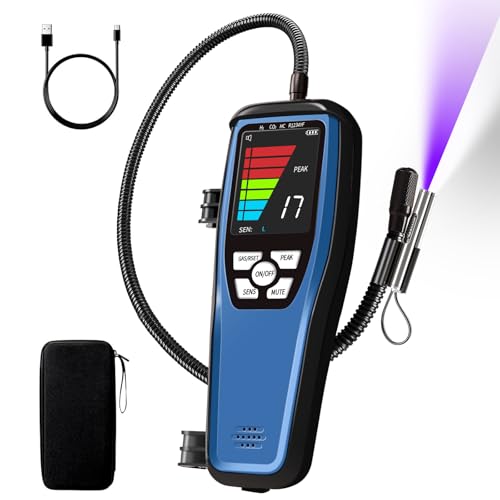
- Supports traditional, A2L, hydrocarbon, and tracer gases
- 0.14 oz./yr. sensitivity with three settings
- 16-inch probe and 2.8-inch TFT color display
Best For: Mixed HVAC and automotive service work
Best Alarm Flexibility
Aituzero Rechargeable Leak Detector

- Three sensitivity levels and 3g/yr sensitivity
- Independent sound, light, and vibration alerts
- TFT ppm, funnel, and trend-graph displays
Best For: Service work requiring customizable alerts
Best Budget DIY Pick

- 0.14 oz./yr. sensitivity for small leaks
- LCD leak-level display with flexible probe
- Built-in LED flashlight and UV dye light
Best For: Homeowners and DIY automotive AC checks
Rechargeable Flex Pick
Tadeto Refrigerant Leak Detector

- Rechargeable Type-C design with LCD and bar graph
- 11-inch flexible probe for obstructed areas
- Audible and visual alerts for many halogen refrigerants
Best For: Portable HVAC, automotive AC, and refrigerator checks
Fast-Sensing Battery Pick
Elitech CPU-1G HVAC Leak Detector

- Three-second response and six-second warm-up
- Seven adjustable sensitivity levels
- Flexible 14-inch probe with alternative sensor tips
Best For: Technicians wanting fast, battery-powered halogen detection
Display-and-Vibration Pick

- Three sensitivity levels with 3 g/year maximum sensitivity
- Color LCD, audible alarm, and vibration alerts
- Rechargeable 3,000mAh battery with over six hours of operation
Best For: Users needing clear visual and tactile leak feedback
Most Versatile
WJL-6000PRO PPM & %LEL Detector

- PPM and %LEL detection modes
- Broad refrigerant compatibility
- 20+ hours of rechargeable operation
Best For: Technicians needing detailed readings and long cordless runtime
Best for Visibility
VIVOHOME Leak Detector with LED Light

- Seven adjustable sensitivity levels
- White and UV work lights
- Up to 50 hours on AAA batteries
Best For: Users inspecting tight, dark HVAC and automotive spaces
Best Simple Option
Elitech WJL-6000 Halogen Sniffer

- Detects common halogenated refrigerants
- Seven sensitivity settings
- Six-second warm-up and three-second response
Best For: Routine home HVAC and automotive leak checks
Best Rechargeable 2-in-1 – SENSYX SFD201 Gas Leak Detector
For shoppers comparing refrigerant leak detectors under 100, the SENSYX SFD201 stands out as a rechargeable tool that also detects combustible gases. Its live ppm display, adjustable sensitivity, and broad refrigerant compatibility make it useful for methodically narrowing down leaks.
Best For: HVAC technicians and DIY users who want refrigerant and combustible-gas detection in one handheld tool.
Pros:
- Built-in 2500mAh battery provides up to 24 hours of continuous use and charges over USB-C.
- Selectable high and low sensitivity settings help with broad sweeps and closer leak locating.
- Color LCD shows ppm readings and a bar graph, while the buzzer can be muted.
- Detects halogenated refrigerants plus gases such as methane, propane, and isobutane.
Cons:
- The metal-oxide sensor needs several hours of initial operation to reach full sensitivity.
- It is a handheld inspection tool, not a substitute for a listed gas alarm.
The SFD201 is a strong value when long battery life and dual-gas capability matter. Follow the recommended warm-up, clean-air startup, slow probe movement, and ventilation procedures for more dependable results.
Best Display and Sensitivity Control – ALD-100 Refrigerant Detector
The ALD-100 is a capable choice among refrigerant leak detectors under 100 for users who want broad gas coverage and clear visual feedback. Its heat-diode sensor, three sensitivity levels, flexible probe, and color display support both residential HVAC and automotive troubleshooting.
Best For: Mobile technicians and DIYers working across traditional, A2L, hydrocarbon, and tracer-gas systems.
Pros:
- Supports traditional refrigerants, R32, R454B, R290, R600a, and hydrogen-nitrogen tracer gas.
- Adjustable sensitivity reaches 0.14 oz./yr. for locating small leaks.
- Sixteen-inch flexible probe helps reach engine bays, coils, and evaporators.
- 2.8-inch TFT display, audible and visual alarms, mute function, and 3000mAh rechargeable battery.
Cons:
- The supplied notes do not specify the unit’s continuous operating time.
- Its extensive compatibility list may require users to confirm the refrigerant used in their system.
With its long probe and wide gas coverage, the ALD-100 is especially practical for cramped service areas and mixed workloads. Three sensitivity settings also help reduce false alarms in higher-concentration environments.
Best Alarm Flexibility – Aituzero Rechargeable Leak Detector
For buyers seeking refrigerant leak detectors under 100 with multiple alert options, this Aituzero model combines a Japanese semiconductor sensor with sound, light, and vibration alarms. Its TFT display and trend views make it easier to monitor whether you are moving toward a leak.
Best For: HVAC, auto AC, and refrigeration users who need flexible alerts in quiet or noisy work areas.
Pros:
- Three sensitivity levels support different leak sizes and refrigerant concentrations.
- Sound, indicator-light, and vibration alarms can be enabled or disabled independently.
- Full-color TFT display provides real-time ppm readings, funnel visualization, and trend graphs.
- USB-C rechargeable 2000mAh battery offers up to eight hours of continuous use.
Cons:
- The stated battery runtime is shorter than some competing rechargeable models.
- The notes describe broad compatibility but do not provide a specific detection threshold for every refrigerant.
The Aituzero is a versatile pick when visual, audible, and vibration feedback are all useful. Its 14.5-inch gooseneck probe and rugged handheld design also suit inspections around coils, pipes, condensers, and service ports.
Best Budget DIY Pick – WJL-6000PRO Leak Detector
The WJL-6000PRO is a practical option for shoppers comparing refrigerant leak detectors under 100 for occasional home or automotive use. It pairs a 0.14 oz./yr. sensitivity rating with an LCD leak-level display, flexible probe, and UV light for dye-assisted inspection.
Best For: DIY mechanics, homeowners, rental-property maintenance, and beginners checking vehicle or residential AC systems.
Pros:
- Upgraded sensitivity is designed to help locate small leaks up to 0.14 oz./yr.
- LCD screen displays sensitivity and gas leakage level instead of relying only on beeps.
- 7.9-inch flexible probe reaches tight pipes, valves, corners, and engine-bay areas.
- White LED and UV light assist with dark workspaces and fluorescent-dye confirmation.
Cons:
- The shorter probe offers less reach than several competing models.
- The supplied notes do not state whether the battery is rechargeable or provide a runtime.
- Its beginner-oriented design may be less suitable for demanding professional workloads.
For occasional troubleshooting, the WJL-6000PRO offers useful extras without requiring separate lighting and UV tools. Start it in fresh air, calibrate as recommended, and move the probe slowly to help limit false alarms.
Rechargeable Flex Pick – Tadeto Refrigerant Leak Detector
For shoppers comparing refrigerant leak detectors under 100, the Tadeto is a convenient choice for routine HVAC, automotive AC, refrigerator, and commercial-system checks. Its rechargeable design, digital display, and flexible probe make it practical for tracing halogen refrigerants in tight spaces.
Best For: Homeowners and technicians who want a rechargeable detector with visual and audible alerts.
Pros:
- Supports many CFC, HCFC, HFC, and HFO refrigerants, including R22, R134a, R410A, R404A, and R1234yf.
- Combines an audible alarm, light alert, LCD readings, and a bar graph.
- Rechargeable through USB Type-C and includes an 11-inch flexible gooseneck probe.
- Includes a carry bag, charging cable, and one-year manufacturer warranty.
Cons:
- Requires about 30 seconds for warm-up and automatic calibration.
- Accurate results depend on moving the probe steadily rather than too quickly.
The Tadeto stands out when portability and easy-to-read feedback matter more than replaceable batteries. Its flexible probe is especially useful around coils, hoses, and other obstructions.
Fast-Sensing Battery Pick – Elitech CPU-1G HVAC Leak Detector
Elitech CPU-1G HVAC Leak Detector Halogen Gas Tester HVAC Refrigerant AC Sniffer R22 R410A R134A
Check Price On AmazonAmong refrigerant leak detectors under 100, the Elitech CPU-1G is designed for fast halogen-gas testing across HVAC, refrigeration, and automotive AC applications. Its upgraded CPU, adjustable sensitivity, and flexible stainless steel probe support targeted leak searches.
Best For: Users who prefer replaceable batteries, rapid response, and multiple sensitivity settings.
Pros:
- Responds in about three seconds and warms up in approximately six seconds.
- Offers seven adjustable sensitivity levels, with maximum sensitivity listed at 0.11 oz./year.
- Detects R11, R22, R134A, R404A, R410A, and other halogenated refrigerants and blends.
- Includes two C alkaline batteries and two alternative sensor tips.
Cons:
- Uses two C alkaline batteries rather than a rechargeable battery.
- Weighs 1.7 pounds, making it heavier than some compact detectors.
The CPU-1G is a sensible fit for repeated service work where quick triggering and fine sensitivity adjustment are priorities. Its modular sensor and included replacement tips also support ongoing maintenance.
Display-and-Vibration Pick – GOTMEET NF-605 Leak Detector
The GOTMEET NF-605 is a strong option among refrigerant leak detectors under 100 for buyers who want clear readings and multiple alert methods. It combines three sensitivity levels, a color display, vibration, sound, and a rechargeable battery for HVAC, refrigeration, and automotive AC troubleshooting.
Best For: Professional and family users who value a bright display and vibration alerts in noisy or low-visibility areas.
Pros:
- Lists maximum sensitivity of 3 g/year and supports a wide range of CFC, HCFC, and HFC refrigerants.
- Provides audible, vibration, and on-screen alerts with a real-time bar graph.
- Offers high, medium, and low sensitivity settings plus reset calibration and mute functions.
- Rechargeable 3,000mAh battery provides over six hours of continuous operation and includes a carry bag.
Cons:
- Requires about 30 seconds of automatic preheating before detection.
- Automatically shuts down after 30 minutes without operation.
Choose the NF-605 if you want more feedback than a basic buzzer provides. Its color LCD and vibration alarm make changing leak intensity easier to monitor while working around active equipment.
Most Versatile – WJL-6000PRO PPM & %LEL Detector
For shoppers comparing refrigerant leak detectors under 100, the WJL-6000PRO stands out for its dual PPM and %LEL readings, broad refrigerant compatibility, and rechargeable design. Its fast response, adjustable sensitivity, and rugged metal probe make it a strong choice for repeated HVAC and automotive diagnostics.
Best For: Technicians who want detailed readings, wide gas compatibility, and extended cordless operation.
Pros:
- Displays both PPM for pinpointing leaks and %LEL for gas-level monitoring.
- Detects numerous CFC, HCFC, HFC, HFO, blend, and PFC refrigerants.
- Offers a flexible metal probe, automatic calibration, adjustable sensitivity, and audible or visual alarms.
- Runs for more than 20 hours on its 1800mAh rechargeable battery.
Cons:
- Its broader feature set may be more than casual users need.
- Requires a clean-air warm-up for stable readings.
The WJL-6000PRO is a feature-rich option in this price range. Choose it when dual measurement modes, rechargeable power, and a durable probe matter more than a minimalist design.
Best for Visibility – VIVOHOME Leak Detector with LED Light
Among refrigerant leak detectors under 100, the VIVOHOME model is a practical pick for users who need straightforward leak detection plus built-in lighting. Seven sensitivity levels, a flexible probe, and dual-color white and UV LEDs help with inspections in tight or poorly lit areas.
Best For: DIYers and automotive or HVAC users who value simple controls, work lighting, and long battery endurance.
Pros:
- Detects halogenated refrigerants, including HFCs, HFOs, CFCs, and HCFCs.
- Provides seven sensitivity levels and alarms with audible and visual indicators.
- Includes a 7.9-inch flexible probe plus white and UV LED lighting.
- Can operate for up to 50 hours with four AAA batteries.
Cons:
- AAA batteries are required and are not included.
- Condensation or damp surfaces can cause false alarms.
- It needs a six-second preheat in fresh air before testing.
The VIVOHOME balances useful inspection features with simple battery-powered operation. Its built-in UV light is especially helpful when fluorescent dye is present, but careful handling around moisture is important.
Best Simple Option – Elitech WJL-6000 Halogen Sniffer
The Elitech WJL-6000 is a straightforward choice among refrigerant leak detectors under 100. It covers common halogenated gases, offers seven sensitivity settings, and combines audible and visual alerts in a compact design with a flexible probe.
Best For: Home HVAC and automotive users who want an uncomplicated electronic halogen leak detector.
Pros:
- Detects R22, R134A, R404A, R410A, R1234YF, and other halogenated refrigerants.
- Seven adjustable sensitivity levels reach up to 0.21 oz/yr.
- Provides audible and visual leak indicators along with dual battery indicators.
- Warms up in six seconds and responds within three seconds.
Cons:
- It does not list PPM or %LEL measurement modes.
- Battery power requires monitoring during extended use.
- The feature set is more basic than models with built-in lighting or rechargeable batteries.
The WJL-6000 focuses on core leak-sniffing functions without adding complex readout modes. It is a sensible fit for routine checks where adjustable sensitivity and quick startup are the main priorities.
How We Picked the Best Refrigerant Leak Detectors Under 100
We focused on models suited to practical leak checks rather than advanced recovery or laboratory work. Our comparison considered advertised refrigerant compatibility, sensor sensitivity, alarm types, probe reach, display readability, battery and charging convenience, included lighting, and the controls needed to adjust detection levels.
Because product specifications and included accessories can vary by seller, verify the current listing before purchase. A low price is useful, but dependable operation and a clear alert are more important when diagnosing a difficult leak.
Quick Comparison
These Refrigerant Leak Detectors Under 100 generally fall into three groups. Basic audible-and-visual models are compact and easy to use for occasional checks. Rechargeable units add convenience for technicians who work away from an outlet. Models with TFT displays, PPM or %LEL readouts, UV lights, or multiple alarm modes provide more feedback, but may require more setup and interpretation.
- Best for simple checks: Choose a straightforward detector with adjustable sensitivity and a loud alarm.
- Best for frequent use: Look for rechargeable power, a durable probe, and accessible controls.
- Best for detailed troubleshooting: Consider a display-based model with multiple detection modes or numerical readings.
- Best for low-light service: An integrated LED or UV light can make inspection around fittings easier.
Key Buying Factors for Refrigerant Leak Detectors Under 100
Refrigerant Compatibility
Check whether the detector is designed for the refrigerants you service, such as R22, R410A, R134a, or newer automotive blends. “Halogen” or “Freon” labeling is not always a complete compatibility list.
Sensitivity and False Alarms
Multiple sensitivity levels help you scan broadly before narrowing in on a suspected leak. A detector that is too sensitive can react to airflow, solvents, or contaminated surroundings, while one that is too insensitive may miss a small leak.
Alarm and Display Design
Audible alarms are useful when you cannot watch the instrument, while visual indicators and displays help confirm a reading in a noisy workspace. Multiple alarm modes can be helpful, but only if the controls are intuitive.
Power and Probe Usability
Rechargeable batteries reduce disposable-battery costs, but confirm charging time and expected runtime. A flexible probe and a narrow sensor tip are valuable around coils, valves, and crowded service compartments.
Included Extras
LED or UV lighting, a carrying case, spare filters, and replacement sensors can improve long-term value. Treat accessories as bonuses, not substitutes for sensor performance.
Who Should Buy Which Refrigerant Leak Detectors Under 100?
Homeowners and occasional DIY users should prioritize simple controls, clear alarms, and rechargeable convenience. HVAC apprentices and maintenance staff may benefit from adjustable sensitivity, a flexible probe, and a readable display. Technicians who regularly service multiple refrigerants should choose the model with the clearest compatibility information and the most useful detection modes.
For very small leaks, difficult refrigerant mixtures, or compliance-critical work, an under-$100 detector may be best used as a screening tool rather than the only diagnostic method. Confirm suspected leaks with appropriate professional procedures and follow the manufacturer’s operating instructions.